. 2017 Nov 7;114(45):12075-12080.
doi: 10.1073/pnas.1713308114. Epub 2017 Oct 23.

Individual differences in associative memory among older adults explained by hippocampal subfield structure and function

Affiliations

Individual differences in associative memory among older adults explained by hippocampal subfield structure and function

Valerie A Carr et al. Proc Natl Acad Sci U S A. .

Abstract

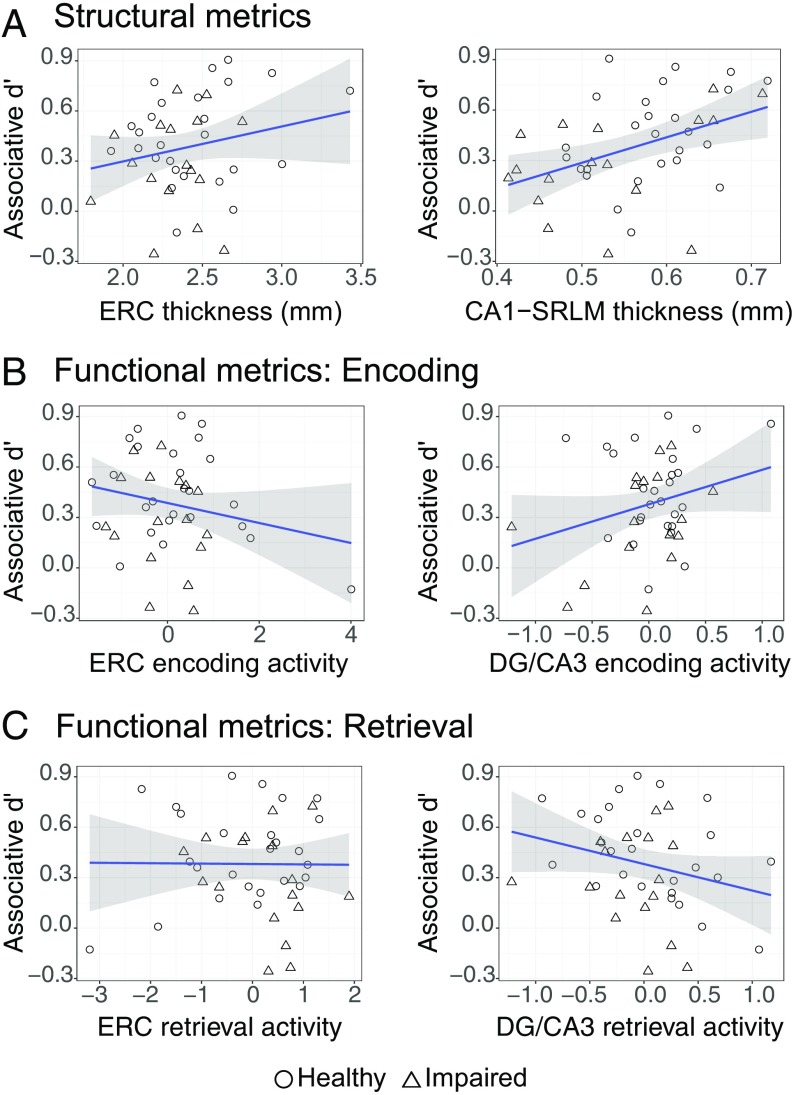
Older adults experience impairments in episodic memory, ranging from mild to clinically significant. Given the critical role of the medial temporal lobe (MTL) in episodic memory, age-related changes in MTL structure and function may partially account for individual differences in memory. Using ultra-high-field 7T structural MRI and high-resolution 3T functional MRI (hr-fMRI), we evaluated MTL subfield thickness and function in older adults representing a spectrum of cognitive health. Participants performed an associative memory task during hr-fMRI in which they encoded and later retrieved face-name pairs. Motivated by prior research, we hypothesized that differences in performance would be explained by the following: (i) entorhinal cortex (ERC) and CA1 apical neuropil layer [CA1-stratum radiatum lacunosum moleculare (SRLM)] thickness, and (ii) activity in ERC and the dentate gyrus (DG)/CA3 region. Regression analyses revealed that this combination of factors significantly accounted for variability in memory performance. Among these metrics, CA1-SRLM thickness was positively associated with memory, whereas DG/CA3 retrieval activity was negatively associated with memory. Furthermore, including structural and functional metrics in the same model better accounted for performance than did single-modality models. These results advance the understanding of how independent but converging influences of both MTL subfield structure and function contribute to age-related memory impairment, complementing findings in the rodent and human postmortem literatures.

Keywords: Alzheimer’s disease; aging; episodic memory; hippocampus; mild cognitive impairment.


Conflict of interest statement

The authors declare no conflict of interest.

Figures
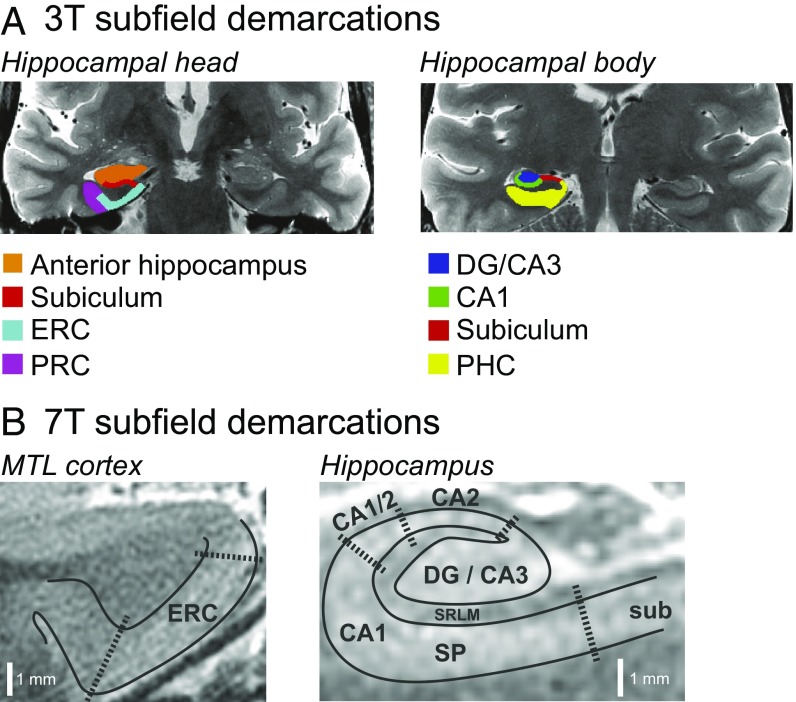
Fig. 1.
Fig. 1.
Sample MTL subfield demarcations. (A) Subfields used in 3T functional analyses. (B) Layer-specific subfields used in 7T structural analyses. DG, dentate gyrus; ERC, entorhinal cortex; MTL, medial temporal lobe; PHC, parahippocampal cortex; PRC, perirhinal cortex; SP, stratum pyramidale; SRLM, stratum radiatum lacunosum moleculare.
Fig. 2.
Fig. 2.
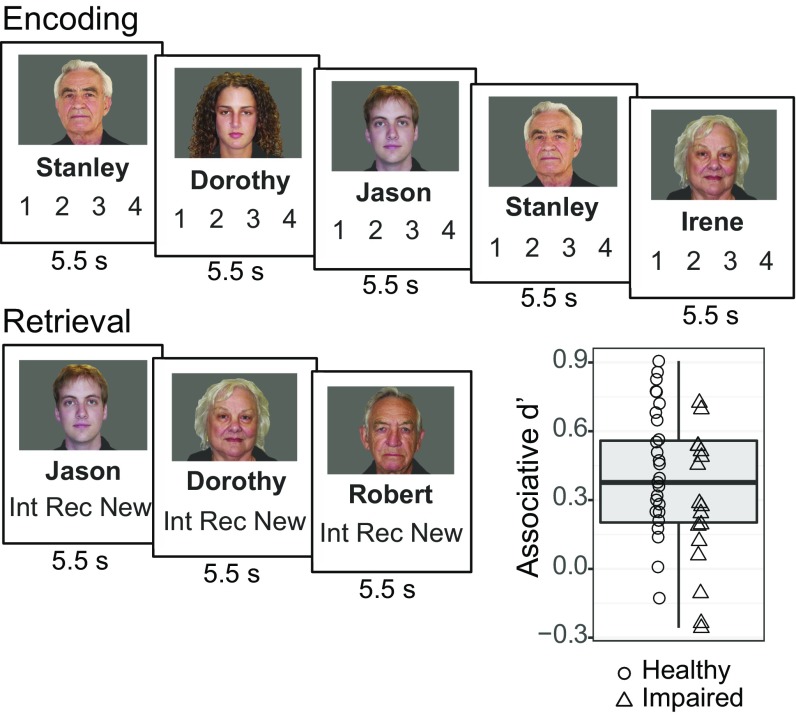
Associative memory paradigm and results. During encoding, participants subjectively rated how well each name fit its associated face on a scale from 1 to 4. During retrieval, participants made judgments regarding whether a given face–name pair was intact, recombined, or new. Box plot demonstrates individual differences in task performance as measured by associative d′.
Fig. S1.
Fig. S1.
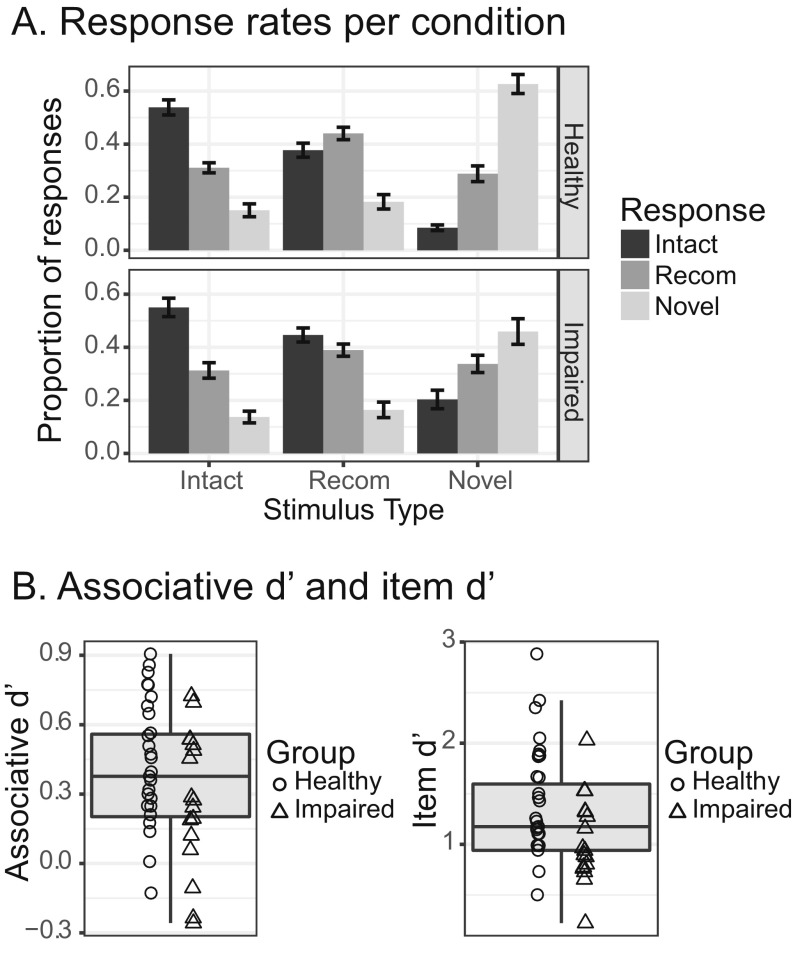
Associative memory task results. (A) Results plotted by condition for each group. (B) Box plots demonstrating variability in associative d′ and item d′ scores.
Fig. 3.
Fig. 3.
Relationship between associative memory performance and measures of MTL subfield structure and function. All plots represent raw data. (A) Scatter plots showing relationship between bilateral ERC or bilateral CA1-SRLM thickness and associative d′. (B) Scatter plots showing relationship between bilateral ERC or bilateral DG/CA3 activity associated with successful encoding and associative d′. (C) Scatter plots showing relationship between bilateral ERC or bilateral DG/CA3 activity associated with retrieval success and associative d′. DG, dentate gyrus; ERC, entorhinal cortex; MTL, medial temporal lobe; SRLM, stratum radiatum lacunosum moleculare.
Fig. S2.
Fig. S2.
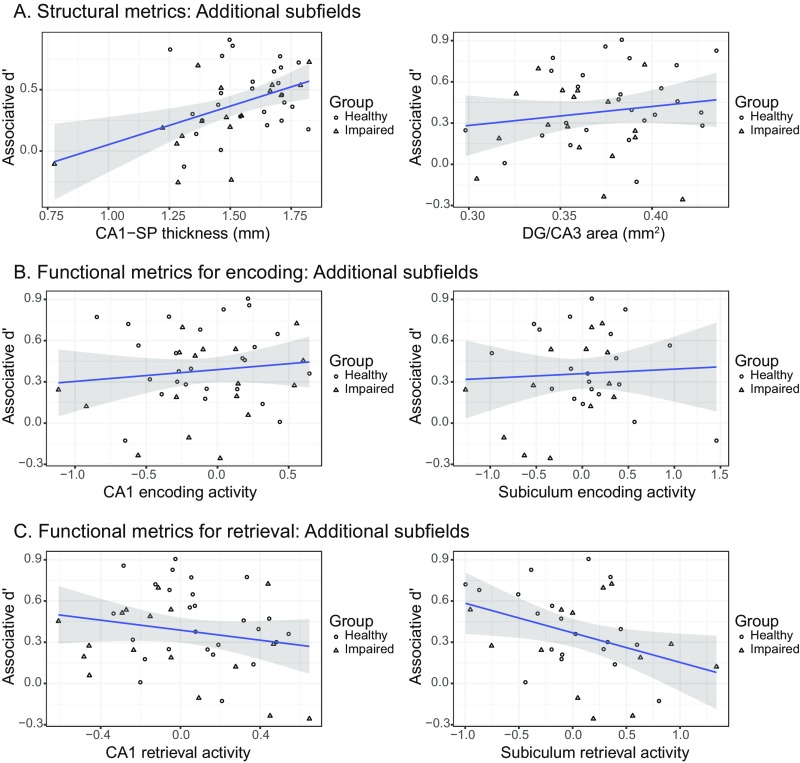
Relationship between associative memory performance and measures of MTL subfield structure and function not included in our main regression models. All plots represent raw data. (A) Scatter plots showing relationship between bilateral SP or bilateral DG/CA3 subfield size and associative d′. (B) Scatter plots showing relationship between bilateral CA1 or bilateral subiculum subfield activity associated with successful encoding and associative d′. (C) Scatter plots showing relationship between bilateral CA1 or bilateral subiculum subfield activity associated with retrieval success and associative d′. DG, dentate gyrus; MTL, medial temporal lobe; SP, stratum pyramidale.
Fig. S3.
Fig. S3.
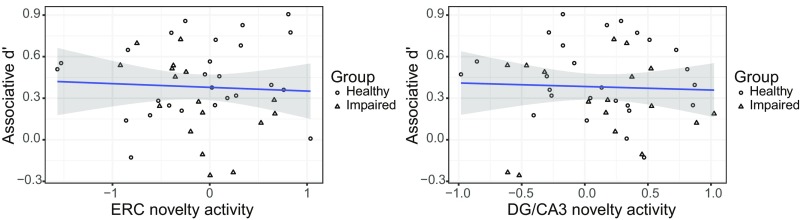
Relationship between associative memory performance and measures of MTL subfield activity related to stimulus novelty. Scatter plots show subfield novelty activity in bilateral ERC or bilateral DG/CA3 and associative d′. All plots represent raw data. DG, dentate gyrus; ERC, entorhinal cortex; MTL, medial temporal lobe.
Fig. S4.
Fig. S4.
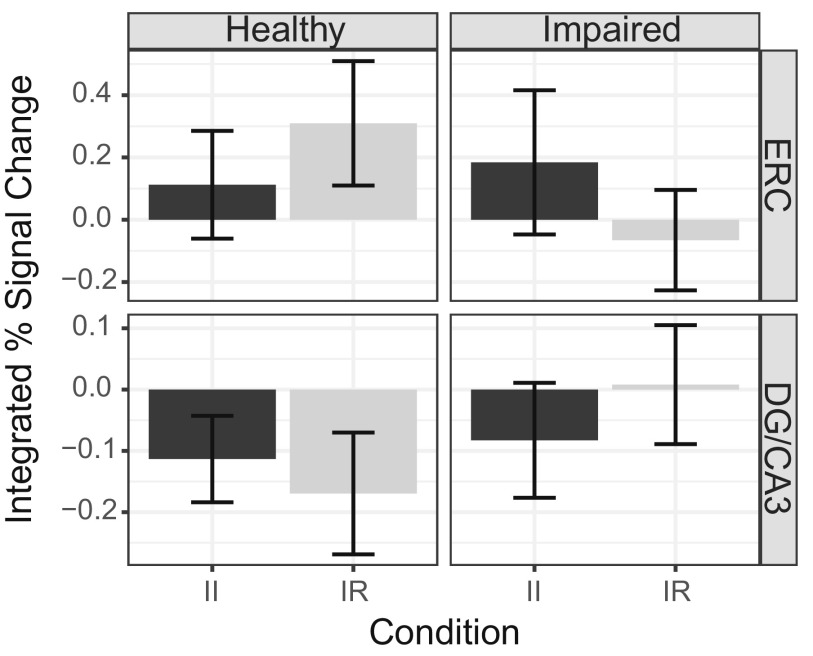
Retrieval activity for each group in each subfield included in the retrieval model, separated by condition. II, intact–intact; IR, intact–recombined.
Fig. S5.
Fig. S5.
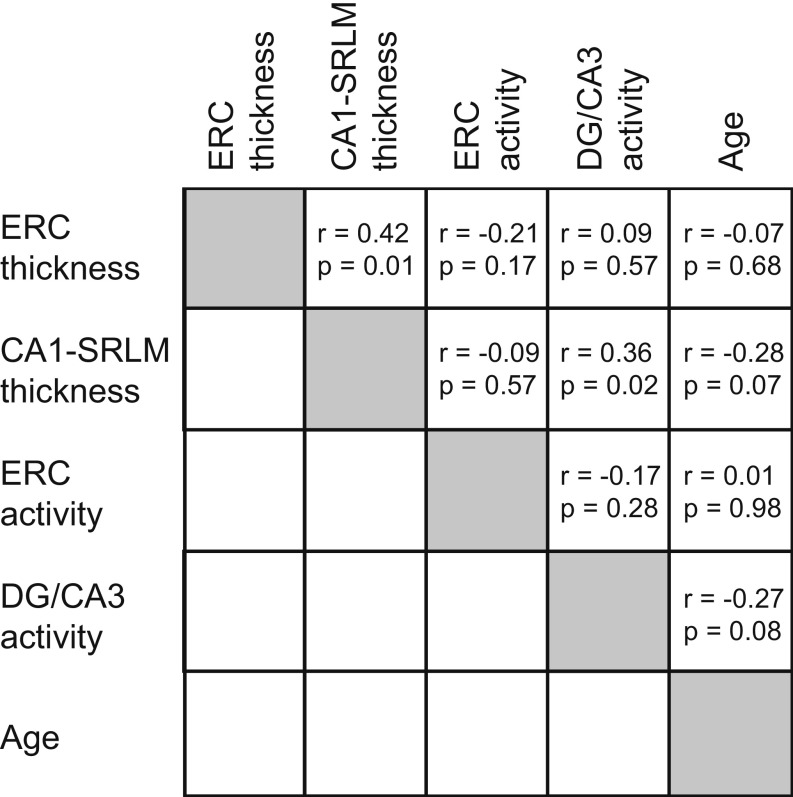
Correlation matrix for explanatory variables included in the retrieval model. DG, dentate gyrus; ERC, entorhinal cortex; SRLM, stratum radiatum lacunosum moleculare.

References

    1. Spencer WD, Raz N. Differential effects of aging on memory for content and context: A meta-analysis. Psychol Aging. 1995;10:527–539. - PubMed
    1. Craik F, Salthouse TA. The Handbook of Aging and Cognition. 3rd Ed Psychology Press; New York: 2011.
    1. Old SR, Naveh-Benjamin M. Differential effects of age on item and associative measures of memory: A meta-analysis. Psychol Aging. 2008;23:104–118. - PubMed
    1. Scoville WB, Milner B. Loss of recent memory after bilateral hippocampal lesions. J Neurol Neurosurg Psychiatry. 1957;20:11–21. - PMC - PubMed
    1. Squire LR, Stark CEL, Clark RE. The medial temporal lobe. Annu Rev Neurosci. 2004;27:279–306. - PubMed

Publication types

LinkOut - more resources