


Comment
doi: 10.1073/pnas.1716329114.
Epub 2017 Oct 23.
Continuum of root-fungal symbioses for plant nutrition
Affiliations
- PMID: 29078417
- PMCID: PMC5676940
- DOI: 10.1073/pnas.1716329114
Item in Clipboard
Comment
Continuum of root-fungal symbioses for plant nutrition
Proc Natl Acad Sci U S A.
.
No abstract available
Conflict of interest statement
The authors declare no conflict of interest.
Figures
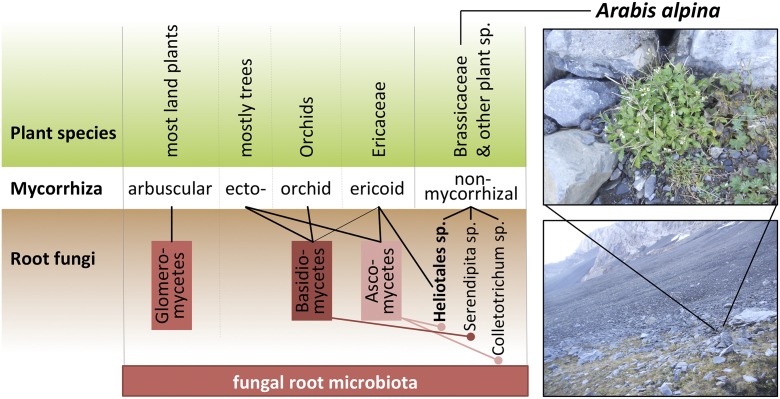
Associations between plants and the fungal root microbiota. Different types of mycorrhizal associations include Glomeromycete fungi forming arbuscular mycorrhiza with most vascular plants. Ascomycete and Basidiomycete members form ecto-mycorrhizal symbiosis (mostly with trees), orchid mycorrhiza with orchids, and ericoid mycorrhizas with plants of the Ericaceae family. Moreover, recent studies demonstrate that the Mucoromycotina, a basal fungal lineage close to the Glomeromycetes, forms symbiotic associations with a wide range of plants (not shown) (16, 17). Emerging studies indicate that various nonmycorrhizal plants have the ability to form a functional symbiosis with Ascomycetous and Basidiomycetous soil fungi. Arabis alpina (Top Right) is a nonmycorrhizal Brassicaceae that is native to harsh arctic–alpine environments (site: Lenk i.S., Switzerland) and typically exposed to water limitations, fluctuating temperatures, and extremely low nutrient availability (18). In recent years, Arabis became a model to study adaptation to extreme environments, flowering control, or perennialism, and therefore also for root microbiome research (19).
Comment on
-
Root-associated fungal microbiota of nonmycorrhizal Arabis alpina and its contribution to plant phosphorus nutrition.Proc Natl Acad Sci U S A. 2017 Oct 31;114(44):E9403-E9412. doi: 10.1073/pnas.1710455114. Epub 2017 Oct 2. Proc Natl Acad Sci U S A. 2017. PMID: 28973917 Free PMC article.
References
-
- Hacquard S, et al. Microbiota and host nutrition across plant and animal kingdoms. Cell Host Microbe. 2015;17:603–616. - PubMed
-
- van der Heijden MGA, Martin FM, Selosse MA, Sanders IR. Mycorrhizal ecology and evolution: The past, the present, and the future. New Phytol. 2015;205:1406–1423. - PubMed
-
- Walker JF, et al. Diverse Helotiales associated with the roots of three species of Arctic Ericaceae provide no evidence for host specificity. New Phytol. 2011;191:515–527. - PubMed
-
- Brundrett MC. Coevolution of roots and mycorrhizas of land plants. New Phytol. 2002;154:275–304. - PubMed
Publication types
MeSH terms
LinkOut - more resources
Full Text Sources
Other Literature Sources
