


A comparison of arsenic exposure in young children and home water arsenic in two rural West Texas communities
- PMID: 29078766
- PMCID: PMC5659039
- DOI: 10.1186/s12889-017-4808-4
A comparison of arsenic exposure in young children and home water arsenic in two rural West Texas communities
Abstract
Background: In a previously conducted Health Impact Assessment of a well-water dependent southwest community, arsenic (As) levels greater than the EPA Maximum Contaminant Level (10 μg/L) were identified in home water samples. The goals of this study were to test whether children from the previously studied well-water dependent community (Community 1) had higher blood As levels than children from a demographically similar and geographically nearby community dependent on a municipal water supply (Community 2); to test whether home water As levels predicted child As blood levels; and to examine how child As blood levels changed over time.
Methods: This was an observational study of 252 children aged 4 to 12 years from two communities. Children were recruited through elementary schools and tested during the school day; 204 children participated in follow-up testing. Home water samples were collected according to U.S. Environmental Protection agency recommended procedures. Child heavy metal blood levels and home water sample heavy metal levels were analyzed using inductively coupled plasma mass spectrometry. General linear regression analysis was used to test the influence of community on child As levels, and to examine the contribution of home water As levels to child blood As levels.
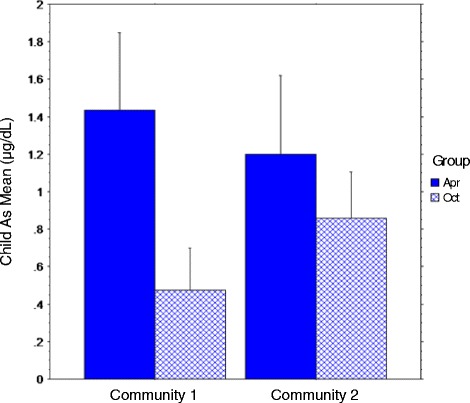
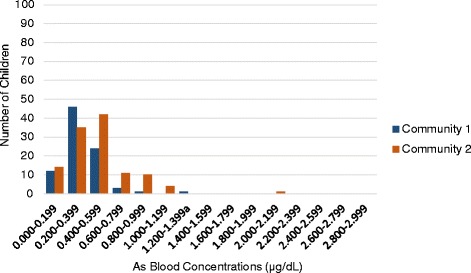
Results: Arsenic was detectable in all children tested. Blood levels ranged from 0.09-2.61 μg/dL; approximately 31% of children tested at Time I (79/252) had blood As values above the current acceptable limit (1.2 μg/dL). Approximately 8% of household water samples (6/76) had As levels higher than 10 μg/L. Community did not predict child blood As levels; seasonal effects differed by Community. At Time II, child blood As levels were higher in Community 2 than in Community 1.
Conclusion: A large proportion of children in the communities tested had As exposure. Home water As levels did not predict child blood As levels. Fluctuating child blood As levels by season and over time suggested the contribution of multiple factors and the need for further studies.
Keywords: Child arsenic exposure; Child environmental health; Child toxicology.
Conflict of interest statement
Ethics approval and consent to participate
Permission to conduct these studies, and approval for recommended procedures, was obtained through sequential meetings with the Mayor of Community 1, the School District Superintendent, School Board, and the principals and nurses from each of the elementary schools, and the studies were approved by the University of Texas Institutional Review Board (IRB Protocol # 564493–3, C.S., PI). Informed consent to participate was obtained from parents prior to the study; child assent was obtained immediately prior to testing. All individuals working on this study completed required training in human subjects research, blood sample collection and handling, parent interviewing, de-identification of subject information, and standards of anonymity and confidentiality.
Consent for publication
Not applicable.
Competing interests
The authors declare that they have no competing interests.
Publisher’s Note
Springer Nature remains neutral with regard to jurisdictional claims in published maps and institutional affiliations.
Figures




References
-
- Agency for Toxic Substance and Disease Registry (ATSDR). Toxicological Profile for Arsenic. US Department of Health & Human Services, Public Health Service; 2007. Available at https://www.atsdr.cdc.gov/toxprofiles/tp2.pdf. - PubMed
Publication types
MeSH terms
Substances
Grants and funding
LinkOut - more resources
Full Text Sources
Other Literature Sources
Medical
Research Materials
