


Resilience or hope? Incremental and convergent validity of the resilience scale for adults (RSA) and the Herth hope scale (HHS) in the prediction of anxiety and depression
- PMID: 29078801
- PMCID: PMC5659010
- DOI: 10.1186/s40359-017-0205-0
Resilience or hope? Incremental and convergent validity of the resilience scale for adults (RSA) and the Herth hope scale (HHS) in the prediction of anxiety and depression
Abstract
Background: Hope and resilience protect against inner vulnerabilities or harsh life circumstances; they explain individual differences in physical or mental health outcomes under high stress. They have been studied in complementary or competing theoretical frameworks; therefore, the study of measures of hope and resilience should be undertaken prior to explore if they are truly value-added for research. This study investigates the convergent and incremental validity of the Resilience Scale for Adults (RSA) and the Herth Hope Scale (HHS), in the prediction of anxiety and depression (HSCL-25).
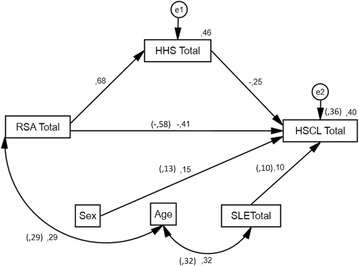
Methods: Participants in this community-based sample are 762 adults from 18 to 74 years old. They answered the RSA, HHS, Spanish Language Stressful Life-Events Checklist (SL-SLE), and the Hopkins Symptom Checklist-25 (HSCL-25). Incremental validity analyses combined hierarchical regression and structural equation models (SEM). First, hierarchical regression models were compared based on three criteria (R 2Diff., ΔF, and semi-partial r), then the direct effect of resilience on affective symptoms was compared with the mediated effect of resilience on affective symptoms through hope.
Results: The hierarchical models showed that (1) hope and resilience account significantly for the variance of affective symptoms above age, sex, and life-stress; (2) Resilience Total score has greater incremental validity than positive scales of HHS Hope; and (3) RSA Total score, HHS Optimism/Spiritual support, Stressful life-events and sex are unique predictors of affective symptoms. The SEM analyses verified a stronger direct effect of resilience in the prediction of affective symptoms above the significant partial mediated effect of resilience through hope. Additionally, results show that age and better educational opportunities were associated with protection (i.e. resilience and hope) and emotional well-being (i.e. affective symptoms and hopelessness). Women showed higher scores in social competences and resources (RSA), interconnectedness and initiative to take action (HHS). However, they have poorer evaluations of own abilities and efficacy (RSA), and higher scores in all the affective symptoms assessed.
Conclusion: The RSA has incremental validity above the HHS, however, both the RSA and the HHS are effective, differentiated and complementary measures of protection that are of high relevance for research on psychosocial and emotional well-being.
Keywords: Anxiety; Depression; Hope; Incremental validity; Resilience; SEM.
Conflict of interest statement
Authors’ information
RM is a Postdoctoral research fellow at the Norwegian University of Science and Technology and Associate Professor of the Department of Psychology and Master Program in Community Psychology of the Catholic University of Peru. She is a Ph.D. in Psychology (University of Leuven, Belgium) and Magister in Gender and Ethnicity (Utrecht University, The Netherlands). Her current research focuses on (1) protective mechanisms of adults and adolescents living in psychosocial disadvantage; (2) cross-cultural research on resilience between Norway and Peru; (3) resilience and adaptation to tertiary education of Peruvian adolescents; and (4) community and educational resilience, participation and gender.
Ethics approval and consent to participate
Written informed consent was obtained for all the participants prior the evaluation. The anonymity and confidentiality of the participants were protected. Participants did not experience any harm and they were allowed to stop their participation during the data collection process. The design and methods were approved by the Doctoral Supervisory Committee of the Faculty of Psychology and Educational Sciences of the University of Leuven (Belgium).
Consent for publication
Not applicable.
Competing interests
The authors declare that they have no competing interests.
Publisher’s Note
Springer Nature remains neutral with regard to jurisdictional claims in published maps and institutional affiliations.
Figures
References
-
- Rand K, Cheavens J: Hope theory. In Oxford handbook of positive psychology. Edited by Lopez S, Snyder C. New York, NY: Oxford University Press; 2009:323–333.
-
- Horton T, Wallander J. Hope and social support as resilience factors against psychological distress of mothers who care for children with chronic physical conditions. Rehabil Psychol. 2001;46:382–399. doi: 10.1037/0090-5550.46.4.382. - DOI
-
- Shorey H, Snyder C, Yang X, Lewin M: The role of hope as a mediator in recollected parenting, adult attachment, and mental health. J Soc Clin Psychol 2003, 22:685 715.
MeSH terms
LinkOut - more resources
Full Text Sources
Other Literature Sources
Medical
