


Parent packs, child eats: Surprising results of Lunch is in the Bag's efficacy trial
- PMID: 29079478
- PMCID: PMC5868976
- DOI: 10.1016/j.appet.2017.10.033
Parent packs, child eats: Surprising results of Lunch is in the Bag's efficacy trial
Abstract
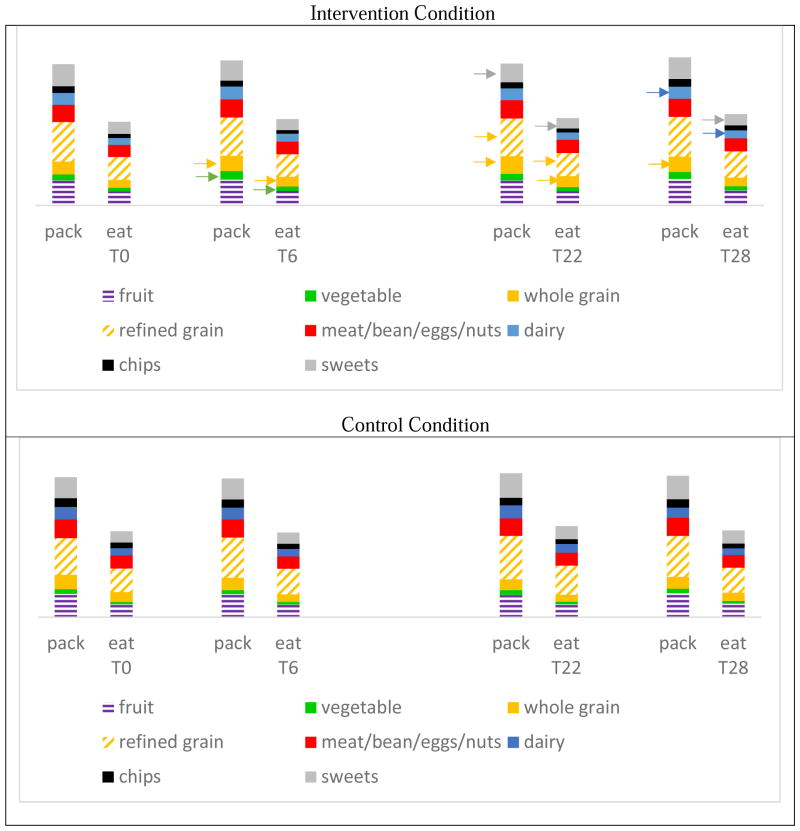
Early care and education (ECE) centers that require lunch brought from home provide an uncluttered view of parent-child dietary interactions in early childhood. Children's eating from parent-provided bag lunches was observed at 30 ECE centers in Texas, with 15 randomly assigned to the Lunch is in the Bag intervention to improve the lunch meal and 15 to a wait-list control condition. Study participants were parent and child aged 3-5 years (N = 633 dyads). Data were collected at baseline (pre-intervention) and follow-ups at weeks 6 (post-intervention), 22 (pre-booster), and 28 (post-booster). Changes effected in the children's lunch eating-e.g., increase of 14 percent in prevalence of children eating vegetables (SE = 5, P = 0.0063)-reciprocated changes in parent lunch-packing. Irrespective of intervention, however, the children consumed one-half to two-thirds of the amounts of whatever foods the parents packed, and the eat-to-pack ratio did not change across time. Thus, children's lunch eating at the ECE centers appeared to be regulated by perceptual cues of food availability rather than food preferences or internal cues of hunger and satiety.
Copyright © 2017 Elsevier Ltd. All rights reserved.
Figures

References
-
- Abrams KM, Evans C, Duff BRL. Ignorance is bliss: How parents of preschool children make sense of front-of-package visuals and claims on food. Appetite. 2015;87:20–29. - PubMed
-
- Aijzen I, Manstead ASR. Changing health related behaviors: An approach based on the Theory of Planned Behavior. In: Hewstone M, Schut H, De Wit J, Van Den Bos K, Stroebe MS, editors. The scope of social psychology: Theory and applications. New York: Psychology Press; 2007. pp. 43–63.
-
- Bandura A. Health promotion by social cognitive means. Health Education & Behavior. 2004;31:143–74. - PubMed
-
- Baranowski T, Missaghian M, Broadfoot A, Watson K, Cullen K, Nicklas T, Fisher J, Baranowski J, O’Donnell S. Fruit and vegetable shopping practices and social support scales: A validation. Journal of Nutrition Education and Behavior. 2006;38:340–351. - PubMed
Publication types
MeSH terms
Grants and funding
LinkOut - more resources
Full Text Sources
Other Literature Sources
