. 2018 Feb;103(2):361-372.
doi: 10.3324/haematol.2017.178608. Epub 2017 Oct 27.

Hypoxia modulates the purine salvage pathway and decreases red blood cell and supernatant levels of hypoxanthine during refrigerated storage

Affiliations

Hypoxia modulates the purine salvage pathway and decreases red blood cell and supernatant levels of hypoxanthine during refrigerated storage

Travis Nemkov et al. Haematologica. 2018 Feb.

Abstract

Hypoxanthine catabolism in vivo is potentially dangerous as it fuels production of urate and, most importantly, hydrogen peroxide. However, it is unclear whether accumulation of intracellular and supernatant hypoxanthine in stored red blood cell units is clinically relevant for transfused recipients. Leukoreduced red blood cells from glucose-6-phosphate dehydrogenase-normal or -deficient human volunteers were stored in AS-3 under normoxic, hyperoxic, or hypoxic conditions (with oxygen saturation ranging from <3% to >95%). Red blood cells from healthy human volunteers were also collected at sea level or after 1-7 days at high altitude (>5000 m). Finally, C57BL/6J mouse red blood cells were incubated in vitro with 13C1-aspartate or 13C5-adenosine under normoxic or hypoxic conditions, with or without deoxycoformycin, a purine deaminase inhibitor. Metabolomics analyses were performed on human and mouse red blood cells stored for up to 42 or 14 days, respectively, and correlated with 24 h post-transfusion red blood cell recovery. Hypoxanthine increased in stored red blood cell units as a function of oxygen levels. Stored red blood cells from human glucose-6-phosphate dehydrogenase-deficient donors had higher levels of deaminated purines. Hypoxia in vitro and in vivo decreased purine oxidation and enhanced purine salvage reactions in human and mouse red blood cells, which was partly explained by decreased adenosine monophosphate deaminase activity. In addition, hypoxanthine levels negatively correlated with post-transfusion red blood cell recovery in mice and - preliminarily albeit significantly - in humans. In conclusion, hypoxanthine is an in vitro metabolic marker of the red blood cell storage lesion that negatively correlates with post-transfusion recovery in vivo Storage-dependent hypoxanthine accumulation is ameliorated by hypoxia-induced decreases in purine deamination reaction rates.


Figures

Figure 1.
Figure 1.
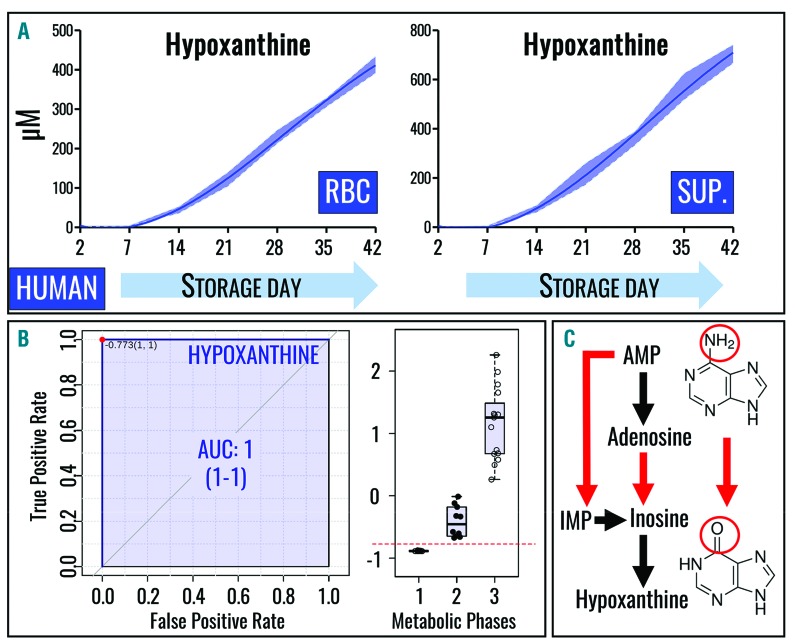
Hypoxanthine is a metabolic marker of the red blood cell storage lesion. (A) Intracellular (left) and supernatant (right) levels of hypoxanthine increase in packed RBC stored in the presence of AS-3. All data points shown on the x axes were tested and interpolated with third order polynomial curves (not assuming linear evolution of hypoxanthine accumulation during storage) and median ± ranges (n=4) are shown (dark blue lines and light blue areas, respectively). (B) ROC curves identify hypoxanthine as a biomarker of the three metabolic stages of stored RBC with extreme sensitivity and specificity (as indicated by high true positive and low false positive rates), confirming previous observations in SAGM. A simplified overview of purine catabolism and oxidation intermediates is outlined. Structures are provided for adenine (top right) and hypoxanthine (bottom right).
Figure 2.
Figure 2.
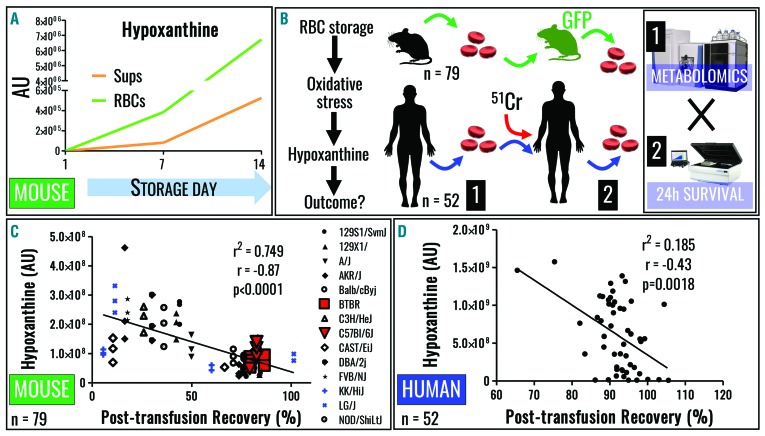
Hypoxanthine negatively correlates with post-trasfusion recovery of using mouse and human red blood cells. (A) Hypoxanthine accumulation is observed in stored C57BL/6J mouse RBC. (B) Transfusion into GFP-RBC mouse recipients (sorting of fluorescence negative RBC) or 51Cr labeling of human RBC was performed to determine 24 h PTR in mice (n=79) and human volunteers (n=52), whereas paired samples were used to determine hypoxanthine levels. (C, D) Negative correlations were observed for mouse (C) and human RBC hypoxanthine levels and 24 h PTR. Linear and quadratic Spearman correlations as well as their levels of significance are shown for mouse (median across strains) and (D) human data.
Figure 3.
Figure 3.
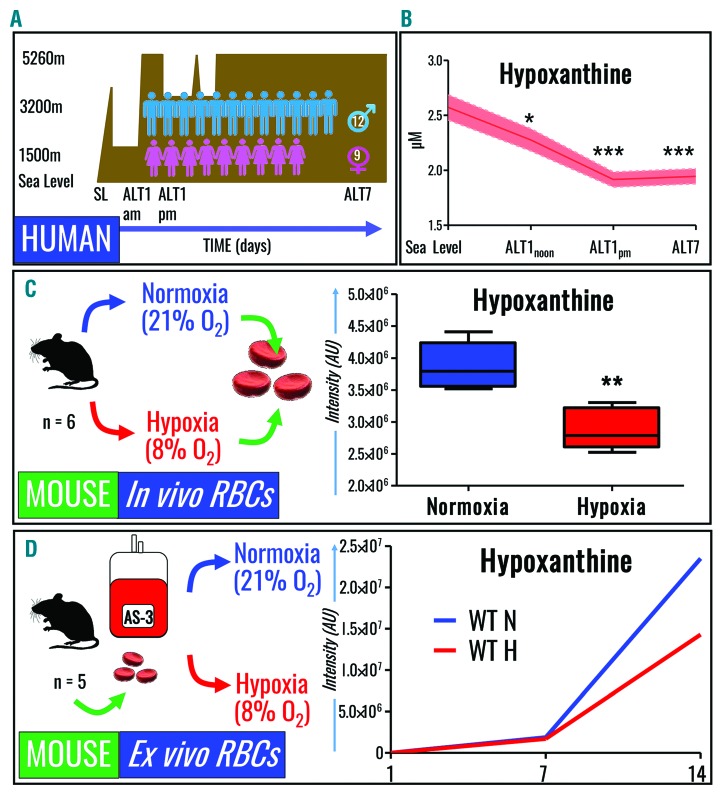
Hypoxanthine levels decrease in human and mouse red blood cells exposed to hypoxia in vivo and in vitro. (A) RBC were collected from 21 healthy volunteers at sea level (SL) and within 3 or >8 h after exposure to high altitude hypoxia on day 1 (ALT1 am and pm, respectively), and at 7 days (ALT7) after exposure to high altitude (>5000 m) hypoxia. (B) Hypoxanthine levels decreased significantly in human RBC within hours of exposure to high altitude hypoxia (x axis labels consistent with description of panel A). (C) C57BL/6J mice (n=6) were exposed to normoxia or 8% oxygen for 3 h, resulting in decreases in RBC levels of hypoxanthine, a phenomenon accompanied by decreased IMP and increased AMP/IMP ratios (Online Supplementary Figure S1). (D) RBC were collected from C57BL/6J mice prior to in vitro storage in AS-3 for up to 2 weeks under normoxic or hypoxic conditions, resulting in decreased hypoxanthine accumulation.
Figure 4.
Figure 4.
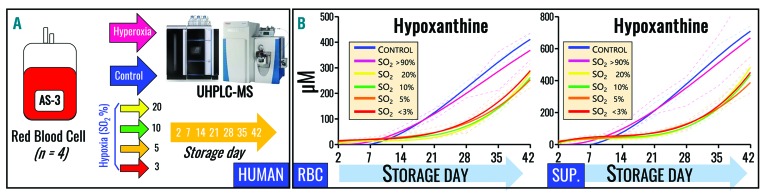
Effects of oxygene saturation on hypoxanthine accumulation during refrigerated storage. (A) Human RBC were donated by healthy volunteers (n=4) prior to refrigerated storage in AS-3 under control (normoxic), hyperoxic (SO2>95%), or hypoxic (SO2 = 20%, 10%, 5% or <3%) conditions for up to 42 days. (B) Hypoxanthine concentration was determined in cells and supernatants, with significant decreases in the presence of hypoxia. All data points shown on the x axes were tested and interpolated with third order polynomial curves (not assuming linear evolution of hypoxanthine accumulation during storage) and medians ± ranges (n=4) are shown (dark blue lines and light blue areas, respectively).
Figure 5.
Figure 5.
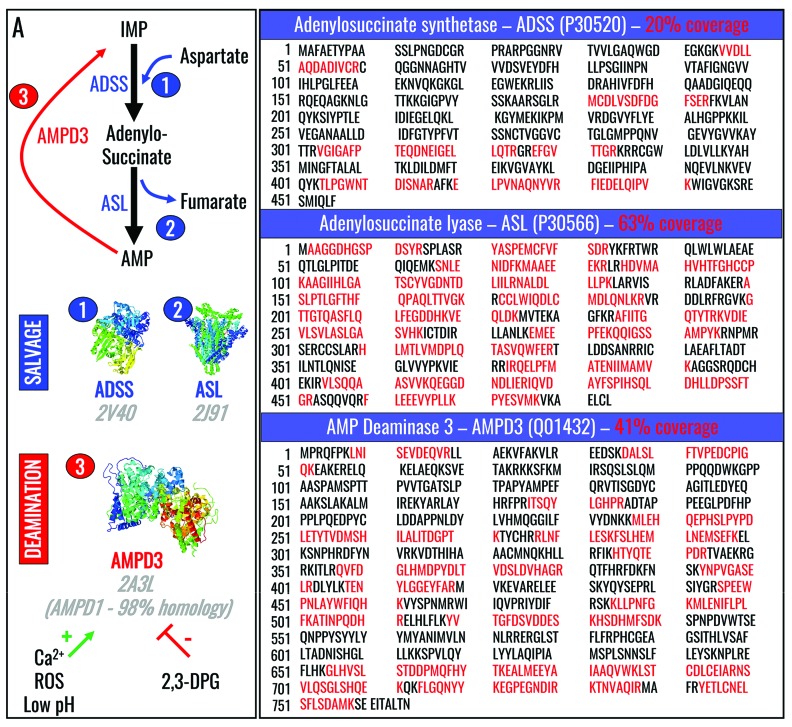
Purine salvage and deamination reactions. (A) Purine salvage and deamination reactions are catalyzed by adenylosuccinate synthase (ADSS - 1) and adenylosuccinate lyase (ASL – 2), and by adenosine monophosphate deaminase (AMPD3 - 3), respectively. (B) Deep proteomic analyses identified ADSS, ASL and AMPD3 in human RBC, in contrast to prior studies indicating the absence of ADSS in mature human RBC.
Figure 6.
Figure 6.
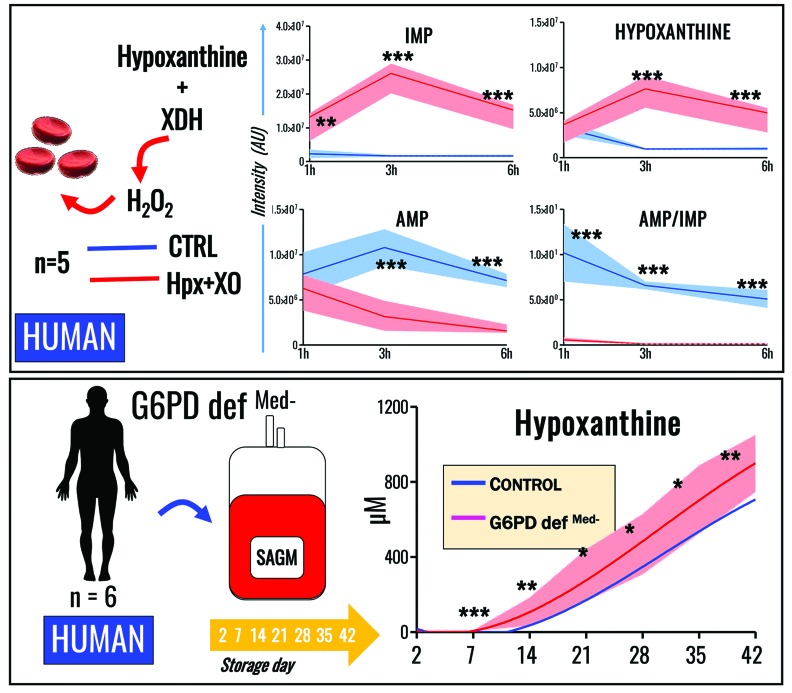
Oxidative injury or impairment of the antioxidant capacity in glucose-6-phosphate dehydrogenase-deficient red blood cells enhances purine deamination. (A) Exposure of human RBC to pro-oxidant treatment with hypoxanthine plus xanthine dehydrogenase (XDH) for up to 6 h enhances AMP deamination to IMP accompanied by accumulation of hypoxanthine. (B) Human RBC from G6PD-deficient donors (Mediterranean variant, <10% residual activity of the enzyme) were stored for up to 42 days, showing significantly higher levels of hypoxanthine throughout the whole storage period (analyses were performed on whole transfusates: cells + supernatants) (median + ranges for RBC from G6PD donors are plotted as a solid red line and light red area, respectively). In (B), all data points shown on the x axis were tested and interpolated with third order polynomial curves (not assuming linear evolution of hypoxanthine accumulation during storage).
Figure 7.
Figure 7.
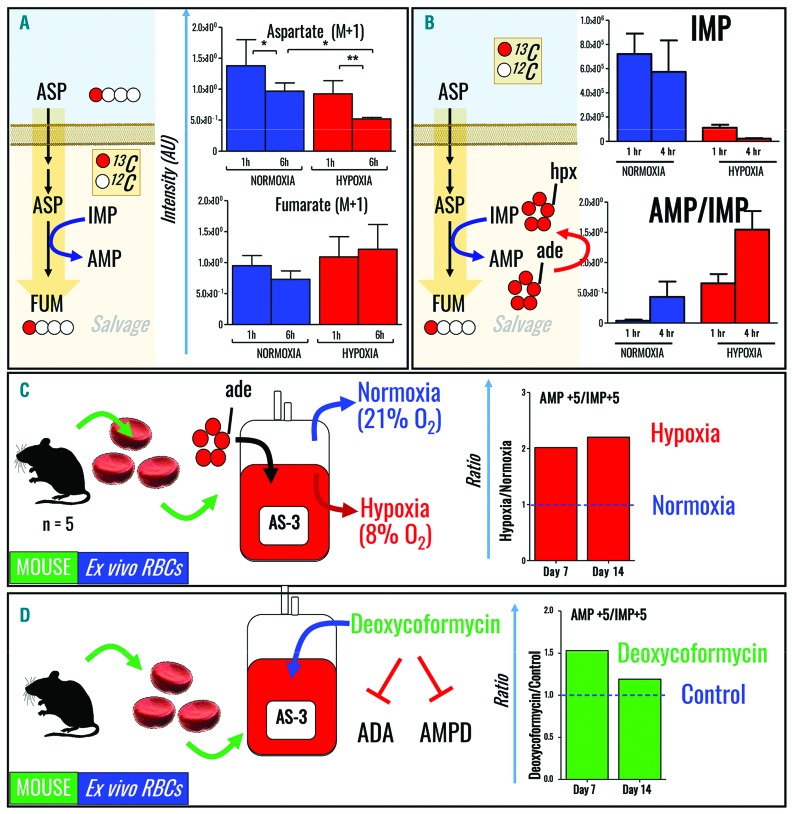
Tracing experiments reveal hypoxic inhibition of purine deamination, rather than hypoxic increases in purine salvage. (A, B) Human RBC were incubated with (A) 13C1-aspartate to determine the rate of fumarate generation (salvage) and with (B) 13C5-adenosine to determine the rate of AMP deamination. (C) 13C5-adenosine tracing experiments demonstrated that in vitro storage of mouse RBC under hypoxic conditions prevents purine deamination. (D) Incubation of mouse RBC with deoxycoformycin, an adenosine and AMP deaminase inhibitor, increases AMP/IMP ratios.
Figure 8.
Figure 8.
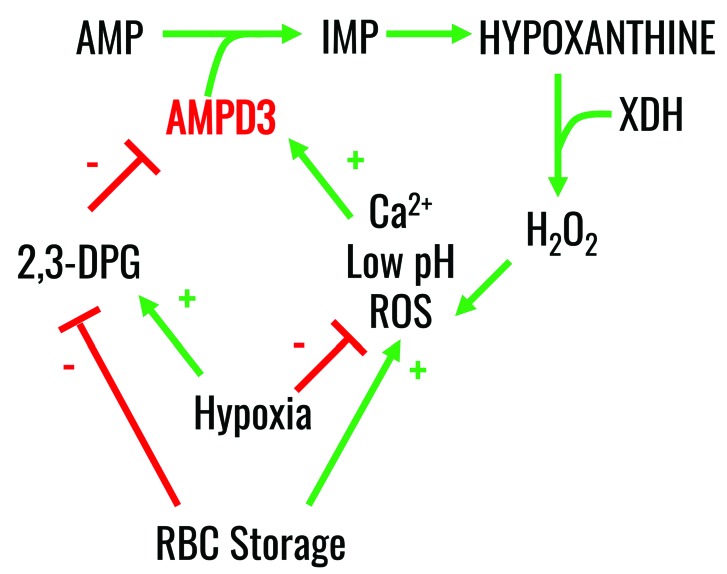
Proposed mechanism of the effect of hypoxia on the purine salvage pathway. RBC storage or oxidative stress promotes activation of RBC AMPD3, which in turn catalyzes purine deamination. This phenomenon is in part counteracted by RBC exposure to hypoxia in vivo or ex vivo, which phenocopies the pharmacological inhibition of purine deaminases.

References

    1. Ellingson KD, Sapiano MR, Haass KA, et al. Continued decline in blood collection and transfusion in the United States-2015. Transfusion. 2017;57(Suppl 2):1588–1598. - PMC - PubMed
    1. D’Alessandro A, Kriebardis AG, Rinalducci S, et al. An update on red blood cell storage lesions, as gleaned through biochemistry and omics technologies. Transfusion. 2015;55(1):205–219. - PubMed
    1. Zimring JC. Widening our gaze of red blood storage haze: a role for metabolomics. Transfusion. 2015;55(6):1139–1142. - PubMed
    1. Hod EA, Zhang N, Sokol SA, et al. Transfusion of red blood cells after pro longed storage produces harmful effects that are mediated by iron and inflammation. Blood. 2010;115(21):4284–4292. - PMC - PubMed
    1. Klein HG. The red cell storage lesion(s): of dogs and men. Blood Transfus. 2017;15(2):107–111. - PMC - PubMed

Publication types