Review
. 2018 Feb:42:1-8.
doi: 10.1016/j.cbpa.2017.10.007. Epub 2017 Nov 5.

Recent advances in ion mobility-mass spectrometry for improved structural characterization of glycans and glycoconjugates

Affiliations
Review

Recent advances in ion mobility-mass spectrometry for improved structural characterization of glycans and glycoconjugates

Zhengwei Chen et al. Curr Opin Chem Biol. 2018 Feb.

Abstract

Glycans and glycoconjugates are involved in regulating a vast array of cellular and molecular processes. Despite the importance of glycans in biology and disease, characterization of glycans remains difficult due to their structural complexity and diversity. Mass spectrometry (MS)-based techniques have emerged as the premier analytical tools for characterizing glycans. However, traditional MS-based strategies struggle to distinguish the large number of coexisting isomeric glycans that are indistinguishable by mass alone. Because of this, ion mobility spectrometry coupled to MS (IM-MS) has received considerable attention as an analytical tool for improving glycan characterization due to the capability of IM to resolve isomeric glycans before MS measurements. In this review, we present recent improvements in IM-MS instrumentation and methods for the structural characterization of isomeric glycans. In addition, we highlight recent applications of IM-MS that illustrate the enormous potential of this technology in a variety of research areas, including glycomics, glycoproteomics, and glycobiology.


Figures

Figure 1
Figure 1
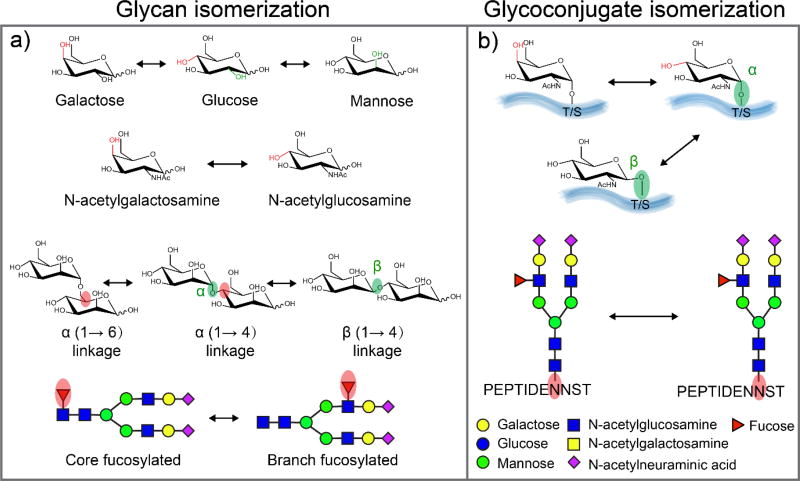
The isomerization of glycan and glycoconjugates. a) The building blocks (monosaccharides) that compose larger glycans are structural isomers (Hexose: galactose, glucose, mannose, N-acetylhexosamine: N-acetylgalactosamine, N-acetylglucosamine); monosaccharides can be connected either α- or β-stereochemistry at multiple potential linkage position; fucose could be either attached to N-glycan core or branches. b) Epimeric glycoconjugates results from alternative configurations (α- or β-) at the anomeric linkages or the presence of epimeric glycan monomers (galactose or glucose), scheme modified from reference [43]; two isomeric N-glycopeptides differ in the site of N-glycan attachment.
Figure 2
Figure 2
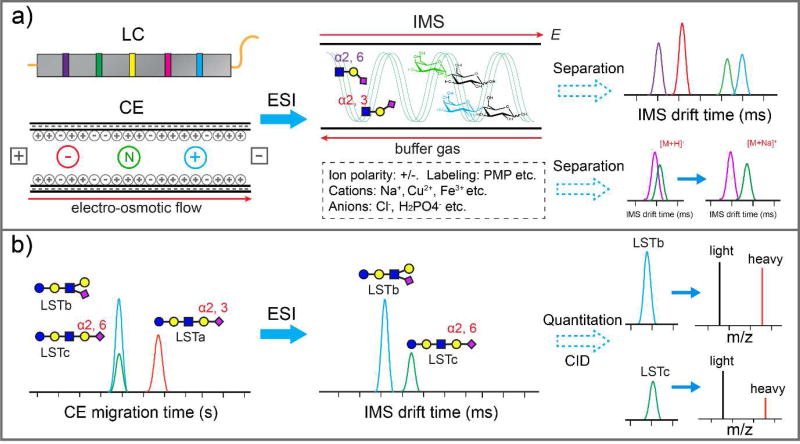
Coupling IM with LC or CE. a) After LC or CE separation, analytes were ionized by ESI and subject to another dimension of separation afforded by IM based on their shape and charge through a buffer gas under a weak electric field (E). Sample preparation or gas-phase chemistry could be manipulated to improve glycan isomer separation. b) CE-ESI-TWIM-MS/MS analysis of a mixture of aminoxyTMT6-128 (light) and aminoxyTMT6-131 (heavy) differentially labeled sialyllacto-N-tetraose a, b, c (LSTa, LSTb, LSTc). CE was able to separate LSTa with LSTb/c, but was unable to resolve LSTb and LSTc. Benefiting from another dimension of separation afforded by TWIM, baseline separation between LSTb and LSTc was achieved, which enables quantitative analysis of each isomer following MS/MS [38].
Figure 3
Figure 3
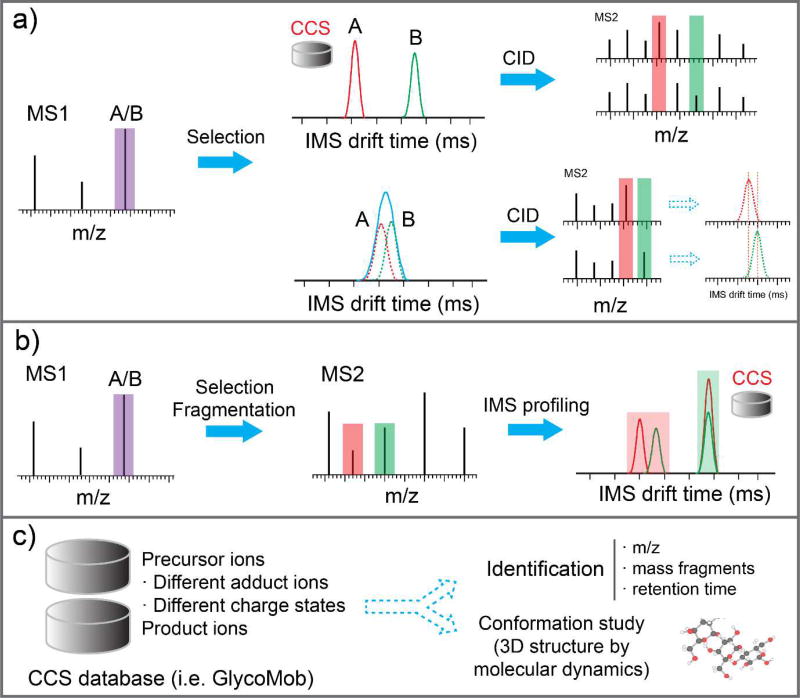
IM-MS analysis of precursor ions and their fragments. a) Two scenarios exist for co-eluted isomers A/B for IM-MS analysis after being selected by quadrupole. Scenario one: A and B could be baseline-separated by IM. The mobility-selected ions could be subject to CID separately and signature product ions could be obtained for each †isomer. Scenario two: A and B could not be completely resolved by IM. Signature product ions were obtained for unresolved species. Drift time profiles of these signature products ions were extracted from total drift time profiles to differentiate A and B. b) Co-eluted isomers A/B were selected by quadrupole for MS/MS and the drift time profiles could be obtained for all product ions. Those product ions that are indicative of the isomeric structures of the analyte could be distinguished by IM and be used to differentiate the isomers. c) The CCS of both precursor ions and product ions could be measured and implemented into a CCS database. The CCS values could be used as an additional parameter for glycan identification besides the commonly used m/z, mass fragments, and retention time. Furthermore, conformational study could be conducted by molecular dynamics to acquire the 3D structures of glycans.

References

    1. Ohtsubo K, Marth JD. Glycosylation in cellular mechanisms of health and disease. Cell. 2006;126:855–867. - PubMed
    1. Rakus JF, Mahal LK. New technologies for glycomic analysis: toward a systematic understanding of the glycome. Annual review of analytical chemistry. 2011;4:367–392. - PubMed
    1. Zhu M, Bendiak B, Clowers B, Hill HH. Ion mobility-mass spectrometry analysis of isomeric carbohydrate precursor ions. Anal Bioanal Chem. 2009;394:1853–1867. - PMC - PubMed
    1. Pabst M, Altmann F. Glycan analysis by modern instrumental methods. Proteomics. 2011;11:631–643. - PubMed
    1. Mariño K, Bones J, Kattla JJ, Rudd PM. A systematic approach to protein glycosylation analysis: a path through the maze. Nat Chem Biol. 2010;6:713–723. - PubMed

Publication types

MeSH terms

LinkOut - more resources