


Novel Toxoplasma gondii inhibitor chemotypes
- PMID: 29081387
- PMCID: PMC5809185
- DOI: 10.1016/j.parint.2017.10.010
Novel Toxoplasma gondii inhibitor chemotypes
Abstract
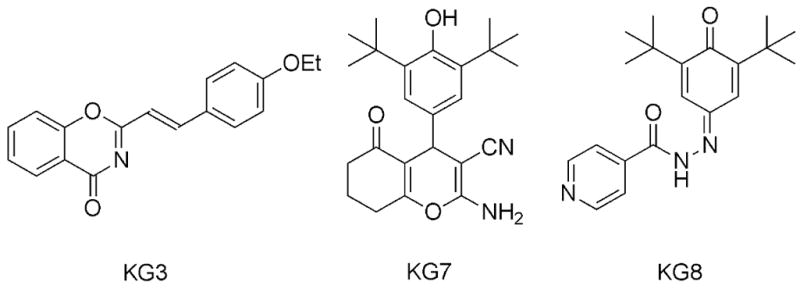
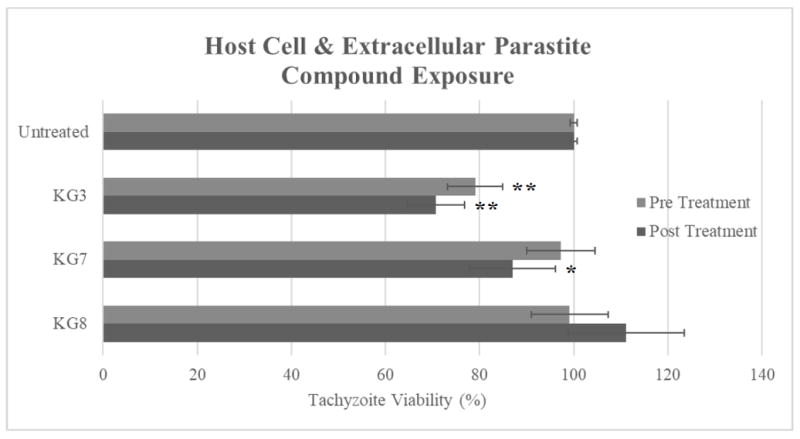
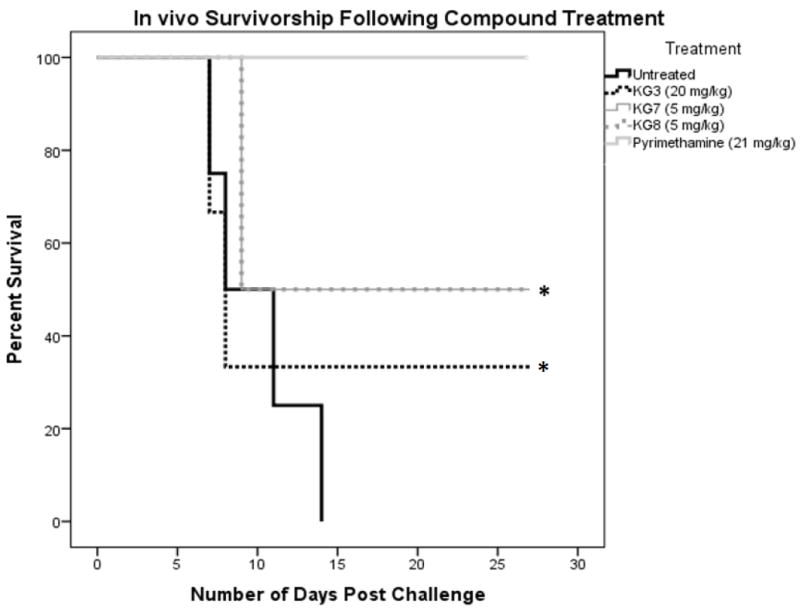
We profiled three novel T. gondii inhibitors identified from an antimalarial phenotypic high throughput screen (HTS) campaign: styryl 4-oxo-1,3-benzoxazin-4-one KG3, tetrahydrobenzo[b]pyran KG7, and benzoquinone hydrazone KG8. These compounds inhibit T. gondii in vitro with IC50 values ranging from 0.3 to 2μM, comparable to that of 0.25 to 1.5μM for the control drug pyrimethamine. KG3 had no measurable cytotoxicity against five mammalian cell lines, whereas KG7 and KG8 inhibited the growth of 2 of 5 cell lines with KG8 being the least selective for T. gondii. None of the compounds were mutagenic in an Ames assay. Experimental gLogD7.4 and calculated PSA values for the three compounds were well within the ranges predicted to be favorable for good ADME, even though each compound had relatively low aqueous solubility. All three compounds were metabolically unstable, especially KG3 and KG7. Multiple IP doses of 5mg/kg KG7 and KG8 increased survival in a T. gondii mouse model. Despite their liabilities, we suggest that these compounds are useful starting points for chemical prospecting, scaffold-hopping, and optimization.
Keywords: Anti-parasitics; Drug discovery; Lead compounds; Plasmodium falciparum; Toxoplasma gondii.
Copyright © 2017 Elsevier B.V. All rights reserved.
Conflict of interest statement
Conflicts of interest: none
Figures
References
-
- Jones JL, Dargelas V, Roberts J, Press C, Remington JS, Montoya JG. Risk factors for Toxoplasma gondii infection in the United States. Clinical Infectious Diseases. 2009;49:878–884. - PubMed
MeSH terms
Substances
Grants and funding
LinkOut - more resources
Full Text Sources
Other Literature Sources
Research Materials
Miscellaneous
