. 2017 Oct 30;13(10):e1007086.
doi: 10.1371/journal.pgen.1007086. eCollection 2017 Oct.

AtHKT1 drives adaptation of Arabidopsis thaliana to salinity by reducing floral sodium content

Affiliations

AtHKT1 drives adaptation of Arabidopsis thaliana to salinity by reducing floral sodium content

Dong An et al. PLoS Genet. .

Abstract

Arabidopsis thaliana high-affinity potassium transporter 1 (AtHKT1) limits the root-to-shoot sodium transportation and is believed to be essential for salt tolerance in A. thaliana. Nevertheless, natural accessions with 'weak allele' of AtHKT1, e.g. Tsu-1, are mainly distributed in saline areas and are more tolerant to salinity. These findings challenge the role of AtHKT1 in salt tolerance and call into question the involvement of AtHKT1 in salinity adaptation in A. thaliana. Here, we report that AtHKT1 indeed drives natural variation in the salt tolerance of A. thaliana and the coastal AtHKT1, so-called weak allele, is actually hyper-functional in reducing flowers sodium content upon salt stress. Our data showed that AtHKT1 positively contributes to saline adaptation in a linear manner. Forward and reverse genetics analysis established that the single AtHKT1 locus is responsible for the variation in the salinity adaptation between Col-0 and Tsu-1. Reciprocal grafting experiments revealed that shoot AtHKT1 determines the salt tolerance of Tsu-1, whereas root AtHKT1 primarily drives the salt tolerance of Col-0. Furthermore, evidence indicated that Tsu-1 AtHKT1 is highly expressed in stems and is more effective compared to Col-0 AtHKT1 at limiting sodium flow to the flowers. Such efficient retrieval of sodium to the reproductive organ endows Tsu-1 with stronger fertility compared to Col-0 upon salt stress, thus improving Tsu-1 adaptation to a coastal environment. To conclude, our data not only confirm the role of AtHKT1 in saline adaptation, but also sheds light on our understanding of the salt tolerance mechanisms in plants.


Conflict of interest statement

The authors have declared that no competing interests exist.

Figures
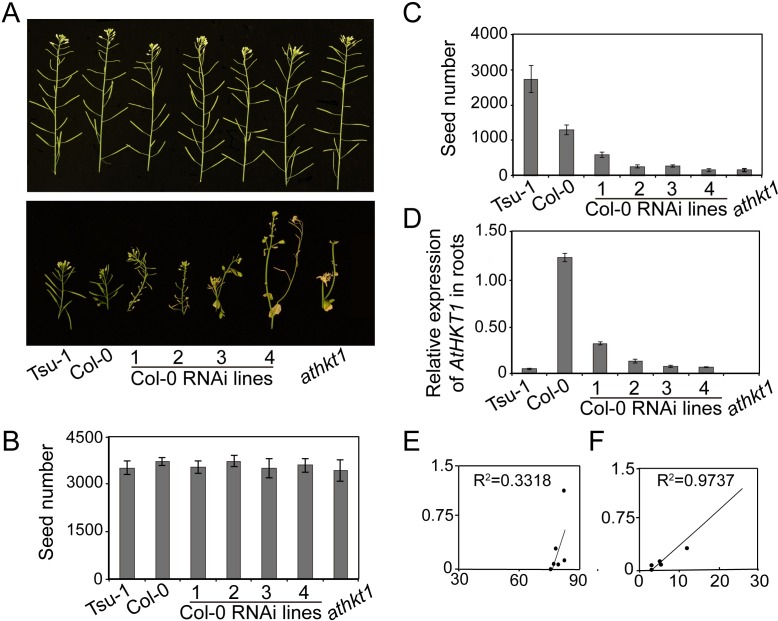
Fig 1
Fig 1. AtHKT1 contributes to salt tolerance in a linear manner.
(A) Flowers and siliques of Tsu-1, Col-0, Col-0 AtHKT1 RNAi lines, and athkt1 under normal conditions (upper) or treated with 100 mM NaCl (lower) for two weeks. (B-C) Numbers of seeds from the plants shown in (A) under normal (B) and 100 mM NaCl treatment conditions (C). Two-week-old plants were treated without or with twice 100 mM NaCl, and seeds were collected continuously during silique maturation. (D) AtHKT1 expression level assessed by qRT-PCR in the roots of 4-week-old Tsu-1, Col-0, Col-0 AtHKT1 RNAi lines, and athkt1 grown in liquid culture. (E-F) Correlation of seed number and AtHKT1 expression level under normal (E) and salt stress conditions (F). Data represented with mean ± SE, n = 12, significant differences were determined by ANOVA.
Fig 2
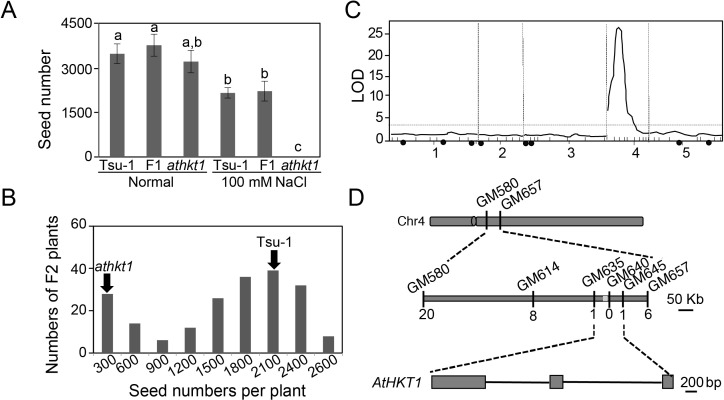
Fig 2. QTL analysis of salt tolerance loci in Tsu-1 mapped to a single major region where AtHKT1 is located.
(A) Numbers of seeds of F1 plants derived from a cross between Tsu-1 and athkt1 under normal and salt stress conditions. Data represented with mean ± SE, n = 12, and significant differences were determined by ANOVA. (B) Numbers of seeds of 201 F2 plants subjected to salt treatment. (C) QTL analysis of the F2 population using the R/qtl package. The threshold of LOD indicated by the dotted line was 2.5. The black dots indicate the genetic locations of 8 NHX genes. (D) Fine mapping of 537 F2 plants using 10 newly developed markers narrowed down the location of the causal gene to a region between GM635 and GM645 on chromosome 4 that contains AtHKT1. The number underlined in the middle line indicates recombination events.
Fig 3
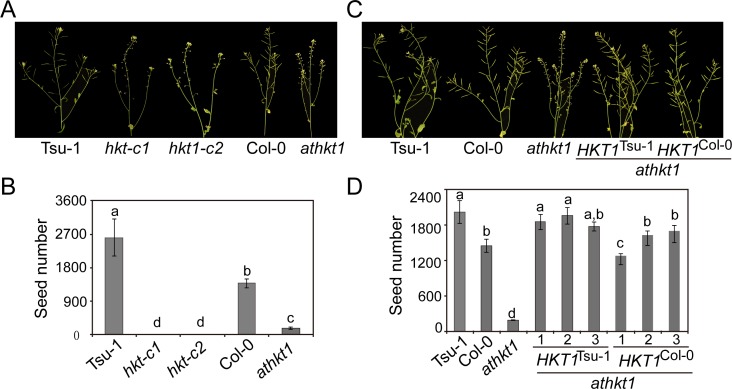
Fig 3. A single AtHKT1 locus is sufficient to drive natural variation in salinity adaptation.
(A) Flowers and siliques of Tsu-1, hkt1-c1, hkt1-c2, Col-0, and athkt1 subjected to salt treatment. (B) Numbers of seeds of the plants shown in (A) under salt treatment (n = 12). (C) Flowers and siliques of Tsu-1, Col-0, athkt1, and athkt1 complementation lines with AtHKT1 fragment from Tsu-1 or Col-0 following salt treatment. (D) Number of seeds of the plants shown in (C) under salt treatment. (n > 40). The plants were treated with 100 mM NaCl twice after growth for 2 weeks. Data represented with mean ± SE; significant differences were determined by ANOVA.
Fig 4
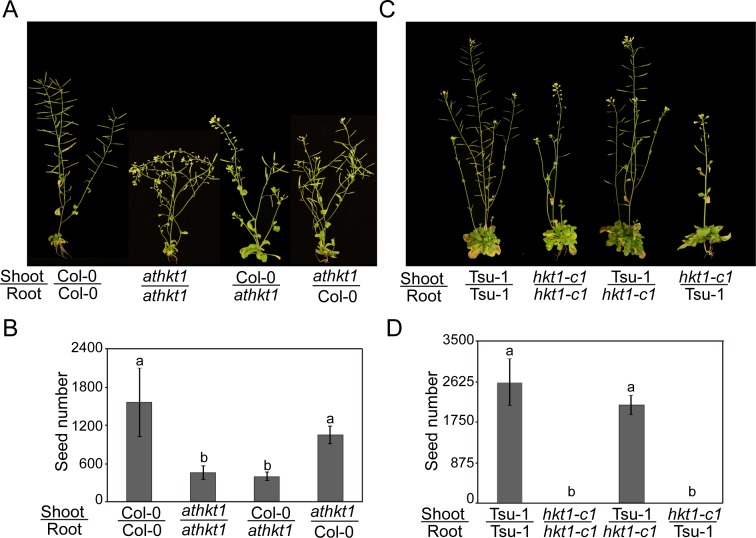
Fig 4. Reciprocal grafting experiments revealed that the salt tolerance phenotype of Tsu-1 is driven by shoot AtHKT1, whereas the phenotype of Col-0 is driven by root AtHKT1.
(A) Plants generated via reciprocal graft between Col-0 and athkt1 treated with 100 mM NaCl for 2 weeks. (B) Numbers of seeds from reciprocally grafted Col-0 and athkt1 plants treated with 100 mM NaCl. (C) Reciprocally grafted plants between Tsu-1 and hkt1-c1subjected to 100 mM NaCl for 2 weeks. (D) Numbers of seeds from reciprocally grafted Tsu-1 and hkt1-c1 plants subjected to 100 mM NaCl. Successfully grafted plants (n > 12) were transferred to pots for 2 weeks following 100 mM NaCl treatment twice for 2 weeks before images were taken. Data represented with mean ± SE; significant differences were determined by ANOVA.
Fig 5
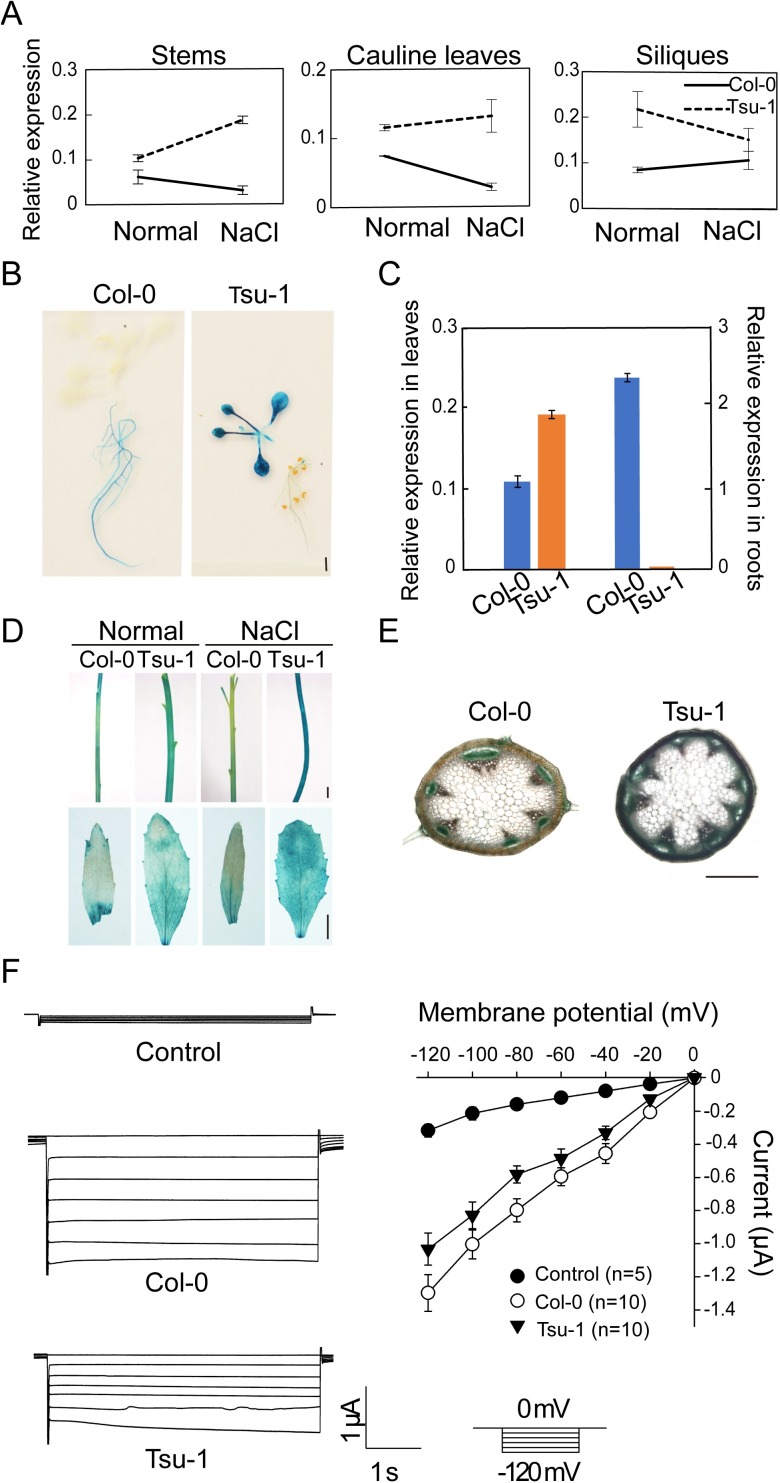
Fig 5. AtHKT1 is hyper-functional in Tsu-1 stems.
(A) AtHKT1 expression in the stems, cauline leaves, and siliques of 4-week-old Tsu-1 and Col-0 before and after 100 mM NaCl treated for 24 h. Data represented with mean ± SE, n = 6. (B) GUS staining of 2-week-old T1 transgenic seedlings expressing pAtHKT1:GUS from Col-0 and Tsu-1. (Scale bar: 0.5 cm). (C) AtHKT1 expression in the shoots and roots of Tsu-1 and Col-0. Two-week-old seedlings grown on 1/2 MS medium. (D) GUS staining of the stems and cauline leaves of transgenic lines expressing pAtHKT1:GUS from Col-0 and Tsu-1. Four-week-old transgenic plants grown in pots before (Normal) and after 100 mM NaCl treatment for 24 h (NaCl). (Scale bars: 0.5 cm). (E) GUS staining of the stems of 4-week-old transgenic lines expressing pAtHKT1:GUS from Col-0 (upper) and Tsu-1 (lower) by hand sectioning. (Scale bar: 250 μm). (F) Electrophysiological recording of the activity of AtHKT1 from Tsu-1 and Col-0. The current-voltage curves were measured using a ramp command in which the membrane potential was stepped from -120 mV to 0 mV. The data shown here are the steady-state current-voltage curve (mean ± SE) in the bath solution containing 10 mM Na+ and 0.3 mM K+.
Fig 6
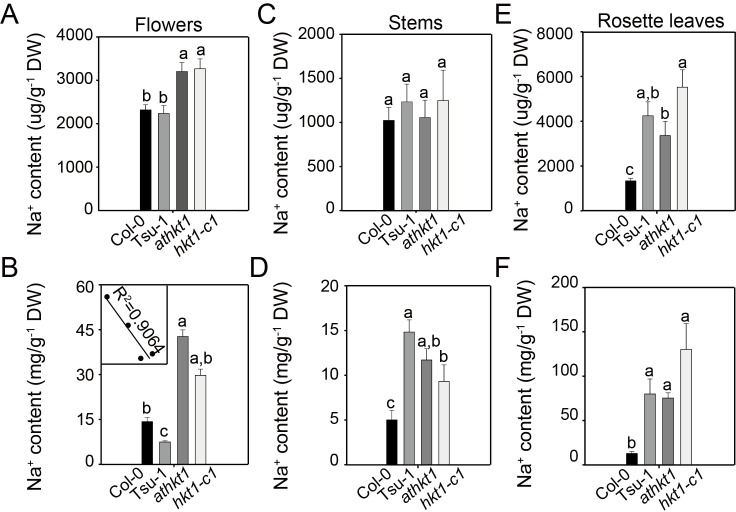
Fig 6. Na+ content of Col-0, Tsu-1, athkt1 and hkt1-c1.
(A) Na+ content in flowers under normal conditions. (B) Na+ content in flowers under salt treatment. Negatively correlated between floral sodium content and seed number under salt stress (Embedded) (C) Na+ content in stems under normal conditions. (D) Na+ content in stems under salt treatment. (E) Na+ content in rosette leaves under normal conditions. (F) Na+ content in rosette leaves under salt treatment. Five-week-old plants irrigated without or twice with 100 mM NaCl were used to analyze Na+ by ICP-MS. Data represented with mean ± SE, n = 12, and significant differences were determined by ANOVA.

References

    1. Ma Y, Dai X, Xu Y, Luo W, Zheng X, Zeng D, et al. COLD1 confers chilling tolerance in rice. Cell. 2015;160: 1209–1221. doi: 10.1016/j.cell.2015.01.046 - DOI - PubMed
    1. Li Y, Huang Y, Bergelson J, Nordborg M, Borevitz JO. Association mapping of local climate-sensitive quantitative trait loci in Arabidopsis thaliana. Proc Natl Acad Sci USA. 2010;107: 21199–21204. doi: 10.1073/pnas.1007431107 - DOI - PMC - PubMed
    1. Lu S, Zhao X, Hu Y, Liu S, Nan H, Li X, et al. Natural variation at the soybean J locus improves adaptation to the tropics and enhances yield. Nat Genet. 2017;49: 773–779. doi: 10.1038/ng.3819 - DOI - PubMed
    1. Todesco M, Balasubramanian S, Hu TT, Traw MB, Horton M, Epple P, et al. Natural allelic variation underlying a major fitness trade-off in Arabidopsis thaliana. Nature. 2010;465: 632–636. doi: 10.1038/nature09083 - DOI - PMC - PubMed
    1. Chao D-Y, Dilkes B, Luo H, Douglas A, Yakubova E, Lahner B, et al. Polyploids exhibit higher potassium uptake and salinity tolerance in Arabidopsis. Science. 2013;341: 658–659. doi: 10.1126/science.1240561 - DOI - PMC - PubMed

LinkOut - more resources