


Association of Distinct Fine Specificities of Anti-Citrullinated Peptide Antibodies With Elevated Immune Responses to Prevotella intermedia in a Subgroup of Patients With Rheumatoid Arthritis and Periodontitis
- PMID: 29084415
- PMCID: PMC5711558
- DOI: 10.1002/art.40227
Association of Distinct Fine Specificities of Anti-Citrullinated Peptide Antibodies With Elevated Immune Responses to Prevotella intermedia in a Subgroup of Patients With Rheumatoid Arthritis and Periodontitis
Abstract
Objective: In addition to the long-established link with smoking, periodontitis (PD) is a risk factor for rheumatoid arthritis (RA). This study was undertaken to elucidate the mechanism by which PD could induce antibodies to citrullinated peptides (ACPAs), by examining the antibody response to a novel citrullinated peptide of cytokeratin 13 (CK-13) identified in gingival crevicular fluid (GCF), and comparing the response to 4 other citrullinated peptides in patients with RA who were well-characterized for PD and smoking.
Methods: The citrullinomes of GCF and periodontal tissue from patients with PD were mapped by mass spectrometry. ACPAs of CK13 (cCK13), tenascin-C (cTNC5), vimentin (cVIM), α-enolase (CEP-1), and fibrinogen β (cFIBβ) were examined by enzyme-linked immunosorbent assay in patients with RA (n = 287) and patients with osteoarthritis (n = 330), and cross-reactivity was assessed by inhibition assays.
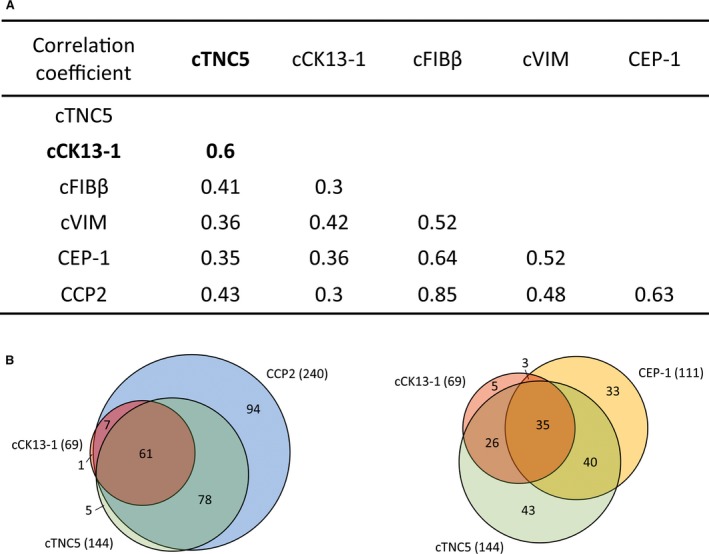
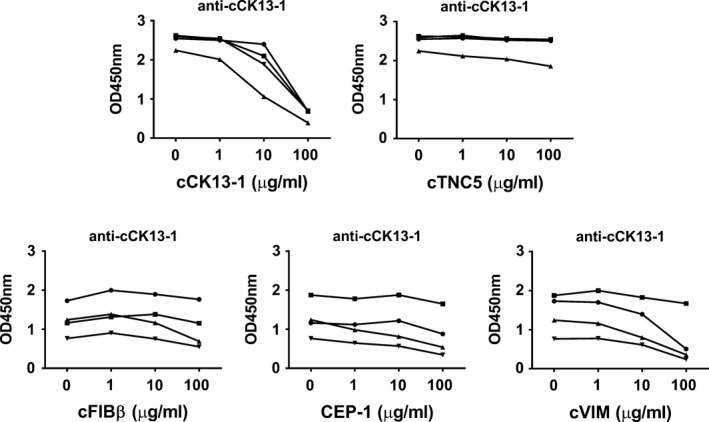
Results: A novel citrullinated peptide cCK13-1 (444 TSNASGR-Cit-TSDV-Cit-RP458 ) identified in GCF exhibited elevated antibody responses in RA patients (24%). Anti-cCK13-1 antibody levels correlated with anti-cTNC5 antibody levels, and absorption experiments confirmed this was not due to cross-reactivity. Only anti-cCK13-1 and anti-cTNC5 were associated with antibodies to the periodontal pathogen Prevotella intermedia (P = 0.05 and P = 0.001, respectively), but not with antibodies to Porphyromonas gingivalis arginine gingipains. Levels of antibodies to CEP-1, cFIBβ, and cVIM correlated with each other, and with smoking and shared epitope risk factors in RA.
Conclusion: This study identifies 2 groups of ACPA fine specificities associated with different RA risk factors. One is predominantly linked to smoking and shared epitope, and the other links anti-cTNC5 and cCK13-1 to infection with the periodontal pathogen P intermedia.
© 2017 The Authors. Arthritis & Rheumatology published by Wiley Periodicals, Inc. on behalf of American College of Rheumatology.
Figures
References
-
- Klareskog L, Ronnelid J, Lundberg K, Padyukov L, Alfredsson L. Immunity to citrullinated proteins in rheumatoid arthritis. Annu Rev Immunol 2008;26:651–75. - PubMed
-
- Masson‐Bessiere C, Sebbag M, Girbal‐Neuhauser E, Nogueira L, Vincent C, Senshu T, et al. The major synovial targets of the rheumatoid arthritis‐specific antifilaggrin autoantibodies are deiminated forms of the α and β chains of fibrin. J Immunol 2001;166:4177–84. - PubMed
Publication types
MeSH terms
Substances
Grants and funding
LinkOut - more resources
Full Text Sources
Other Literature Sources
Medical
Molecular Biology Databases
Research Materials
Miscellaneous
