Review
. 2017 Oct 30;18(1):205.
doi: 10.1186/s13059-017-1347-3.

Rewriting the transcriptome: adenosine-to-inosine RNA editing by ADARs

Affiliations
Review

Rewriting the transcriptome: adenosine-to-inosine RNA editing by ADARs

Carl R Walkley et al. Genome Biol. .

Abstract

One of the most prevalent forms of post-transcritpional RNA modification is the conversion of adenosine nucleosides to inosine (A-to-I), mediated by the ADAR family of enzymes. The functional requirement and regulatory landscape for the majority of A-to-I editing events are, at present, uncertain. Recent studies have identified key in vivo functions of ADAR enzymes, informing our understanding of the biological importance of A-to-I editing. Large-scale studies have revealed how editing is regulated both in cis and in trans. This review will explore these recent studies and how they broaden our understanding of the functions and regulation of ADAR-mediated RNA editing.


Conflict of interest statement

The authors declare that they have no competing interests.

Figures
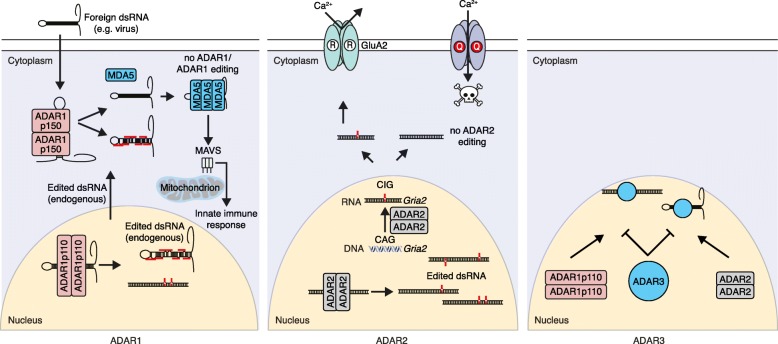
Fig. 1
Fig. 1
The roles of ADAR1, ADAR2, and ADAR3. ADAR1 is present in the nucleus (ADAR1 p110) and cytoplasm (ADAR1 p150) and can edit endogenous RNA. ADAR1 is required to edit endogenous RNA to prevent the activation of the cytosolic pattern recognition receptor MDA5 in the cytosol, leading to induction of the innate immune/interferon response. ADAR1 can also edit viral dsRNA and participate in the innate immune response as a direct interferon-stimulated gene (ADAR1 p150 isoform). The absence of ADAR1 or the absence of ADAR1-mediated editing leads to innapropriate activation of the MDA5–MAVS axis. ADAR2 is essential for site-selective editing and is very highly expressed in the brain and central nervous system. The editing of Gria2 at the Q/R site is ADAR2 specific and is required to recode the transcript to form a functional GluA2 protein and allow survival. ADAR3 competes with ADAR1 or ADAR2 for binding to dsRNA substrates, which then are protected from editing due to ADAR3 not having deamination activity
Fig. 2
Fig. 2
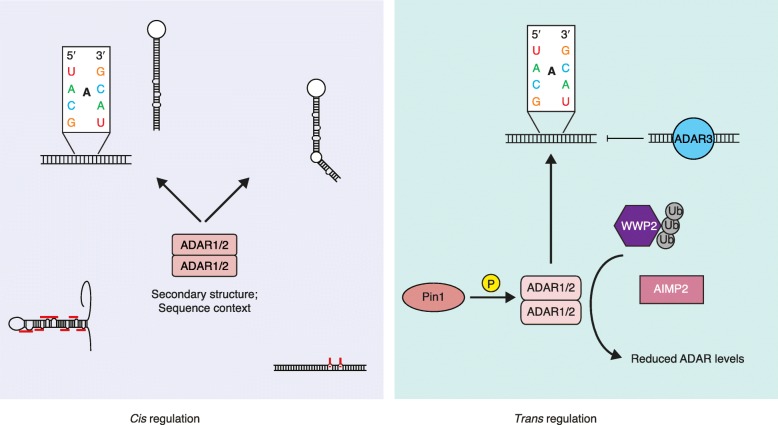
Cis versus trans regulation of A-to-I editing. Cis regulation contributes significantly to the efficiency of editing by ADARs. The sequence context and secondary structure surrounding the adenosine are important in determining the efficiency of editing. The 5′ and 3′ nucleotides adjacent to the adenosine are important contributors to the editing efficiency. Trans regulation contributes less significantly to the overall editing, and can either enhance editing, such as occurs with Pin1 phosphorylation of ADAR, or reduce overall editing, as occurs with WWP2 (ubiquitination of ADAR) or AIMP2 (reduces overall levels of ADAR1)

References

    1. Gilbert WV, Bell TA, Schaening C. Messenger RNA modifications: Form, distribution, and function. Science. 2016;352:1408–12. doi: 10.1126/science.aad8711. - DOI - PMC - PubMed
    1. Zhao BS, Roundtree IA, He C. Post-transcriptional gene regulation by mRNA modifications. Nat Rev Mol Cell Biol. 2017;18:31–42. doi: 10.1038/nrm.2016.132. - DOI - PMC - PubMed
    1. Bass BL. RNA Editing by adenosine deaminases that act on RNA. Annu Rev Biochem. 2002;71:817–46. doi: 10.1146/annurev.biochem.71.110601.135501. - DOI - PMC - PubMed
    1. Hogg M, Paro S, Keegan LP, O’Connell MA. RNA editing by mammalian ADARs. Adv Genet. 2011;73:87–120. - PubMed
    1. Nishikura K. Functions and regulation of RNA editing by ADAR deaminases. Annu Rev Biochem. 2010;79:321–49. doi: 10.1146/annurev-biochem-060208-105251. - DOI - PMC - PubMed

Publication types