Review
. 2018 Mar 30;293(13):4628-4635.
doi: 10.1074/jbc.R117.000176. Epub 2017 Oct 30.

Copper signaling in the brain and beyond

Affiliations
Review

Copper signaling in the brain and beyond

Cheri M Ackerman et al. J Biol Chem. .

Abstract

Transition metals have been recognized and studied primarily in the context of their essential roles as structural and metabolic cofactors for biomolecules that compose living systems. More recently, an emerging paradigm of transition-metal signaling, where dynamic changes in transitional metal pools can modulate protein function, cell fate, and organism health and disease, has broadened our view of the potential contributions of these essential nutrients in biology. Using copper as a canonical example of transition-metal signaling, we highlight key experiments where direct measurement and/or visualization of dynamic copper pools, in combination with biochemical, physiological, and behavioral studies, have deciphered sources, targets, and physiological effects of copper signals.

Keywords: cancer biology; copper signaling; copper transport; immunology; lipolysis; metal homeostasis; neurobiology.


Conflict of interest statement

The authors declare that they have no conflicts of interest with the contents of this article

Figures
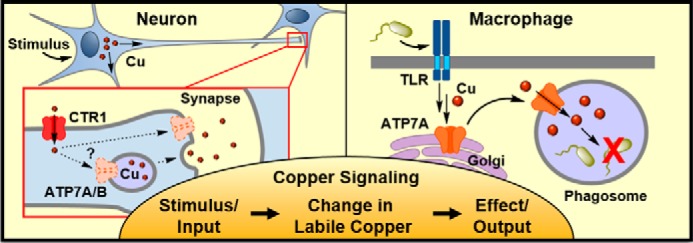
Figure 1.
Figure 1.
Observations of copper signaling in mammalian biology. Left (Neuron), upon depolarization, copper relocalizes from the cell body to dendrites. Copper can be released from neurons by an unknown process requiring ATP7A. Copper transporter 1 (CTR1) is an essential copper import channel for copper cycling in neurons. Right (Macrophage), upon stimulation of Toll-like receptors (TLRs), the copper exporter ATP7A moves from the Golgi to the phagosome in a copper-dependent manner. ATP7A pumps copper into the phagosome, leading to microbial death or requiring microbes to adapt to high copper conditions.
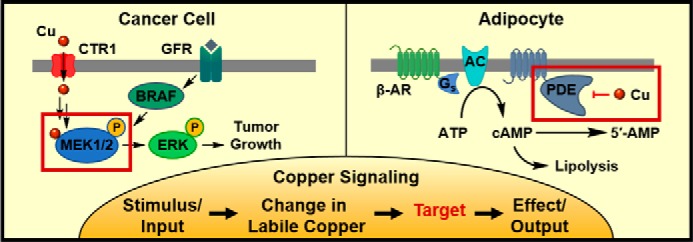
Figure 2.
Figure 2.
Copper-signaling pathways and molecular targets in mammalian biology. Left (Cancer Cell), stimulation of growth factor receptors (GFRs) or mutations in proto-oncogene protein B-Raf (BRAF) cause activation of the MAPK pathway, leading to phosphorylation of mitogen-activated protein kinase kinase (MAP2K1/2 or MEK1/2). MEK1/2 activation requires direct binding of cellular copper, which is supplied through the copper importer CTR1. Fully activated MEK1/2 phosphorylates MAPK or ERK, leading to tumor growth. Right (Adipocyte), activation of the β-adrenergic receptor (β-AR) causes recruitment of a G-protein (Gs) and activation of adenylyl cyclase (AC). Adenylyl cyclase converts adenosine triphosphate (ATP) to cyclic-adenosine monophosphate (cAMP), which activates downstream pathways leading to lipolysis. The pathway is shut down when cAMP is hydrolyzed by phosphodiesterase 3B (PDE). However, direct binding of copper to phosphodiesterase inhibits cAMP hydrolysis and maintains activation of the lipolysis pathway.

References

    1. Lippard S. J., and Berg J. M. (1994) Principles of Bioinorganic Chemistry, University Science Books, Mill Valley, CA
    1. Yruela I. (2013) Transition metals in plant photosynthesis. Metallomics 5, 1090–1109 10.1039/c3mt00086a - DOI - PubMed
    1. Chang C. J. (2015) Searching for harmony in transition-metal signaling. Nat. Chem. Biol. 11, 744–747 10.1038/nchembio.1913 - DOI - PubMed
    1. Kim B.-E., Nevitt T., and Thiele D. J. (2008) Mechanisms for copper acquisition, distribution and regulation. Nat. Chem. Biol. 4, 176–185 10.1038/nchembio.72 - DOI - PubMed
    1. Lee J., Petris M. J., and Thiele D. J. (2002) Characterization of mouse embryonic cells deficient in the Ctr1 high affinity copper transporter. J. Biol. Chem. 277, 40253–40259 10.1074/jbc.M208002200 - DOI - PubMed

Publication types