Monitoring disease progression with plasma creatinine in amyotrophic lateral sclerosis clinical trials
- PMID: 29084868
- PMCID: PMC5800333
- DOI: 10.1136/jnnp-2017-317077
Monitoring disease progression with plasma creatinine in amyotrophic lateral sclerosis clinical trials
Abstract
Objectives: Plasma creatinine is a predictor of survival in amyotrophic lateral sclerosis (ALS). It remains, however, to be established whether it can monitor disease progression and serve as surrogate endpoint in clinical trials.
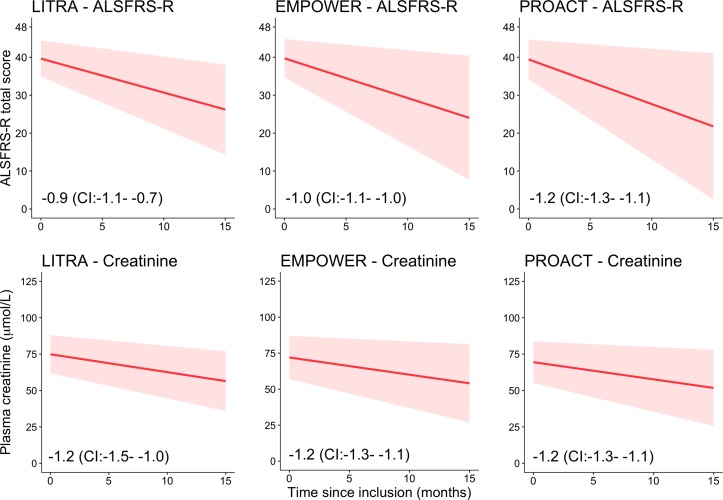
Methods: We used clinical trial data from three cohorts of clinical trial participants in the LITRA, EMPOWER and PROACT studies. Longitudinal associations between functional decline, muscle strength and survival with plasma creatinine were assessed. Results were translated to trial design in terms of sample size and power.
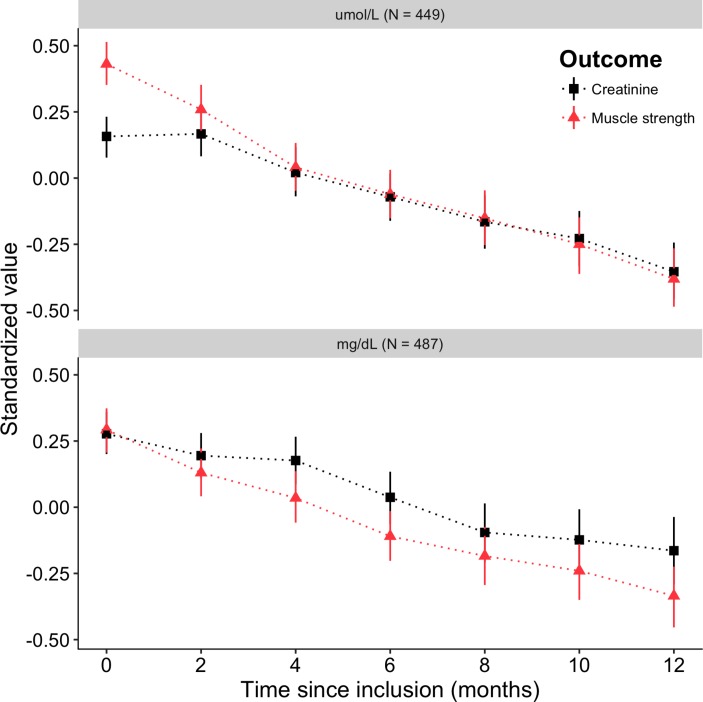
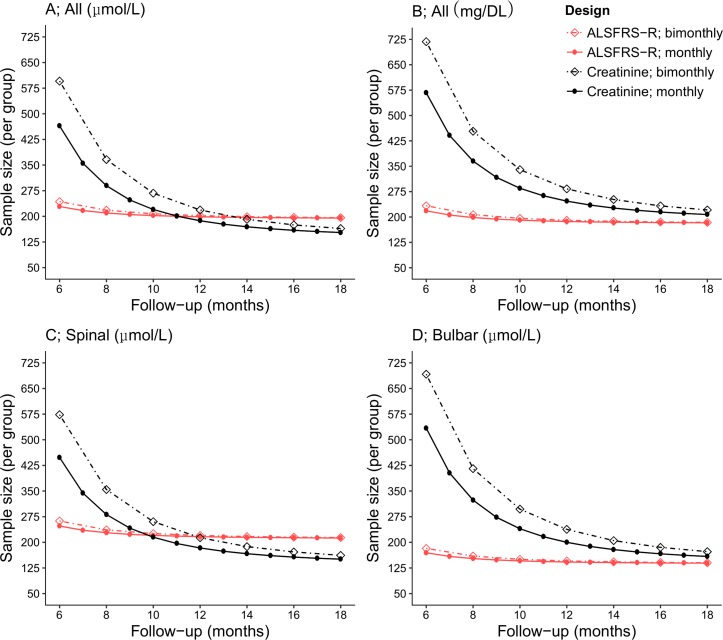
Results: A total of 13 564 measurements were obtained for 1241 patients. The variability between patients in rate of decline was lower in plasma creatinine than in ALS functional rating scale-Revised (ALSFRS-R; p<0.001). The average rate of decline was faster in the ALSFRS-R, with less between-patient variability at baseline (p<0.001). Plasma creatinine had strong longitudinal correlations with the ALSFRS-R (0.43 (0.39-0.46), p<0.001), muscle strength (0.55 (0.51-0.58), p<0.001) and overall mortality (HR 0.88 (0.86-0.91, p<0.001)). Using plasma creatinine as outcome could reduce the sample size in trials by 21.5% at 18 months. For trials up to 10 months, the ALSFRS-R required a lower sample size.
Conclusions: Plasma creatinine is an inexpensive and easily accessible biomarker that exhibits less variability between patients with ALS over time and is predictive for the patient's functional status, muscle strength and mortality risk. Plasma creatinine may, therefore, increase the power to detect treatment effects and could be incorporated in future ALS clinical trials as potential surrogate outcome.
Keywords: amyotrophic lateral sclerosis; clinical trials; disease progression; plasma creatinine.
© Article author(s) (or their employer(s) unless otherwise stated in the text of the article) 2018. All rights reserved. No commercial use is permitted unless otherwise expressly granted.
Conflict of interest statement
Competing interests: None declared.
Figures
Comment in
-
Plasma creatinine: a potential prognostic biomarker in amyotrophic lateral sclerosis?J Neurol Neurosurg Psychiatry. 2018 Feb;89(2):119. doi: 10.1136/jnnp-2017-317413. Epub 2017 Nov 15. J Neurol Neurosurg Psychiatry. 2018. PMID: 29142144 No abstract available.
References
-
- Bacci ED, Staniewska D, Coyne KS, et al. Item response theory analysis of the amyotrophic lateral sclerosis ffunctional rating scale-revised in the pooled resource open-access ALS clinical trials database. Amyotroph Lateral Scler Frontotemporal Degener 2016;17:157–67. 10.3109/21678421.2015.1095930 - DOI - PubMed
-
- Biomarkers definitions working G. Biomarkers and surrogate endpoints: preferred definitions and conceptual framework. Clin Pharmacol Ther 2001;69:89–95. - PubMed
MeSH terms
Substances
LinkOut - more resources
Full Text Sources
Other Literature Sources
Medical
Miscellaneous