. 2017 Oct 30;7(1):14330.
doi: 10.1038/s41598-017-14569-5.

Co-Culture of Plant Beneficial Microbes as Source of Bioactive Metabolites

Affiliations

Co-Culture of Plant Beneficial Microbes as Source of Bioactive Metabolites

F Vinale et al. Sci Rep. .

Abstract

In microbial cultures the production of secondary metabolites is affected by experimental conditions, and the discovery of novel compounds is often prevented by the re-isolation of known metabolites. To limit this, it is possible to cultivate microorganisms by simulating naturally occurring interactions, where microbes co-exist in complex communities. In this work, co-culturing experiments of the biocontrol agent Trichoderma harzianum M10 and the endophyte Talaromyces pinophilus F36CF have been performed to elicit the expression of genes which are not transcribed in standard laboratory assays. Metabolomic analysis revealed that the co-culture induced the accumulation of siderophores for both fungi, while production of M10 harzianic and iso-harzianic acids was not affected by F36CF. Conversely, metabolites of the latter strain, 3-O-methylfunicone and herquline B, were less abundant when M10 was present. A novel compound, hereby named harziaphilic acid, was isolated from fungal co-cultures, and fully characterized. Moreover, harzianic and harziaphilic acids did not affect viability of colorectal cancer and healthy colonic epithelial cells, but selectively reduced cancer cell proliferation. Our results demonstrated that the co-cultivation of plant beneficial fungi may represent an effective strategy to modulate the production of bioactive metabolites and possibly identify novel compounds.


Conflict of interest statement

The authors declare that they have no competing interests.

Figures
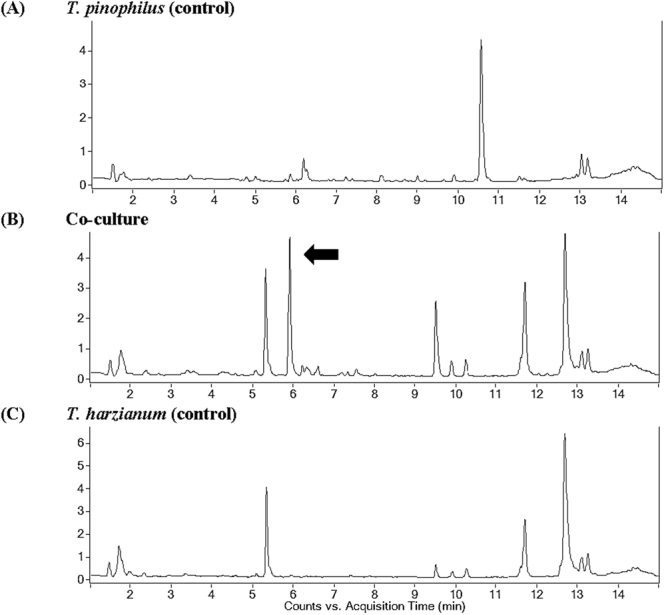
Figure 1
Figure 1
Total Ion Chromatogram (TIC) in positive ion mode (m/z 100–1700 uma) of the culture filtrate of: (A) T. pinophilus (top); (B) co-culture (middle); (C) T. harzianum (bottom). The black arrow indicates the new peak observed only in the co-culture.
Figure 2
Figure 2
Chemical structures of 3-O-methylfunicone (1), herquline B (2), ferrirubin (3), ferricrocin (4), coprogen B (5), dimerumic acid (6), harzianic acid (7), iso-harzianic acid (8), the new metabolite named harziaphilic acid (9) and trichoharzin (10).
Figure 3
Figure 3
The minimum energy conformer of compound 9 as determined by quantum mechanical calculations. Arrows represent the most significant correlations detected in the NOESY spectrum.
Figure 4
Figure 4
Hemiacetals equilibrium of harziaphilic acid (9) and deuterium exchanges obtained after 3 days in CD3OD.
Figure 5
Figure 5
Production of harziaphilic acid during the M10–TP1 co-culture, from 0 to 30 days. The amount of harziaphilic acid is expressed as peak area of the corresponding compound. Bars indicate standard deviation.
Figure 6
Figure 6
Effect of harzianic acid (0.1–10 μM, 24-h exposure, (A) iso-harzianic acid (0.1–10 μM, 24-h exposure, (B) and harziaphilic acid (0.1–10 μM, 24-h exposure, (C) on Caco-2 cells proliferation. Proliferation rate (expressed as percentage) was studied using the 3H-thymidine incorporation assay. Each bar represents the mean ± standard errors mean of three independent experiments. **p < 0.01 and ***p < 0.001 vs. control.
Figure 7
Figure 7
Effect of harzianic acid (0.1–10 μM, 24-h exposure, (A) and harziaphilic acid (0.1–10 μM, 24-h exposure, (B) on cells proliferation performed on healthy human colonic epithelial cells (HCEC). Proliferation rate (expressed as percentage) was studied using the 3H-thymidine incorporation assay. Each bar represents the mean ± standard errors mean of three independent experiments.

References

    1. Harvey AL, Edrada-Ebel R, Quinn RJ. The re-emergence of natural products for drug discovery in the genomics era. Nat Rev Drug Discov. 2015;14:111–129. doi: 10.1038/nrd4510. - DOI - PubMed
    1. Newman DJ, Cragg GM. Natural products as sources of new drugs over the 30 years from 1981 to 2010. J Nat Prod. 2012;75:311–335. doi: 10.1021/np200906s. - DOI - PMC - PubMed
    1. Marmann A, Aly AH, Lin W, Wang B, Proksch P. Co-cultivation - A powerful emerging tool for enhancing the chemical diversity of microorganisms. Mar Drugs. 2014;12:1043–1065. doi: 10.3390/md12021043. - DOI - PMC - PubMed
    1. Rutledge PJ, Challis GL. Discovery of microbial natural products by activation of silent biosynthetic gene clusters. Nat Rev Microbiol. 2015;13:509–523. doi: 10.1038/nrmicro3496. - DOI - PubMed
    1. Wu C, et al. H. Expanding the chemical space for natural products by Aspergillus-Streptomyces co-cultivation and biotransformation. Sci Rep. 2015;5:10868. doi: 10.1038/srep10868. - DOI - PMC - PubMed

Publication types
