doi: 10.1523/ENEURO.0295-17.2017.
eCollection 2017 Sep-Oct.
An Emerging Field of Primate Social Neurophysiology: Current Developments
Affiliations
- PMID: 29085898
- PMCID: PMC5659241
- DOI: 10.1523/ENEURO.0295-17.2017
Item in Clipboard
An Emerging Field of Primate Social Neurophysiology: Current Developments
eNeuro.
.
Abstract
Recently, there has been increased interest in investigating neurophysiological mechanisms underlying social interactions using a nonhuman primate model system. Several studies in this subfield, known as primate social neurophysiology, have begun to provide novel insights into how single neurons encode socially-relevant variables. This opinion piece intends to provide insight into the state of this field. In doing so, it discusses some common principles learned from primate social neurophysiology experiments.
Keywords: agency; allocentric representation; egocentric representation; nonhuman primates; social neurophysiology.
Figures
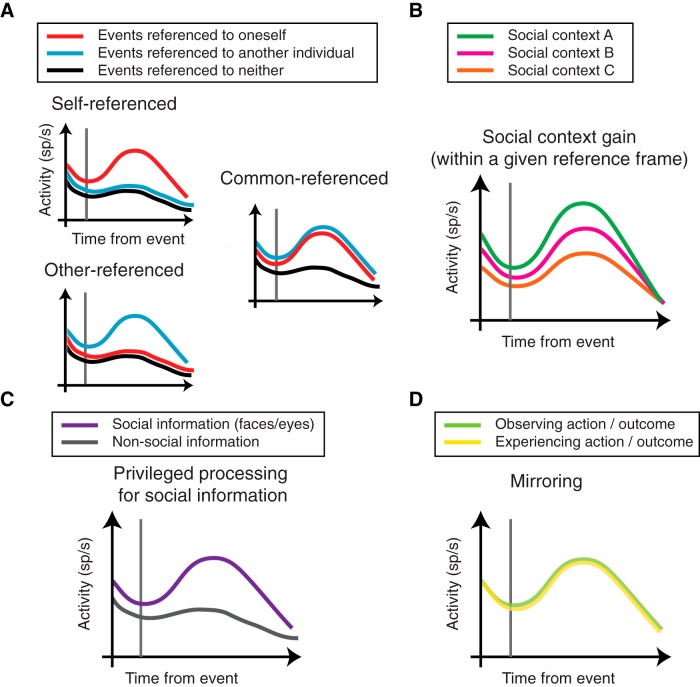
Schematic illustrations of the main neuronal principles discovered from primate social neurophysiology research. A, Illustrations of three different neurons encoding task events in referenced to self (self-referenced), another individual (other-referenced), or both (common-referenced). B, An illustration of a neuron whose activity is gain-modulated by different social contexts within a given reference frame. C, An illustration of a neuron whose activity is specifically gated by particular social information, such as face and eyes. D, An illustration of mirroring in a neuron with comparable firing rate profiles for experienced and observed actions and/or outcomes. Refer to the main texts for the empirical sources for these encoding schemes during social interactions.
References
Publication types
MeSH terms
Grants and funding
LinkOut - more resources
Full Text Sources
Other Literature Sources