


Postoperative cognitive dysfunction and mortality following lung transplantation
- PMID: 29087035
- PMCID: PMC5820215
- DOI: 10.1111/ajt.14570
Postoperative cognitive dysfunction and mortality following lung transplantation
Abstract
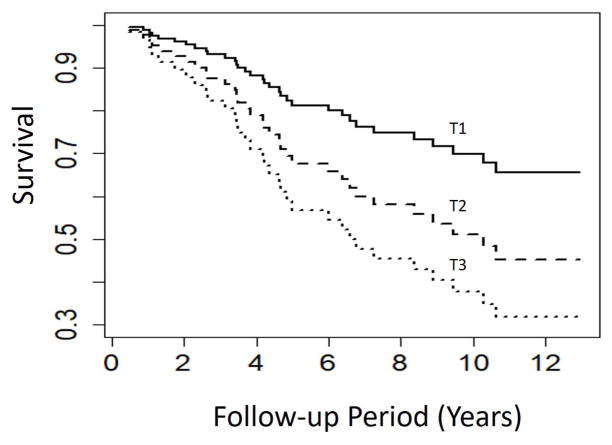
Preliminary evidence suggests that postoperative cognitive dysfunction (POCD) is common after lung transplantation. The impact of POCD on clinical outcomes has yet to be studied. The association between POCD and longer-term survival was therefore examined in a pilot study of posttransplantation survivors. Forty-nine participants from a prior randomized clinical trial underwent a neurocognitive assessment battery pretransplantation and 6 months posttransplantation, including assessments of the domains of Executive Function (Trail Making Test, Stroop, Digit Span), Processing Speed (Ruff 2 and 7 Test, Digit Symbol Substitution Test), and Verbal Memory (Verbal Paired Associates, Logical Memory, Animal Naming, and Controlled Oral Word Association Test). During a 13-year follow-up, 33 (67%) participants died. Greater neurocognition was associated with longer survival (hazard ratio [HR] = 0.49 [0.25-0.96], P = .039), and this association was strongest on tests assessing Processing Speed (HR = 0.58 [0.36-0.95], P = .03) and Executive Function (HR = 0.52 [0.28-0.97], P = .040). In addition, unadjusted analyses suggested an association between greater Memory performance and lower risk of CLAD (HR = 0.54 [0.29-1.00], P = .050). Declines in Executive Function tended to be predictive of worse survival. These preliminary findings suggest that postoperative neurocognition is predictive of subsequent mortality among lung transplant recipients. Further research is needed to confirm these findings in a larger sample and to examine mechanisms responsible for this relationship.
Keywords: allied health/nursing; clinical research/practice; lung disease; transplant social worker.
© 2017 The American Society of Transplantation and the American Society of Transplant Surgeons.
Conflict of interest statement
The authors of this manuscript have no conflicts of interest to disclose as described by the American Journal of Transplantation.
Figures
References
-
- Yusen RD, Edwards LB, Kucheryavaya AY, et al. The Registry of the International Society for Heart and Lung Transplantation: Thirty-first Adult Lung and Heart-Lung Transplant Report-2014; Focus Theme: Retransplantation. J Heart Lung Transpl. 2014;33(10):1009–1024. - PubMed
-
- Singer LG, Chowdhury NA, Faughnan ME, et al. Effects of Recipient Age and Diagnosis on Health-related Quality-of-Life Benefit of Lung Transplantation. Am J Resp Crit Care. 2015;192(8):965–973. - PubMed
-
- Kniepeiss D, Wagner D, Pienaar S, et al. Solid organ transplantation: technical progress meets human dignity: a review of the literature considering elderly patients’ health related quality of life following transplantation. Ageing Res Rev. 2012;11(1):181–187. - PubMed
Publication types
MeSH terms
Grants and funding
LinkOut - more resources
Full Text Sources
Other Literature Sources
Medical
