. 2017 Dec 5;114(49):13030-13035.
doi: 10.1073/pnas.1709119114. Epub 2017 Oct 27.

Coexpression of NOS2 and COX2 accelerates tumor growth and reduces survival in estrogen receptor-negative breast cancer

Affiliations

Coexpression of NOS2 and COX2 accelerates tumor growth and reduces survival in estrogen receptor-negative breast cancer

Debashree Basudhar et al. Proc Natl Acad Sci U S A. .

Abstract

Proinflammatory signaling pathways are commonly up-regulated in breast cancer. In estrogen receptor-negative (ER-) and triple-negative breast cancer (TNBC), nitric oxide synthase-2 (NOS2) and cyclooxygenase-2 (COX2) have been described as independent predictors of disease outcome. We further explore these findings by investigating the impact of their coexpression on breast cancer survival. Elevated coexpression of NOS2/COX2 proteins is a strong predictor of poor survival among ER- patients (hazard ratio: 21). Furthermore, we found that the key products of NOS2 and COX2, NO and prostaglandin E2 (PGE2), respectively, promote feed-forward NOS2/COX2 crosstalk in both MDA-MB-468 (basal-like) and MDA-MB-231 (mesenchymal-like) TNBC cell lines in which NO induced COX2 and PGE2 induced NOS2 proteins. COX2 induction by NO involved TRAF2 activation that occurred in a TNFα-dependent manner in MDA-MB-468 cells. In contrast, NO-mediated TRAF2 activation in the more aggressive MDA-MB-231 cells was TNFα independent but involved the endoplasmic reticulum stress response. Inhibition of NOS2 and COX2 using amino-guanidine and aspirin/indomethacin yielded an additive reduction in the growth of MDA-MB-231 tumor xenografts. These findings support a role of NOS2/COX2 crosstalk during disease progression of aggressive cancer phenotypes and offer insight into therapeutic applications for better survival of patients with ER- and TNBC disease.

Keywords: COX2; NOS2; PGE2; breast cancer; nitric oxide.


Conflict of interest statement

The authors declare no conflict of interest.

Figures
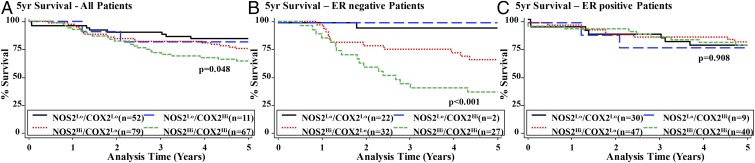
Fig. 1.
Fig. 1.
Association between COX2 and NOS2 expression and breast cancer survival by ER status. (A) Kaplan–Meier cumulative breast cancer-specific 5-y survival curves of all breast cancer patients by COX2 and NOS2 status (n = 209); log-rank test: P = 0.048. (B) Kaplan–Meier cumulative breast cancer-specific 5-y survival curves of ER patients by COX2 and NOS2 status (n = 83); log-rank test: P < 0.001. (C) Kaplan–Meier cumulative breast cancer-specific 5-y survival curves of ER+ patients by COX2 and NOS2 status (n = 126); log-rank test: P = 0.908.
Fig. 2.
Fig. 2.
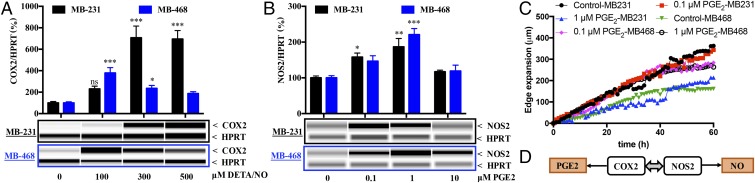
DETA/NO and PGE2 regulate COX2 and NOS2, respectively. MB-231 and MB-468 cells were treated for 24 h with different doses of (A) DETA/NO to determine effect on COX2 protein levels; or (B) PGE2 to determine effect on NOS2 protein levels. In A and B, error bars show SEM; *P < 0.05, **P < 0.01, ***P < 0.001; n ≥ 3; one-way ANOVA. (C) The effect of PGE2 on the migration of MB-468 and MB-231 cells. (D) Summary of data.
Fig. 3.
Fig. 3.
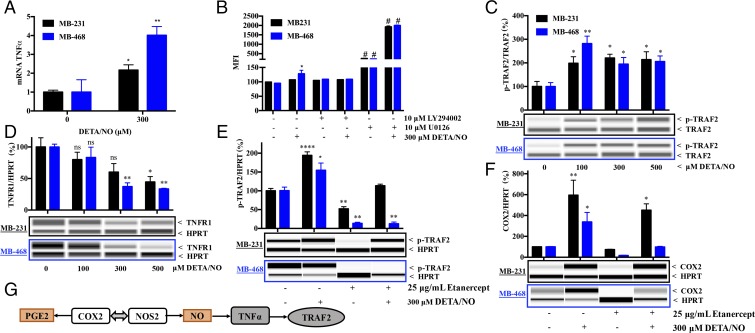
NO-mediated signaling of COX2 is TNFα dependent. (A) TNFα mRNA levels induced in MB-231 and MB-468 cells by 300 μM DETA/NO. (B) Change in surface TNFα in MB-231 and MB-468 cells with 300 μM DETA/NO with or without the MEK inhibitor U0126 and the PI3K inhibitor LY294002. (CF) The effect in MB-231 and MB-468 cells of NO on pTRAF2 (C) and TNFR1 (D) levels and on pTRAF2 (E) and COX2 (F) levels in the presence and absence of the TNFα antagonist etanercept. Error bars show SEM; ns, not significant; *P < 0.05, **P < 0.01, ***P < 0.001, ****P < 0.0001, and #P < 0.0001; n ≥ 3; one-way ANOVA. (G) Summary of data.
Fig. 4.
Fig. 4.
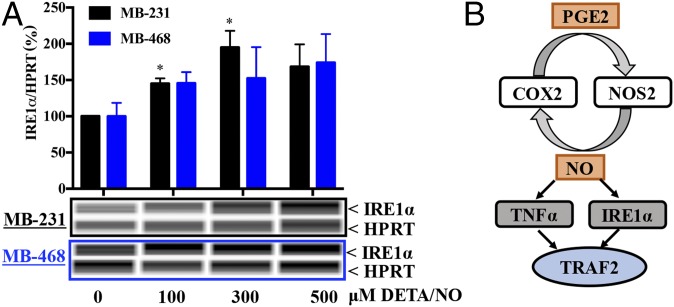
The NO-mediated increase in pTRAF2 is mediated by ERS in the MB-231 cell line. (A) Cells were treated with different doses of DETA/NO, and IRE1α protein was measured in MB-231 and MB-468 cells. Error bars indicate SEM; *P < 0.05; n ≥ 3; one-way ANOVA. (B) Summary of data.
Fig. 5.
Fig. 5.
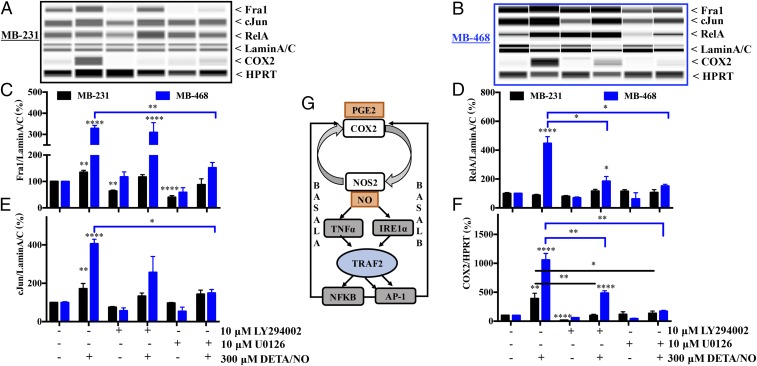
NO-induced COX2 signaling is mediated by the PI3K and MEK pathways. (AF) The expression of Fra1, cJun, and RelA proteins in the nucleus and COX2 expression in whole-cell lysate was measured after 24 h treatment with 300 μM DETA/NO alone or in the presence of 10 μM LY294002 or U0126 in MB-231 cells (A) and MB-468 cells (B), and their levels after 24 h of treatment were quantified (CF). Error bars show SEM; *P < 0.05, **P < 0.01, ***P < 0.001, ****P < 0.0001; n ≥ 3; one-way ANOVA. (G) Summary of data.
Fig. 6.
Fig. 6.
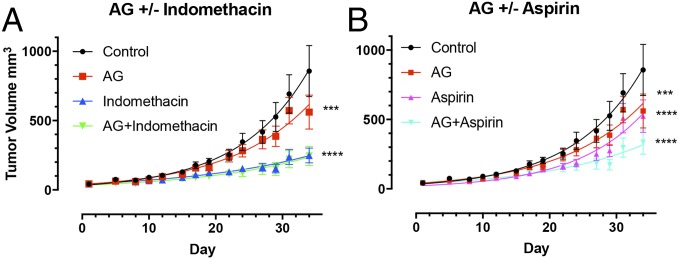
NOS2/COX2 promotes tumor progression. Inhibition of NOS2 and COX2 in MB-231 xenograft model using AG and (A) indomethacin and (B) aspirin, respectively. Error bars show SEM; ***P < 0.001, ****P < 0.0001; two-way ANOVA, n ≥ 3.
Fig. 7.
Fig. 7.
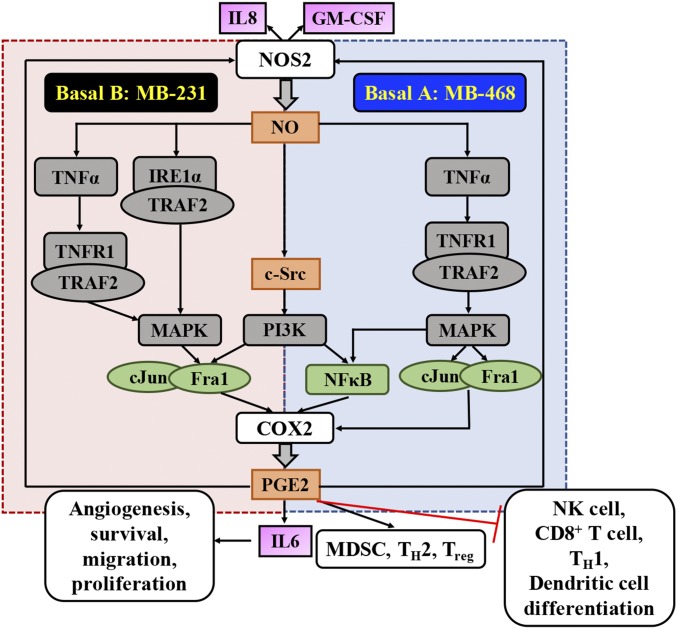
Summary of NOS2/COX2 crosstalk in ER breast cancer.

Comment in

  • NO and COX2: Dual targeting for aggressive cancers.
    Davila-Gonzalez D, Chang JC, Billiar TR. Davila-Gonzalez D, et al. Proc Natl Acad Sci U S A. 2017 Dec 26;114(52):13591-13593. doi: 10.1073/pnas.1717440114. Epub 2017 Dec 13. Proc Natl Acad Sci U S A. 2017. PMID: 29237749 Free PMC article. No abstract available.

References

    1. Grivennikov SI, Greten FR, Karin M. Immunity, inflammation, and cancer. Cell. 2010;140:883–899. - PMC - PubMed
    1. DeNardo DG, Coussens LM. Inflammation and breast cancer. Balancing immune response: Crosstalk between adaptive and innate immune cells during breast cancer progression. Breast Cancer Res. 2007;9:212. - PMC - PubMed
    1. Coussens LM, Werb Z. Inflammation and cancer. Nature. 2002;420:860–867. - PMC - PubMed
    1. Glynn SA, et al. Increased NOS2 predicts poor survival in estrogen receptor-negative breast cancer patients. J Clin Invest. 2010;120:3843–3854. - PMC - PubMed
    1. Granados-Principal S, et al. Inhibition of iNOS as a novel effective targeted therapy against triple-negative breast cancer. Breast Cancer Res. 2015;17:25. - PMC - PubMed

Publication types

MeSH terms