. 2017 Nov 14;114(46):E9999-E10008.
doi: 10.1073/pnas.1714380114. Epub 2017 Oct 30.

Genome diversity of tuber-bearing Solanum uncovers complex evolutionary history and targets of domestication in the cultivated potato

Affiliations

Genome diversity of tuber-bearing Solanum uncovers complex evolutionary history and targets of domestication in the cultivated potato

Michael A Hardigan et al. Proc Natl Acad Sci U S A. .

Abstract

Cultivated potatoes (Solanum tuberosum L.), domesticated from wild Solanum species native to the Andes of southern Peru, possess a diverse gene pool representing more than 100 tuber-bearing relatives (Solanum section Petota). A diversity panel of wild species, landraces, and cultivars was sequenced to assess genetic variation within tuber-bearing Solanum and the impact of domestication on genome diversity and identify key loci selected for cultivation in North and South America. Sequence diversity of diploid and tetraploid Stuberosum exceeded any crop resequencing study to date, in part due to expanded wild introgressions following polyploidy that captured alleles outside of their geographic origin. We identified 2,622 genes as under selection, with only 14-16% shared by North American and Andean cultivars, showing that a limited gene set drove early improvement of cultivated potato, while adaptation of upland (Stuberosum group Andigena) and lowland (S. tuberosum groups Chilotanum and Tuberosum) populations targeted distinct loci. Signatures of selection were uncovered in genes controlling carbohydrate metabolism, glycoalkaloid biosynthesis, the shikimate pathway, the cell cycle, and circadian rhythm. Reduced sexual fertility that accompanied the shift to asexual reproduction in cultivars was reflected by signatures of selection in genes regulating pollen development/gametogenesis. Exploration of haplotype diversity at potato's maturity locus (StCDF1) revealed introgression of truncated alleles from wild species, particularly Smicrodontum in long-day-adapted cultivars. This study uncovers a historic role of wild Solanum species in the diversification of long-day-adapted tetraploid potatoes, showing that extant natural populations represent an essential source of untapped adaptive potential.

Keywords: adaptation; diversity; domestication; introgression; potato.


Conflict of interest statement

The authors declare no conflict of interest.

Figures

Fig. 1.
Fig. 1.
(A) Phenotypic diversity within wild species, cultivated landraces, and cultivars through domestication, improvement, and modern breeding efforts. Exemplar species, landraces, and elite North American cultivars are shown that highlight tuber size, shape, and pigmentation diversity. (B) Phylogeny and population structure of the samples in the domestication panel. The phylogenetic tree is based Nei’s genetic distances calculated from 687,172 fourfold-degenerate sites from conserved potato genes. Population structure is based on 50,000 genome-wide SNPs. The optimal number of subpopulations (K = 5) included wild outgroups (purple), wild Solanum relatives (green), a wild subgroup diverging from the cultivated lineage after most other species (gold), Andean landraces (teal), and S. tuberosum group Tuberosum (navy).
Fig. 2.
Fig. 2.
Genome diversity in tuber-bearing Solanum species. (A) Fraction of annotated potato genes affected by duplication (blue), heterozygous deletion (light red), or homozygous deletion (red) across landraces, cultivars, tuber-bearing wild-species relatives, and outgroups (OG). (B) Heatmap of gene conservation across tuber-bearing Solanum genotypes on chromosome 9. Genes are ordered along the chromosome y axis, and the x axis contains samples organized into panels (separated by thin black lines) containing (Left to Right) 20 landraces, 23 cultivars, 20 tuber-bearing wild species relatives, and four outgroups. (C) Comparison of nucleotide diversity (π) in domesticated germplasm (cultivars diploid landraces, and tetraploid landraces) and wild relatives for major crop species. Color-coding is shown in the key. Species diversity estimates were obtained from existing resequencing studies: cucumber (35), tomato (35), watermelon (31), rice (32), maize (33), and soybean (34). (D) Heterozygous nucleotide frequency within potato outgroups, wild species relatives, diploid landraces, tetraploid landraces, and cultivars.
Fig. 3.
Fig. 3.
Wild Solanum species introgressions in cultivated potato. (A) Fraction of assessed genome sequences (5-kb windows) with introgressions from individual wild species in diploid landraces, tetraploid landraces, and cultivars. (B) Map of wild species introgressions on potato chromosome 11 for diploid landraces, tetraploid landraces, and cultivars. Color codes for species introgressions are blue, ambiguous/multiple taxa; red, S. microdontum; green, S. candolleanum; orange, Solanum sparsipilum; purple, S. leptophyes; pink, S. raphanifolium; gold, S. brevicaule; brown, S. medians; navy, S. chacoense; dark red, S. berthaultii; and light green, Solanum infundibuliforme. All 12 chromosomes, including names of accessions, can be seen in Fig. S6.
Fig. 4.
Fig. 4.
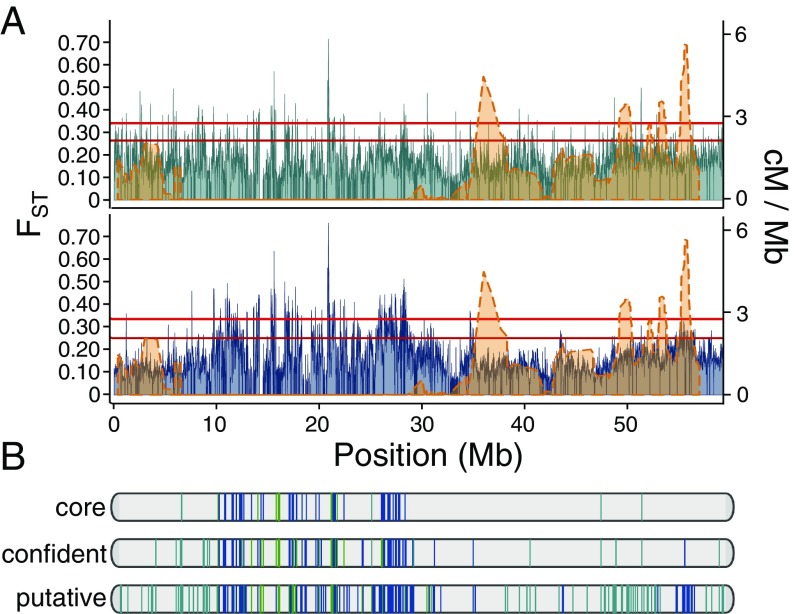
Genome-wide selection signatures on potato chromosome 6. (A) Chromosome-wide FST estimates (left axis) from 20-kb sliding window analysis (5-kb step size) comparing Andean landraces (teal) and S. tuberosum group Tuberosum (navy) to wild Solanum; plotted with chromosomal recombination rate in centimorgan/Mb (orange; right axis) based on a diploid biparental population (111). Red lines indicate top 1% and 5% cutoffs for FST window estimates. (B) Locations of genes under putative, confident, and core selective pressure in Andean landraces (teal), S. tuberosum group Tuberosum (navy), or both groups (domestication candidates; green).
Fig. 5.
Fig. 5.
Circadian rhythms and pollen development phenotypes in wild species, landraces, and cultivars of potato. (A) Example of delayed fluorescence (DF) traces of one potato wild species and landrace. Data are from one representative experiment; values are the average ± SEM of five (wild) or six (landrace) plants. (B) Circadian period length and latitude of origin of potato populations. The origin of modern cultivated lines was determined as the location in which the line was initially bred. Circadian rhythms were measured using delayed fluorescence. Values are the average ± SEM of 2–11 plants from at least two independent experiments. (C) Simplified model of the photoperiod control of tuberization in potato. Elements in white display signatures of selection. Black lines represent transcriptional regulation; blue lines represent posttranslational regulation. (DG) Pollen grains stained with actetocarmine of S. infundibuliforme PI 472894 at 10× (D) and 40× (E) magnification and S. tuberosum group Tuberosum cv Superior at 10× (F) and 40× (G) magnification; viable pollen grains stain red, and nonviable pollen grains are unstained.
Fig. 6.
Fig. 6.
Selection impacts within the glycoalkaloid biosynthetic pathway. Plant mevalonate pathway [modified from figure 1 in Ginzberg et al. (69) with permission from Springer] with branches into terpenoid, lanosterol, steroidal glycoalkaloid (SGA-specific pathway shaded in red), brassinosteroid, and phytosterol biosynthesis. Red arrows show pathways directly regulated by SQS and GAME9. Blue arrows show pathways controlled indirectly via GAME9 regulation of enzymes guiding substrates into the SGA-specific pathway.

Comment in

  • Genome diversity of the potato.
    Huang B, Spooner DM, Liang Q. Huang B, et al. Proc Natl Acad Sci U S A. 2018 Jul 10;115(28):E6392-E6393. doi: 10.1073/pnas.1805917115. Epub 2018 Jun 22. Proc Natl Acad Sci U S A. 2018. PMID: 29934399 Free PMC article. No abstract available.
  • Reply to Huang et al.: Avoiding "one-size-fits-all" approaches to variant discovery.
    Hardigan MA, Laimbeer FPE, Hamilton JP, Vaillancourt B, Douches DS, Farré EM, Veilleux RE, Buell CR. Hardigan MA, et al. Proc Natl Acad Sci U S A. 2018 Jul 10;115(28):E6394-E6395. doi: 10.1073/pnas.1807622115. Epub 2018 Jun 22. Proc Natl Acad Sci U S A. 2018. PMID: 29934402 Free PMC article. No abstract available.

References

    1. Spooner DM, McLean K, Ramsay G, Waugh R, Bryan GJ. A single domestication for potato based on multilocus amplified fragment length polymorphism genotyping. Proc Natl Acad Sci USA. 2005;102:14694–14699. - PMC - PubMed
    1. Brush SB, Carney HJ, Humán Z. Dynamics of Andean potato agriculture. Econ Bot. 1981;35:70–88.
    1. Pearsall DM. Plant domestication and the shift to agriculture in the Andes. In: Silverman H, Isbell WH, editors. The Handbook of South American Archaeology. Springer; New York: 2008. pp. 105–120.
    1. Hosaka K. Evolutionary pathway of T-type chloroplast DNA in potato. Am J Potato Res. 2004;81:153–158.
    1. Raker CM, Spooner DM. Chilean tetraploid cultivated potato is distinct from the Andean populations. Crop Sci. 2002;42:1451–1458.

MeSH terms