


Secondary stressors are associated with probable psychological morbidity after flooding: a cross-sectional analysis
- PMID: 29087460
- PMCID: PMC5881756
- DOI: 10.1093/eurpub/ckx182
Secondary stressors are associated with probable psychological morbidity after flooding: a cross-sectional analysis
Abstract
Background: The impact of flooding on mental health is exacerbated due to secondary stressors, although the mechanism of action is not understood. We investigated the role of secondary stressors on psychological outcomes through analysis of data collected one-year after flooding, and effect modification by sex.
Methods: We analysed data from the English National Study on Flooding and Health collected from households flooded, disrupted and unexposed to flooding during 2013-14. Psychological outcomes were probable depression, anxiety and post-traumatic stress disorder (PTSD). Parsimonious multivariable logistic regression models were fitted to determine the effect of secondary stressors on the psychological outcomes. Sex was tested as an effect modifier using subgroup analyses.
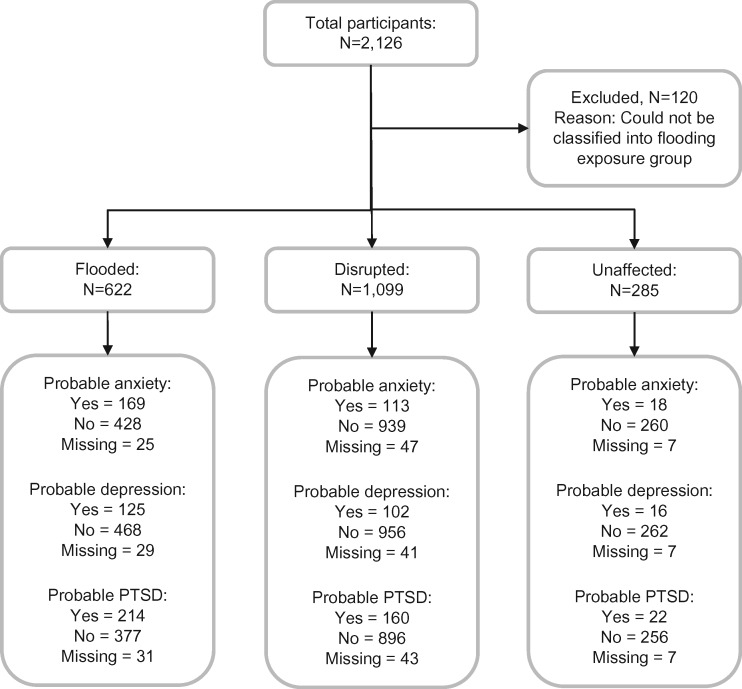
Results: A total of 2006 people participated (55.5% women, mean age 60 years old). Participants reporting concerns about their personal health and that of their family (concerns about health) had greater odds of probable depression (adjusted odds ratio [aOR] 1.77, 95% CI 1.17-2.65) and PTSD (aOR 2.58, 95% CI 1.82-3.66). Loss of items of sentimental value was associated with probable anxiety (aOR 1.82, 95% CI 1.26-2.62). For women, the strongest associations were between concerns about health and probable PTSD (aOR 2.86, 95% CI 1.79-4.57). For men, the strongest associations were between 'relationship problems' and probable depression (aOR 3.25, 95% CI 1.54-6.85).
Conclusions: Concerns about health, problems with relationships and loss of sentimental items were consistently associated with poor psychological outcomes. Interventions to reduce the occurrence of these secondary stressors are needed to mitigate the impact of flooding on probable psychological morbidity.
© The Author 2017. Published by Oxford University Press on behalf of the European Public Health Association.
References
-
- Centre for Research on the Epidemiology of Disasters (CRED) and United Nations Office for Disasters Risk Reduction (UNISDR). The Human Cost of Weather Related Disasters 1995-2015;2015.
-
- Smith KR, Woodward A, Campbell-Lendrum D, Chadee D, et al. Human health: impacts, adaptation, and co-benefits In: Climate Change 2014: Impacts, Adaptation, and Vulnerability Part A: Global and Sectoral Aspects Contribution of Working Group II to the Fifth Assessment Report of the Intergovernmental Panel on Climate Change. Cambridge: Cambridge University Press, 2014;709–54.
-
- Kovats RS, Valentini R, Bouwer LM, et al. Europe In: Climate Change 2014: Impacts, Adaptation, and Vulnerability Part B: Regional Aspects Contribution of Working Group II to the Fifth Assessment Report of the Intergovernmental Panel on Climate Change. Cambridge: Cambridge University Press, 2014;1267–326.
-
- EM-DAT. Disaster Profiles [Internet]. The International Disaster Database. 2016http://www.emdat.be/database (21 September 2016, date last acessed).
-
- Menne B, Murray V Floods in the WHO European region: health effects and their prevention. Copenhagen; 2013. http://www.euro.who.int/en/health-topics/environment-and-health/Climate-....
Publication types
MeSH terms
LinkOut - more resources
Full Text Sources
Other Literature Sources
Medical
