. 2017 Oct 31;9(4):0.
doi: 10.1080/19490976.2017.1398871. Online ahead of print.

Enterotoxigenic Escherichia coli is phagocytosed by macrophages underlying villus-like intestinal epithelial cells: modeling ex vivo innate immune defenses of the human gut

Affiliations

Enterotoxigenic Escherichia coli is phagocytosed by macrophages underlying villus-like intestinal epithelial cells: modeling ex vivo innate immune defenses of the human gut

Gaelle Noel et al. Gut Microbes. .

Abstract

There is a paucity of information on diarrheagenic enterotoxigenic Escherichia coli (ETEC)'s interaction with innate immune cells, in part due to the lack of reliable models that recapitulate infection in human gut. In a recent publication, we described the development of an ex vivo enteroid-macrophage co-culture model using human primary cells. We reported that macrophages residing underneath the epithelial monolayer acquired "resident macrophage" phenotype characterized by lower production of inflammatory cytokines and strong phagocytic activity. These macrophages extended projections across the epithelium, which captured ETEC applied to the apical side of the epithelium and reduced luminal bacterial load. Additional evidence presented in this addendum confirms these findings and further demonstrates that macrophage adaptation occurs regardless of the stage of differentiation of epithelial cells, and that ETEC uptake arises rapidly after infection. The enteroid-macrophage co-culture represents a novel and relevant tool to study host-cell interactions and pathogenesis of enteric infections in humans.

Keywords: Enterotoxigenic E. coli; enteroid model; intestine; macrophages.


Figures
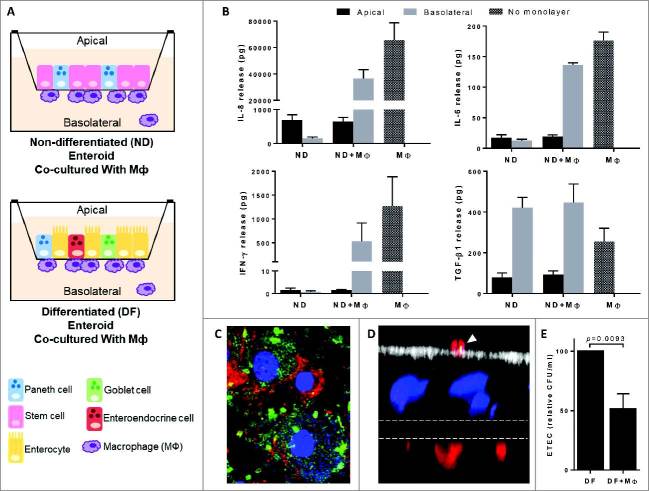
Figure 1.
Figure 1.
Sub-epithelial macrophages exhibited lower production of pro-inflammatory cytokines and high phagocytic activity. A) Schematic representation of enteroid-macrophages co-cultures established with non-differentiated (ND) and differentiated (DF) enteroid monolayers. B) IL-8, IL-6, IFN-γ, and TGF-β1 produced by ND enteroid-macrophage co-culture. Lower levels of IL-8, IL-6, and IFN-γ, but not TGF-β1, were produced by the ND enteroid-macrophage co-culture as compared to macrophages alone. Data correspond to mean ± SEM of multiple independent experiments; n = 6 for IL-8, n = 4 for TGF-β1, and n = 2 for IL-6 and IFN-γ. C) ETEC are phagocytosed by human macrophages following overnight infection. DNA (bacterium and macrophage DNA), blue; ETEC, green; CD14 (macrophages), red. D) Apical ETEC (yellow) phagocytosed by sub-epithelial macrophages extending dendrites across the epithelial cell monolayer. Actin (microvilli), white; nuclei, blue; ETEC, green; CD14 (macrophages), red; filter, dashed lines. E) ETEC CFU recovered from the apical compartment 30 min after infection was greatly reduced in the macrophage-enteroid co-culture as opposed to enteroid alone. Data represent mean ± SEM of N = 9 from 4 independent experiments. Methods and experimental conditions were the same as described in our previous publication.

Erratum for

References

    1. Qadri F, Svennerholm A-M, Faruque ASG, Sack RB. Enterotoxigenic Escherichia coli in Developing Countries: Epidemiology, Microbiology, Clinical Features, Treatment, and Prevention. Clinical Microbiology Reviews 2005; 18:465–83. - PMC - PubMed
    1. Croxen MA, Law RJ, Scholz R, Keeney KM, Wlodarska M, Finlay BB. Recent Advances in Understanding Enteric Pathogenic Escherichia coli. Clinical Microbiology Reviews 2013; 26:822–80. - PMC - PubMed
    1. Luo Q, Kumar P, Vickers TJ, Sheikh A, Lewis WG, Rasko DA, Sistrunk J, Fleckenstein JM. Enterotoxigenic Escherichia coli Secretes a Highly Conserved Mucin-Degrading Metalloprotease To Effectively Engage Intestinal Epithelial Cells. Infection and Immunity 2014; 82:509–21. - PMC - PubMed
    1. Roy K, Hilliard GM, Hamilton DJ, Luo J, Ostmann MM, Fleckenstein JM. Enterotoxigenic Escherichia coli EtpA mediates adhesion between flagella and host cells. Nature 2009; 457:594–8. - PMC - PubMed
    1. Roy K, Kansal R, Bartels SR, Hamilton DJ, Shaaban S, Fleckenstein JM. Adhesin Degradation Accelerates Delivery of Heat-labile Toxin by Enterotoxigenic Escherichia coli. The Journal of Biological Chemistry 2011; 286:29771–9. - PMC - PubMed

LinkOut - more resources
