Review
. 2017 Oct 31;5(4):39.
doi: 10.3390/vaccines5040039.

Neutralization of Human Cytomegalovirus Entry into Fibroblasts and Epithelial Cells

Affiliations
Review

Neutralization of Human Cytomegalovirus Entry into Fibroblasts and Epithelial Cells

Felix Wussow et al. Vaccines (Basel). .

Abstract

Human cytomegalovirus (HCMV) is a leading cause of permanent birth defects, highlighting the need to develop an HCMV vaccine candidate. However, HCMV vaccine development is complicated by the varying capacity of neutralizing antibodies (NAb) to interfere in vitro with the HCMV entry routes mediating infection of fibroblast (FB) and epithelial cells (EC). While HCMV infection of FB and EC requires glycoprotein complexes composed of gB and gH/gL/gO, EC infection depends additionally on the envelope pentamer complex (PC) composed of gH, gL, UL128, UL130 and UL131A. Unlike NAb to gB or gH epitopes that can interfere with both FB and EC infection, NAb targeting predominantly conformational epitopes of the UL128/130/131A subunits are unable to prevent FB entry, though they are highly potent in blocking EC infection. Despite the selective requirement of the PC for EC entry, the PC is exceptionally immunogenic as vaccine antigen to stimulate both EC- and FB-specific NAb responses due to its capacity to elicit NAb that target epitopes of the UL128/130/131A subunits and gH. These findings suggest that the PC could be sufficient in a subunit vaccine formulation to induce robust FB- and EC-specific NAb responses. In this short review, we discuss NAb responses induced through natural infection and vaccination that interfere in vitro with HCMV infection of FB and EC.

Keywords: cytomegalovirus; epithelial cells; fibroblasts; glycoprotein complex; neutralizing antibody; pentamer; vaccine.


Conflict of interest statement

All authors receive research support from Helocyte Inc. Don J. Diamond, Felix Wussow and Flavia Chiuppesi receive royalty payments from Helocyte Inc. Don J. Diamond chairs the Scientific Advisory Board and has an equity interest in Helocyte Inc.

Figures
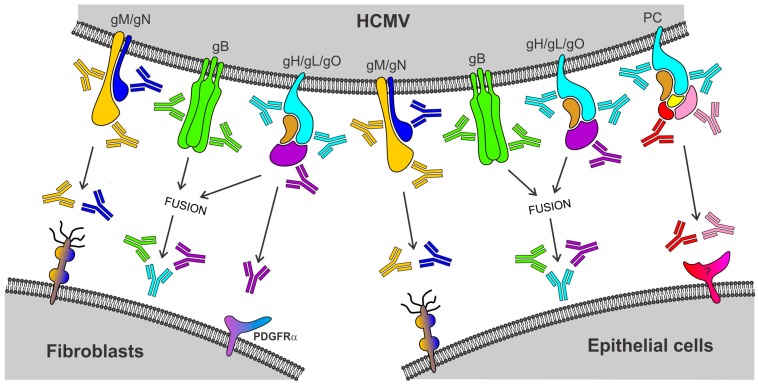
Figure 1
Figure 1
Model for Human cytomegalovirus (HCMV) entry and antibody-mediated neutralization. While HCMV entry into both fibroblasts (FB) and epithelial cells (EC) depends on envelope glycoprotein complexes composed of gM/gN, gB, or gH/gL/gO, HCMV entry into EC additionally requires the pentamer complex (PC) composed of gH, gL, UL128, UL130, and UL131A. While gM/gN may mediate initial attachment via glycosaminoglycans, gB and gH/gL/gO are thought to be involved in fusion of the virion envelope with cellular membranes during entry into both FB and EC, and gH/gL/gO or the PC appears to mediate receptor-binding during entry into FB or EC, respectively. Unlike NAb targeting glycoproteins of gM/gN (yellow and blue antibodies), gB (green antibodies), or gH/gL/gO (cyan and purple antibodies) that can block both FB and EC entry, NAb targeting epitopes of the UL128/130/131A subunits of the PC (red and pink antibodies) are unable to block FB infection, though they are highly potent in blocking EC infection.
Figure 2
Figure 2
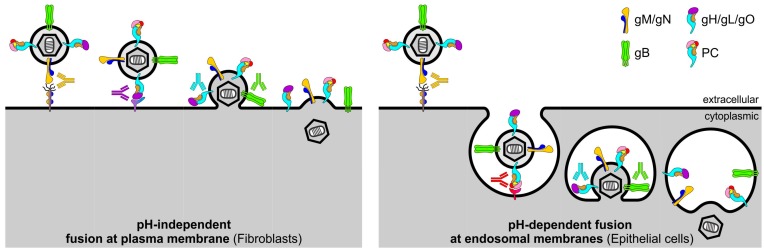
Model of HCMV entry routes and antibody interference. While HCMV entry into FB occurs by fusion at the plasma membrane, HCMV infection of EC is mediated by fusion at the endosomal membrane following endocytosis. During FB and EC entry, initial attachment may be mediated by gM/gN. Receptor-binding during FB entry is thought to occur by interaction of gH/gL/gO with PDGFRα. In contrast, receptor-binding during EC infection is mediated by interaction of the PC with an unknown molecule, which may in turn trigger PC-mediated endocytosis. Upon receptor-binding, gB and gH/gL/gO are thought to be involved in the fusion of the virion envelope with cellular membranes, which may occur either at the plasma membrane during FB entry or at endosomal membranes during EC entry. While NAb targeting gM/gN may interfere with the initial attachment, NAb targeting specific epitopes of gH/gL/gO or the PC may block receptor-binding during FB or EC entry, respectively. In addition, NAb targeting gH/gL/gO and gB may interfere with fusion of the virion envelope and cellular membranes.
Figure 3
Figure 3
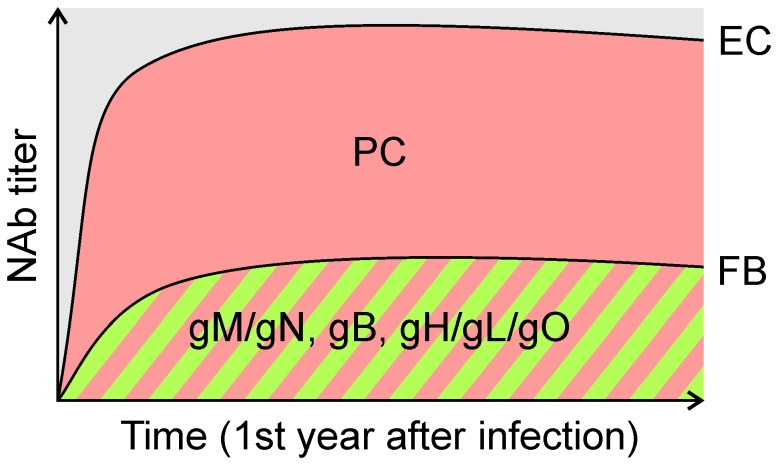
In vitro HCMV NAb responses. During the first year after primary HCMV infection, HCMV+ individuals develop NAb responses with different capacity to prevent in vitro EC and FB infection [56]. NAb measured with EC exceed those measured with FB by orders of magnitude. While FB-specific NAb responses are the result of NAb targeting epitopes of gM/gN, gB, and gH/gL/gO, EC-specific NAb responses are the result of NAb targeting the PC in addition to NAb targeting the gM/gN, gB or gH/gL/gO complexes. The predominant difference in FB- and EC- specific NAb responses is likely a consequence of NAb that target the UL128/130/131A subunits of the PC.

References

    1. Crough T., Khanna R. Immunobiology of human cytomegalovirus: From bench to bedside. Clin. Microbiol. Rev. 2009;22:76–98. doi: 10.1128/CMR.00034-08. - DOI - PMC - PubMed
    1. Britt W. Manifestations of human cytomegalovirus infection: Proposed mechanisms of acute and chronic disease. Curr. Top. Microbiol. Immunol. 2008;325:417–470. - PubMed
    1. Stratton K.R., Durch J.S., Lawrence R.S. Vaccines for the 21st Century: A Tool for Decisionmaking. The National Academies Press; Washington, DC, USA: 2000. - PubMed
    1. Schleiss M.R. Cytomegalovirus vaccines under clinical development. J. Virus Erad. 2016;2:198–207. - PMC - PubMed
    1. Anderholm K.M., Bierle C.J., Schleiss M.R. Cytomegalovirus vaccines: Current status and future prospects. Drugs. 2016;76:1625–1645. doi: 10.1007/s40265-016-0653-5. - DOI - PMC - PubMed