


Chronic Health Conditions and Neurocognitive Function in Aging Survivors of Childhood Cancer: A Report from the Childhood Cancer Survivor Study
- PMID: 29088360
- PMCID: PMC6059140
- DOI: 10.1093/jnci/djx224
Chronic Health Conditions and Neurocognitive Function in Aging Survivors of Childhood Cancer: A Report from the Childhood Cancer Survivor Study
Abstract
Background: Neurocognitive impairment in survivors of childhood cancer may be associated with direct neurotoxicity, as well as indirect effects of systemic health complications. We evaluated associations among treatment exposures, chronic health conditions, and neurocognitive outcomes in adult survivors of childhood cancer.
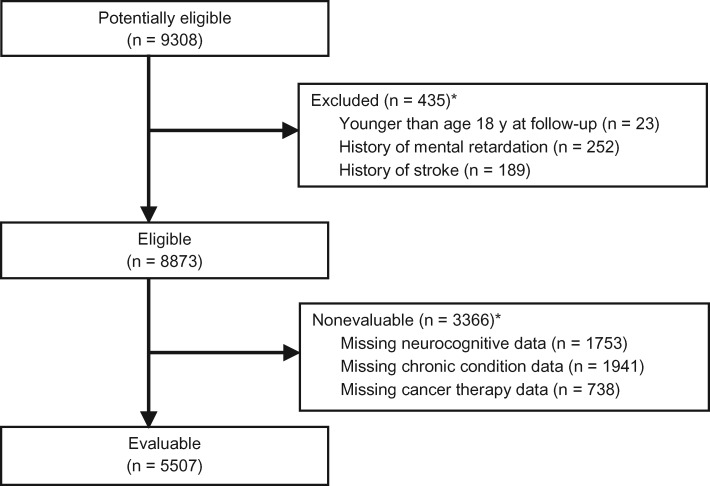
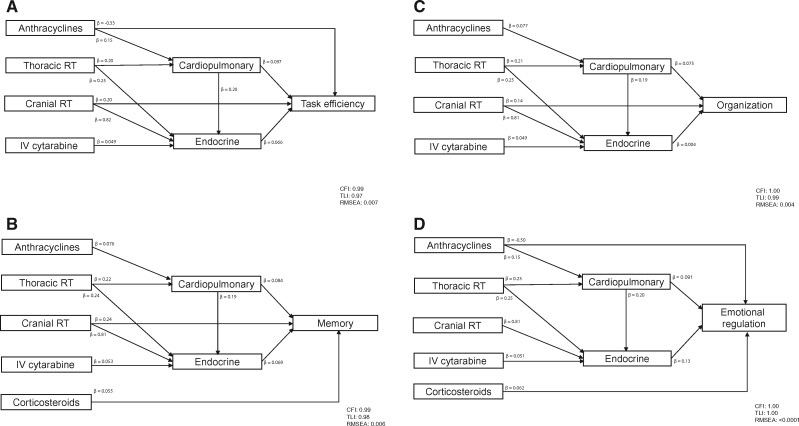
Methods: Participants included 5507 adult survivors of childhood cancer (47.1% male; mean [SD] age = 31.8 [7.6] years at evaluation; 23.1 [4.5] years postdiagnosis) in the Childhood Cancer Survivor Study who completed a self-report measure of neurocognitive function. Cardiac, pulmonary, and endocrine chronic health conditions were graded using the National Cancer Institute Common Terminology Criteria for Adverse Events (version 4.03). Structural equation modeling was used to examine a priori hypothesized causal pathways among cancer treatment, subsequent chronic health conditions, and neurocognitive outcomes. Multivariable models were used to estimate relative risk for associations of treatments and chronic conditions on neurocognitive function. All statistical tests were two-sided.
Results: One-third of survivors with a grade 2 or higher chronic condition reported impairments in task efficiency and memory. In addition to direct effects of cranial radiation, path analyses and multivariable models demonstrated direct effects of cardiopulmonary (β = 0.10, P = .002; relative risk [RR] = 1.27, 95% confidence interval [CI] = 1.12 to 1.44) and endocrine (β = 0.07, P = .04; RR = 1.14, 95% CI = 1.02 to 1.28) conditions on impaired task efficiency. We identified similar effects of cardiopulmonary condition on memory (P = .01) and emotional regulation (P = .01). Thoracic radiation was associated with impaired task efficiency (P = .01) and emotional regulation (P = .01) through endocrine morbidity.
Conclusions: Non-neurotoxic exposures, such as thoracic radiation, can adversely impact survivors' neurocognitive function through chronic conditions. Management of chronic diseases may mitigate neurocognitive outcomes among aging survivors of childhood cancer.
Figures
References
-
- Oeffinger KC, Mertens AC, Sklar CA et al. , Chronic health conditions in adult survivors of childhood cancer. N Engl J Med. 2006;35515:1572–1582. - PubMed
-
- Hudson MM, Mertens AC, Yasui Y et al. , Health status of adult long-term survivors of childhood cancer: A report from the childhood cancer survivor study. JAMA. 2003;29012:1583–1592. - PubMed
-
- Gurney JG, Kadan-Lottick NS, Packer RJ et al. , Endocrine and cardiovascular late effects among adult survivors of childhood brain tumors: Childhood cancer survivor study. Cancer. 2003;973:663–673. - PubMed
Publication types
MeSH terms
Grants and funding
LinkOut - more resources
Full Text Sources
Other Literature Sources
