


Safety of mechanical chest compression devices AutoPulse and LUCAS in cardiac arrest: a randomized clinical trial for non-inferiority
- PMID: 29088439
- PMCID: PMC5837501
- DOI: 10.1093/eurheartj/ehx318
Safety of mechanical chest compression devices AutoPulse and LUCAS in cardiac arrest: a randomized clinical trial for non-inferiority
Abstract
Aims: Mechanical chest compression (CC) during cardiopulmonary resuscitation (CPR) with AutoPulse or LUCAS devices has not improved survival from cardiac arrest. Cohort studies suggest risk of excess damage. We studied safety of mechanical CC and determined possible excess damage compared with manual CC.
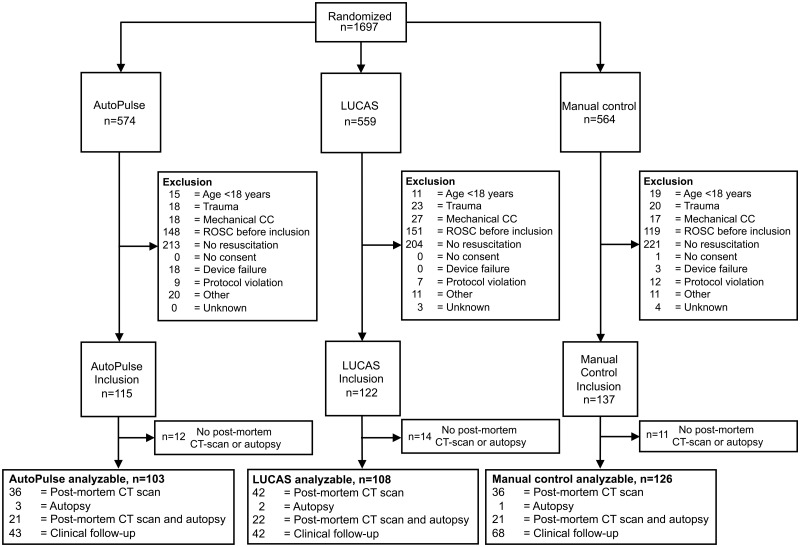
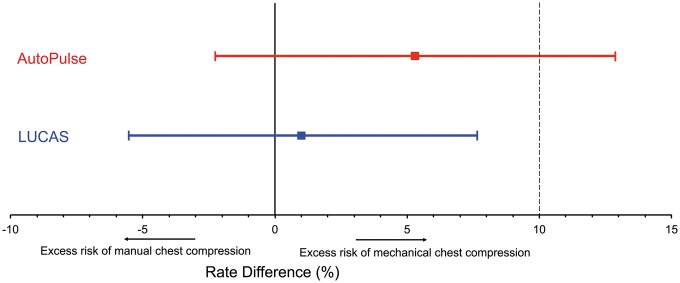
Methods and results: This is a randomized non-inferiority safety study. Randomization to AutoPulse, LUCAS, or manual CC with corrective depth and rate feedback was performed. We included patients with in-hospital cardiac arrest or with out-of-hospital cardiac arrest arriving with manual CPR at the emergency department. The primary outcome was serious or life-threatening visceral resuscitation-related damage, assessed blind by post-mortem computed tomography scan and/or autopsy or by clinical course until discharge. Non-inferiority hypothesis: mechanical CC compared with manual control does not increase the primary outcome by a risk difference of > 10% [upper 95% confidence interval (CI)]. We included 115 patients treated with AutoPulse, 122 with LUCAS, and 137 patients received manual CC. Safety outcome analysis was possible in 337 of 374 (90.1%) included patients. The primary outcome was observed in 12 of 103 AutoPulse patients (11.6%), 8 of 108 LUCAS patients (7.4%), and 8 of 126 controls (6.4%). Rate difference AutoPulse-control: +5.3% (95% CI - 2.2% to 12.8%), P = 0.15. Rate difference LUCAS-control +1.0% (95% CI - 5.5% to 7.6%), P = 0.75.
Conclusion: LUCAS does not cause significantly more serious or life-threatening visceral damage than manual CC. For AutoPulse, significantly more serious or life-threatening visceral damage than manual CC cannot be excluded.
Keywords: Cardiopulmonary resuscitation; Chest compressions; Damage; Heart arrest; Mechanical chest compressions; Safety.
© The Author 2017. Published by Oxford University Press on behalf of the European Society of Cardiology
Figures
Comment in
-
Looking at the Force beyond the Dark side of mechanical massage.Eur Heart J. 2017 Oct 21;38(40):3014-3016. doi: 10.1093/eurheartj/ehx500. Eur Heart J. 2017. PMID: 29020265 No abstract available.
-
Out-of-hospital cardiopulmonary resuscitation.Emergencias. 2020 Abr;32(2):146. Emergencias. 2020. PMID: 32125120 English, Spanish. No abstract available.
-
Author's reply.Emergencias. 2020 Abr;32(2):146-147. Emergencias. 2020. PMID: 32125121 English, Spanish. No abstract available.
References
-
- Kleinman ME, Brennan EE, Goldberger ZD, Swor RA, Terry M, Bobrow BJ, Gazmuri RJ, Travers AH, Rea T.. Part 5: adult basic life support and cardiopulmonary resuscitation quality: 2015 American Heart Association guidelines update for cardiopulmonary resuscitation and emergency cardiovascular care. Circulation 2015;132:S414–S435. - PubMed
-
- Perkins GD, Handley AJ, Koster RW, Castrén M, Smyth MA, Olasveengen T, Monsieurs KG, Raffay V, Gräsner J-T, Wenzel V, Ristagno G, Soar J, Bossaert LL, Caballero A, Cassan P, Granja C, Sandroni C, Zideman DA, Nolan JP, Maconochie I, Greif R.. European Resuscitation Council Guidelines for Resuscitation 2015: Section 2. Adult basic life support and automated external defibrillation. Resuscitation 2015;95:81–99. - PubMed
-
- Berg RA, Hemphill R, Abella BS, Aufderheide TP, Cave DM, Hazinski MF, Lerner EB, Rea TD, Sayre MR, Swor RA.. Part 5: adult basic life support: 2010 American Heart Association guidelines for cardiopulmonary resuscitation and emergency cardiovascular care. Circulation 2010;122:S685–S705. - PubMed
-
- Wik L, Kramer-Johansen J, Myklebust H, Sørebø H, Svensson L, Fellows B, Steen PA.. Quality of cardiopulmonary resuscitation during out-of-hospital cardiac arrest. JAMA 2005;293:299–304. - PubMed
-
- Timerman S, Cardoso LF, Ramires JAF, Halperin H.. Improved hemodynamic performance with a novel chest compression device during treatment of in-hospital cardiac arrest. Resuscitation 2004;61:273–280. - PubMed
Publication types
MeSH terms
LinkOut - more resources
Full Text Sources
Other Literature Sources
Medical
