


Stabilization of the transcription factors slug and twist by the deubiquitinase dub3 is a key requirement for tumor metastasis
- PMID: 29088851
- PMCID: PMC5650406
- DOI: 10.18632/oncotarget.20561
Stabilization of the transcription factors slug and twist by the deubiquitinase dub3 is a key requirement for tumor metastasis
Abstract
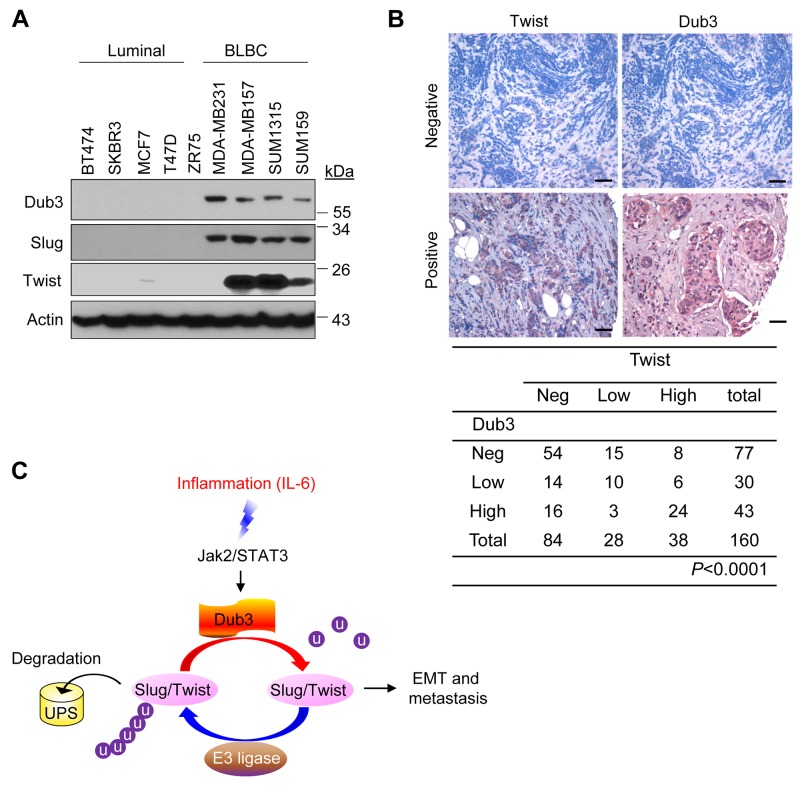
The epithelial-mesenchymal transition (EMT) represents a cellular de-differentiation process that provides cells with the increased plasticity required during embryonic development, tissue remodeling, wound healing and metastasis. Slug and Twist are two key EMT transcription factors (EMT-TFs) that are tightly regulated via ubiquitination and degradation. How Slug and Twist escape degradation and become stabilized in cancer cells remains unclear. One plausible mechanism of Slug and Twist stabilization involves removal of ubiquitin by deubiquitinases (DUBs). In this study, we identified Dub3 as a novel DUB for both Slug and Twist. We further found that Dub3 overexpression increased Slug and Twist protein levels in a dose-dependent manner, whereas Dub3-knockdown decreased their protein levels. Of importance, Dub3 interacted with Slug and Twist and prevented them from degradation, thereby promoting migration, invasion, and cancer stem cell (CSC)-like properties of breast cancer cells. Intriguingly, Dub3 was identified as an early response gene that was upregulated after exposure to inflammatory cytokines such as IL-6, which plays a critical role in the growth and metastasis of breast cancer cells, as well as the maintenance of breast CSCs. We found that Dub3 played an essential role in IL-6 induced EMT through stabilization of Slug and Twist. Our study has uncovered an IL-6-Dub3-Slug/Twist signaling axis during EMT and suggests potential approaches that could target Dub3 to prevent metastatic breast tumor.
Keywords: Dub3; IL-6; Slug; Twist; metastasis.
Conflict of interest statement
CONFLICTS OF INTEREST The authors declare no conflicts of interest.
Figures


References
-
- Nieto MA. The snail superfamily of zinc-finger transcription factors. Nat Rev Mol Cell Biol. 2002;3:155–66. https://doi.org/10.1038/nrm757. - DOI - PubMed
-
- Peinado H, Olmeda D, Cano A. Snail, Zeb and bHLH factors in tumour progression: an alliance against the epithelial phenotype? Nat Rev Cancer. 2007;7:415–28. https://doi.org/10.1038/nrc2131. - DOI - PubMed
-
- Thiery JP, Sleeman JP. Complex networks orchestrate epithelial-mesenchymal transitions. Nat Rev Mol Cell Biol. 2006;7:131–42. https://doi.org/10.1038/nrm1835. - DOI - PubMed
-
- Thiery JP, Acloque H, Huang RY, Nieto MA. Epithelial-mesenchymal transitions in development and disease. Cell. 2009;139:871–90. https://doi.org/10.1016/j.cell.2009.11.007. - DOI - PubMed
-
- Alderton GK. Metastasis: epithelial to mesenchymal and back again. Nat Rev Cancer. 2012;13:3. https://doi.org/10.1038/nrc3428. - DOI - PubMed
Grants and funding
LinkOut - more resources
Full Text Sources
Other Literature Sources
Research Materials
