. 2017 Oct 31;7(1):14701.
doi: 10.1038/s41598-017-14822-x.

Acute and long-term cardioprotective effects of the Traditional Chinese Medicine MLC901 against myocardial ischemia-reperfusion injury in mice

Affiliations

Acute and long-term cardioprotective effects of the Traditional Chinese Medicine MLC901 against myocardial ischemia-reperfusion injury in mice

Anne Vincent et al. Sci Rep. .

Abstract

MLC901, a traditional Chinese medicine containing a cocktail of active molecules, both reduces cerebral infarction and improves recovery in patients with ischemic stroke. The aim of this study was to evaluate the acute and long-term benefits of MLC901 in ischemic and reperfused mouse hearts. Ex vivo, under physiological conditions, MLC901 did not show any modification in heart rate and contraction amplitude. However, upon an ischemic insult, MLC901 administration during reperfusion, improved coronary flow in perfused hearts. In vivo, MLC901 (4 µg/kg) intravenous injection 5 minutes before reperfusion provided a decrease in both infarct size (49.8%) and apoptosis (49.9%) after 1 hour of reperfusion. Akt and ERK1/2 survival pathways were significantly activated in the myocardium of those mice. In the 4-month clinical follow-up upon an additional continuous per os administration, MLC901 treatment decreased cardiac injury as revealed by a 45%-decrease in cTnI plasmatic concentrations and an improved cardiac performance assessed by echocardiography. A histological analysis revealed a 64%-decreased residual scar fibrosis and a 44%-increased vascular density in the infarct region. This paper demonstrates that MLC901 treatment was able to provide acute and long-term cardioprotective effects in a murine model of myocardial ischemia-reperfusion injury in vivo.


Conflict of interest statement

This work was supported by CNRS/MOLEAC contracts. A.V., A.C., L.G., S.T., C.B., C.P., C.H., J.N. and S.B-L. C.H. report no disclosure. M.L. reports significant ownership interest (Moleac).

Figures
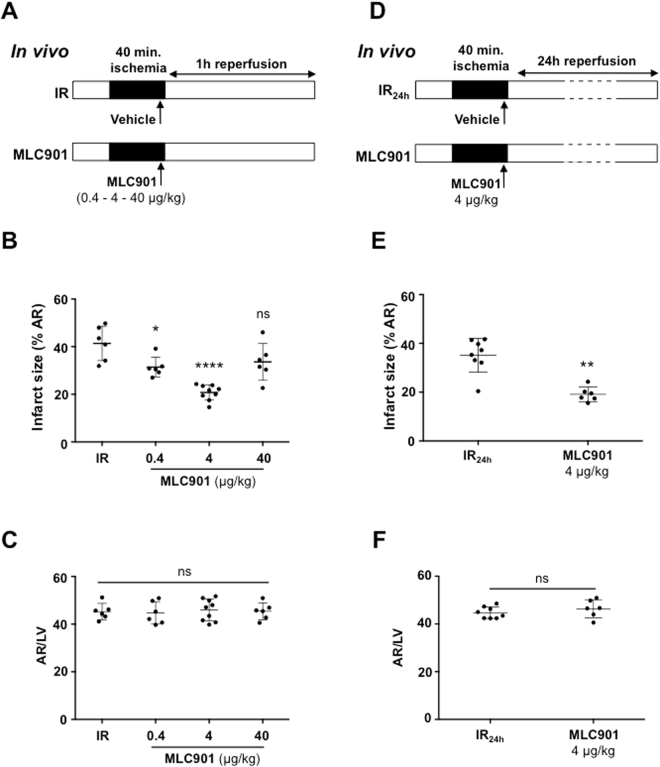
Figure 1
Figure 1
Cardioprotection induced by MLC901 in vivo at the acute phase of myocardial ischemia-reperfusion. (A,D) Experimental protocols: mice underwent a surgical protocol of myocardial 40 min-ischemia followed by 1h-reperfusion (IR; panel A) or 24h-reperfusion (IR24h; panel D). Injection of MLC901 (0.4, 4 or 40 µg/kg) was performed intravenously 5 minutes before the onset of reperfusion. Infarct size measurement was performed at the end of reperfusion. (B) Scatter dot blots and means ± SD were plotted for infarct size (in % of area at risk). When mice were treated with MLC901 at 4 µg/kg, a 49.8%-decrease in infarct size was observed. A smaller cardioprotective effect was observed for the treatment with 0.4 µg/kg MLC901. This cardioprotective effect was not observed with 40 µg/kg MLC901. (C) Scatter dot blots and means ± SD were plotted for AR/LV mass. (D) IR24h animals received MLC901 (4 µg/kg) or physiological saline serum alone (IR). (E) Scatter dot blots and means ± SD were plotted for infarct size (in % of area at risk). (F) Scatter dot blots and means ± SD were plotted for AR/LV mass. Statistical analysis was performed using ANOVA test with the Tukey’s post hoc test for multiple comparisons or Mann-Whitney test for comparisons between 2 groups.
Figure 2
Figure 2
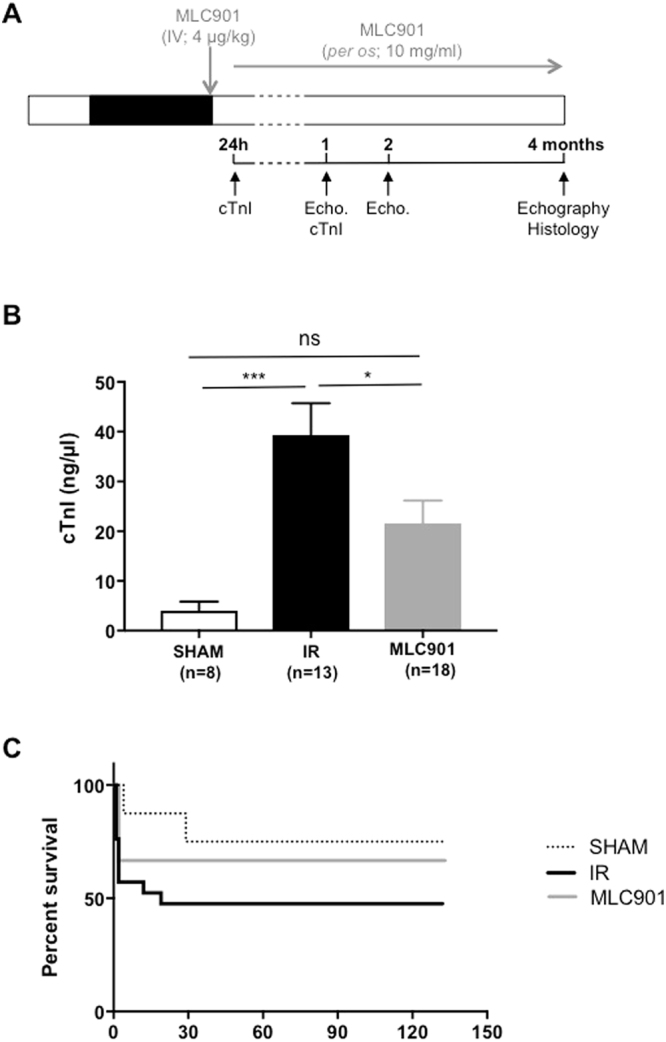
Evaluation of long-term cardioprotective effects. (A) Experimental protocol of myocardial ischemia-reperfusion (IR4m). MLC901 solution was administered intravenously 5 minutes before the onset of reperfusion (4 µg/kg) and in the drinking water (10 mg/ml) during 4 months. Blood samples were collected at 24 h and 1 month post-surgery. Echocardiographic recordings were performed at 1, 2 and 4 months. At the end of the protocol, a histological analysis was performed. (B) Plasmatic fractions were used to quantify cTnI level using the high sensitivity mouse cardiac Troponin-I Elisa. Statistical analysis was performed using ANOVA test with the Tukey’s post hoc test for multiple comparisons. (C) Kaplan-Meier survival curves for the 4-months period of follow-up (total of 130 days) (Logrank comparison of the curves: p = ns).
Figure 3
Figure 3
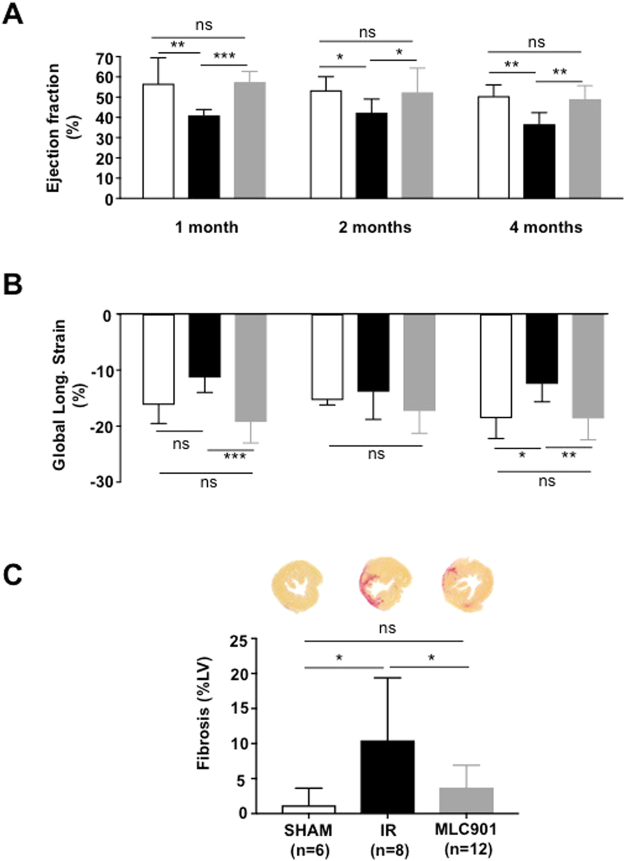
4-month follow-up study of MLC901 treated mice. (A) Ejection fraction (%) was assessed by echocardiography from measurements performed on bidimensional images of the parasternal long axis (B-mode) using Vevolab software in n = 6 SHAM, n = 7 IR and n = 12 MLC901. (B) Evaluation of the global longitudinal strain (peak, %) in parasternal long axis view using Vevostrain software (n = 5 SHAM, n = 7 IR and n = 10 MLC901 mice). Statistical significance was tested using Two-way ANOVA (Tukey’s post hoc test). (C) Fibrosis area (presented as histogram of means ± SD) was 64%-decreased in MLC901-treated versus IR LV samples (*p = 0.03). Statistical analysis was performed using ANOVA with the Tukey’s post hoc test for multiple comparisons.
Figure 4
Figure 4
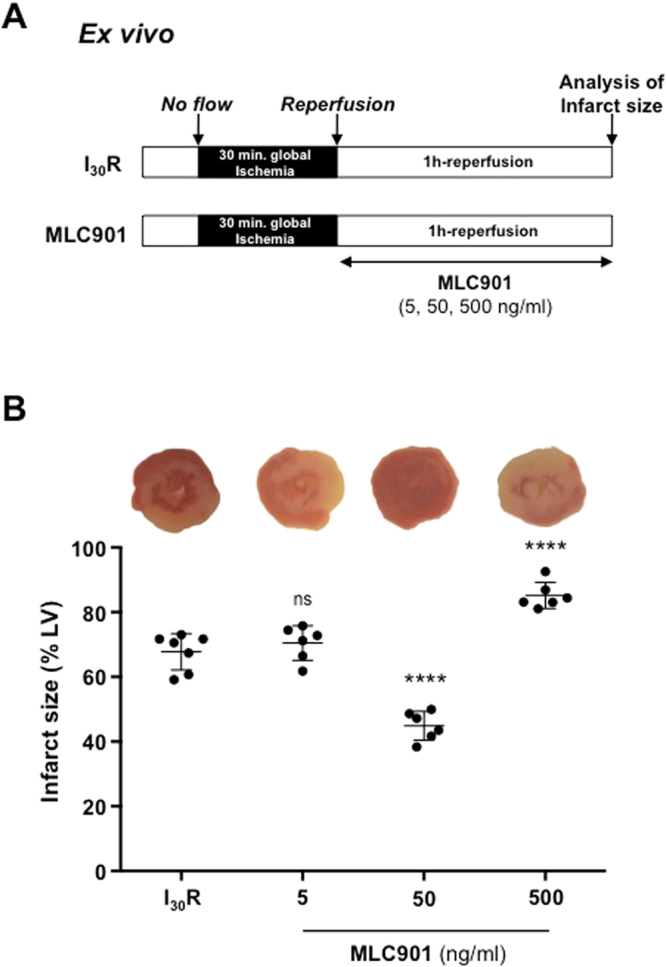
Cardioprotective effect of MLC901 on isolated hearts. (A) C57Bl6 mouse hearts were mounted on a Langendorff system. After a 20 minutes period of stabilization, global ischemia was induced during 30 minutes. Reperfusion was achieved by restoring the flow during 60 minutes with the Krebs solution. MLC901 was administered during reperfusion at 3 different concentrations: 5, 50 and 500 ng/ml. (B) Scatter dot blots (means ± SD) were represented for infarct size (in % of LV) in IR (n = 7), MLC901 (5 ng/ml, n = 6), MLC901 (50 ng/ml, n = 6), MLC901 (500 ng/ml; n = 6). Representative pictures of TTC-stained LV slices were shown for each group. Statistical analysis was performed using ANOVA with the Tukey’s post hoc test for multiple comparisons.
Figure 5
Figure 5
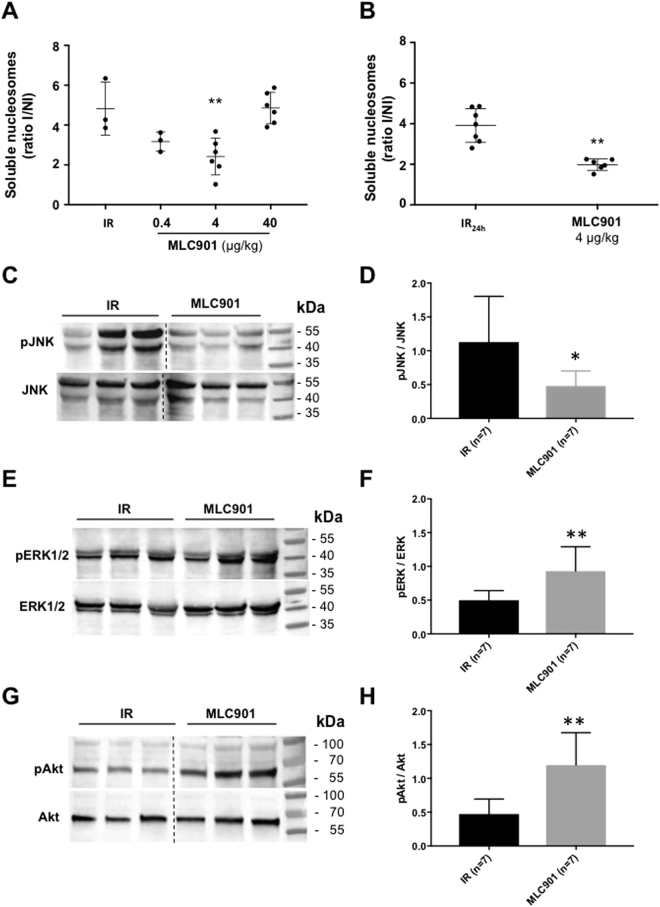
Cardioprotection is mediated by an inhibition of apoptosis in vivo. (A) Specific DNA fragmentation was quantified after 1h-reperfusion. Injection of MLC901 (0.4, 4 and 40 µg/kg) was performed intravenously 5 minutes before the onset of reperfusion. Scatter dot blots and means ± SD were plotted for the ratio of internucleosomal DNA fragmentation measured in I versus NI regions of LV from IR or MLC901-treated mice. (B) Scatter dot blots and means ± SD were plotted for the ratio of internucleosomal DNA fragmentation measured in I versus NI regions of LV after 24h-reperfusion in mice not treated (IR24h) or treated by MLC901 (4 µg/kg). (CH) Western blot analysis of pJNK, JNK, pERK1/2, ERK1/2, pAkt and Akt was performed on LV from MLC901 treated versus non-treated IR mice. (C,E,G) Representative gel blots for LV protein extract were cropped from initial blots presented in Supplementary Figures S5, S6 and S7. Histograms (means ± SD) were plotted for (D) pJNK/JNK, (F) pERK1/2/ERK1/2 and (H) pAKT/AKT ratios for MLC901 (n = 7) versus IR (n = 7); Statistical analysis was performed using ANOVA with the Tukey’s post hoc test for multiple comparisons or using the Mann-Whitney test for comparison between two groups.
Figure 6
Figure 6
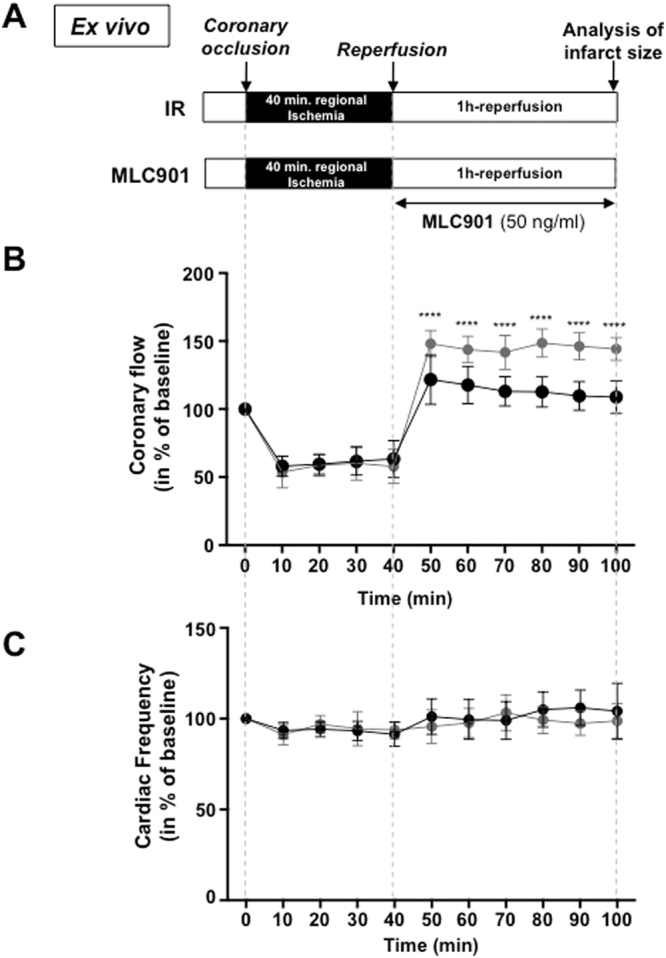
Improved coronary flow in MLC901 treated hearts subjected to IR ex vivo. (A) Mouse hearts were mounted on an Emka Langendorff system. After a 15 minutes period of stabilization, 40 min. of regional ischemia was applied followed by 1 hour-reperfusion with oxygenated Krebs for control IR hearts (n = 7) or with MLC901 solution at the optimal dose (50 ng/ml) for the MLC901 group (n = 7). All along the protocol, coronary flow and ECG were monitored. Infarct size measurement was performed at the end of reperfusion. (B,C) Maximum coronary flow and cardiac frequency were measured each 10 minutes during ischemia and reperfusion. Statistical analysis was performed using two-way ANOVA for repeated measures with a Sidak’s multiple comparisons test. (D) Scatter dot blots and means ± SD were plotted for infarct size/AR (in % of area at risk) and AR/LV mass. A 39.8% decrease in infarct size was observed when MLC901 was perfused after ischemia (***p = 0.0006). Statistical analysis was performed using ANOVA test with the Tukey’s post hoc test for multiple comparisons or Mann-Whitney test for comparisons between 2 groups.
Figure 7
Figure 7
Increased vascular density in the ischemic area in 4 month-MLC901 treated hearts. Immunochemistry was performed on LV sections after 4 months of MLC901-treatment using co-immunostaining with anti-Isolectin B4 and DAPI in order to determine microvascular density in LV tissue. (A) Representative pictures of microscopic observations for SHAM, IR and MLC901-treated LV picrosirirus stained section and corresponding enlarged immunostaining images (Original magnification: ×40 oil immersion) showing vessels (isolectinB4, upper panel) and cell nuclei (DAPI, lower panel) taken in the ischemic (I) or non-ischemic region (NI). (B) IsolectinB4-positive vessels were determined by randomly counting n = 3 in the ischemic and n = 3 in the non-ischemic areas of both SHAM (n = 5), IR (n = 5) and MLC901 (n = 5).

References

    1. Jennings RB, Sommers HM, Smyth GA, Flack HA, Linn H. Myocardial necrosis induced by temporary occlusion of a coronary artery in the dog. Archives of pathology. 1960;70:68–78. - PubMed
    1. Boisguerin P, et al. Systemic delivery of BH4 anti-apoptotic peptide using CPPs prevents cardiac ischemia-reperfusion injuries in vivo. J Control Release. 2011;156:146–153. doi: 10.1016/j.jconrel.2011.07.037. - DOI - PubMed
    1. Hausenloy DJ, et al. Novel targets and future strategies for acute cardioprotection: Position Paper of the European Society of Cardiology Working Group on Cellular Biology of the Heart. Cardiovasc Res. 2017;113:564–585. doi: 10.1093/cvr/cvx049. - DOI - PubMed
    1. Piot C, et al. Effect of cyclosporine on reperfusion injury in acute myocardial infarction. N Engl J Med. 2008;359:473–481. doi: 10.1056/NEJMoa071142. - DOI - PubMed
    1. Roubille F, et al. Myocardial expression of a dominant-negative form of Daxx decreases infarct size and attenuates apoptosis in an in vivo mouse model of ischemia/reperfusion injury. Circulation. 2007;116:2709–2717. doi: 10.1161/CIRCULATIONAHA.107.694844. - DOI - PubMed

Publication types