Horizontal gaze palsy with progressive scoliosis - A case report
- PMID: 29089675
- PMCID: PMC5644320
- DOI: 10.4103/ijri.IJRI_368_16
Horizontal gaze palsy with progressive scoliosis - A case report
Abstract
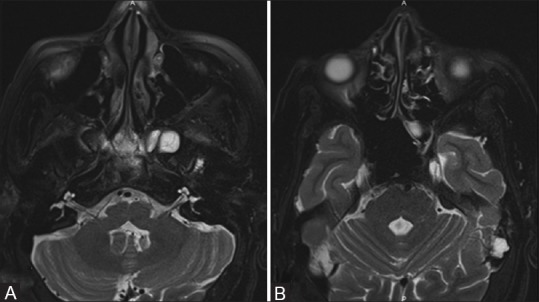
Horizontal gaze palsy with progressive scoliosis (HGPPS) is a rare congenital disorder characterized by absence of conjugate horizontal eye movements and accompanied by progressive scoliosis developing in childhood and adolescence. It occurs due to mutation in ROBO 3 gene/chromosome 11q23-q25. We report a case of a 60-year-old lady who presented with complaints of defective vision in both eyes. On examination, she had scoliosis with restricted abduction and adduction in both eyes with intact elevation and depression. Magnetic resonance imaging of the brain and orbit showed brainstem hypoplasia with absence of facial colliculi, presence of a deep midline pontine cleft (split pons sign), and a butterfly configuration of the medulla, which are the radiological findings seen in this disorder.
Keywords: HGPPS; horizontal gaze palsy; scoliosis.
Conflict of interest statement
There are no conflicts of interest.
Figures

References
-
- Crisfield RJ. Scoliosis with progressive external ophthalmoplegia in four siblings. J Bone Joint Surg. 1974;56:484–9. - PubMed
-
- Dretakis EK, Kondoyannis PN. Congenital scoliosis associated with encephalopathy in five children of two families. J Bone Joint Surg. 1974;56:1747–50. - PubMed
-
- Sharpe JA, Silversides JL, Blair RD. Familial paralysis of horizontal gaze: Associated with pendular nystagmus, progressive scoliosis, and facial contraction with myokymia. Neurology. 1975;25:1035–40. - PubMed
-
- Thomsen M, Steffen H, Sabo D, Niethard FU. Juvenile progressive scoliosis and congenital horizontal gaze palsy. J Pediatr Orthop B. 1996;5:185–9. - PubMed
Publication types
LinkOut - more resources
Full Text Sources
Other Literature Sources