. 2017 Oct 24:17:95.
doi: 10.1186/s12935-017-0466-y. eCollection 2017.

miR-1296-5p decreases ERBB2 expression to inhibit the cell proliferation in ERBB2-positive breast cancer

Affiliations

miR-1296-5p decreases ERBB2 expression to inhibit the cell proliferation in ERBB2-positive breast cancer

Gang Chen et al. Cancer Cell Int. .

Abstract

Background: The tumor suppressive role of miR-1296 is observed in triple negative breast cancer (TNBC). However, the effect of miR-1296-5p in ERBB2-positive breast cancers remains obscure.

Methods: Whether ERBB2 was the target gene of the miR-1296-5p was predicted by online software, and determined by dual-luciferase activity assay. miR-1296-5p expression levels were determined in breast cancer samples (114 breast cancer tissues and 30 adjacent normal tissues) by using qRT-PCR. The effect of miR-1296-5p and inhibition of ERBB2/mTORC1 signaling on the downstream target was assessed by Western blot. SK-BR-3 and BT-474 breast cancer cell line was transfected with miR-1296-5p mimic after which cell proliferation and apoptosis were determined by the clonogenic assay and the flow cytometry system, respectively. In addition, the chemotherapeutic drug sensitivity of SK-BR-3 and BT-474 cells transfected with miR-1296-5p mimic were determined by MTT assay.

Results: The luciferase assay carrying ERBB2 3'-untranslated region-based reporters expressed in SK-BR-3 and BT-474 cells suggested that ERBB2 was the target gene of miR-1296-5p. MiR-1296-5p was significantly decreased in breast cancer tissues compared to adjacent normal tissues. Moreover, it was declined in ERBB2-positive breast cancer samples compared with that in ERBB2-negative breast cancer tissues. Overexpressed miR-1296-5p reduced its target protein level and mTORC1/S6 activation, inhibited the proliferation of ERBB2-positive breast cancer cells and sensitized these cells to cisplatin and 5-fluorouracil-induced apoptosis.

Conclusions: Our findings suggest that miR-1296-5p is involved in the regulation of proliferation in breast cancer cells via targeting ERBB2/mTORC1 signaling pathway.

Keywords: Breast cancer; ERBB2; Proliferation; mTORC1; miR-1296-5p.


Figures
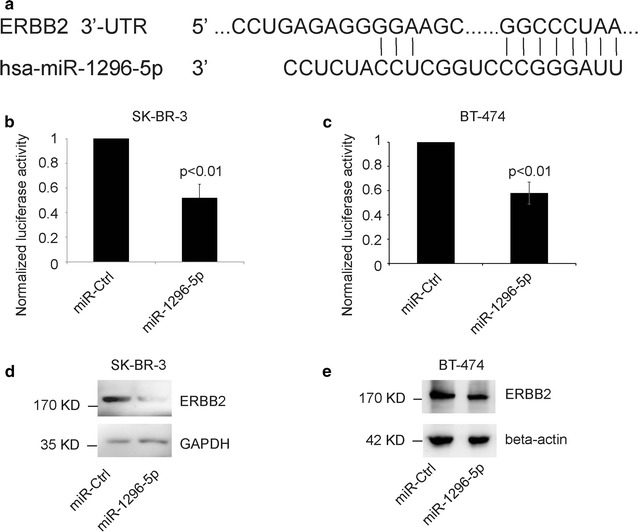
Fig. 1
Fig. 1
ERBB2 as target of miR-1296-5p. a The seed sequence of miR-1296-5p is complementary to the 3′-UTR of ERBB2. b, c Luciferase assay showing reduction in reporter activity (relative luciferase units) after co-transfection of ERBB2-3′UTR with miR-1296-5p in SK-BR-3 or BT-474 cells. d, e Western blot analysis showing suppression of ERBB2 protein levels in SK-BR-3 or BT-474 cells after miR-1296-5p overexpression
Fig. 2
Fig. 2
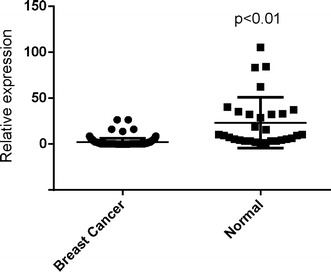
MiR-1296-5p is down-regulated in breast cancer tissues. The miR-1296-5p expression is suppressed in a majority of breast cancer samples (n = 114) when compared to normal breast samples (n = 30). The miRNA relative expression levels were normalized to the average value of breast cancer samples
Fig. 3
Fig. 3
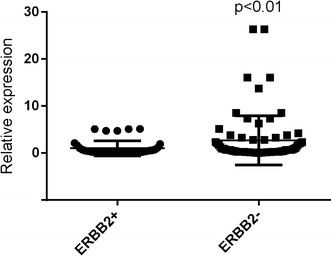
MiR-1296-5p is down-regulated in ERBB2-positive breast cancer tissues. The miR-1296-5p expression is suppressed in a majority of ERBB2-positive breast cancer samples (n = 40) when compared to ERBB2-negative breast cancer samples (n = 74). The miRNA relative expression levels were normalized to the average value of ERBB2-positive breast cancer samples
Fig. 4
Fig. 4
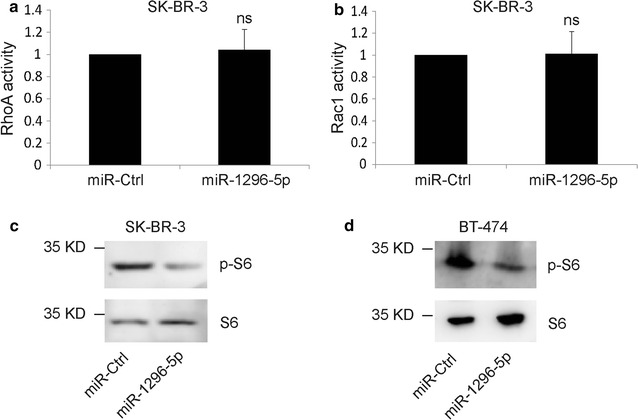
MiR-1296-5p suppresses mTORC1 signaling. a, b miR-1296-5p overexpression did not alter the activation of RhoA and Rac1 in SK-BR-3 breast cancer cells. The RhoA or Rac1 relative active levels were normalized to the average value of SK-BR-3 cells transfected with control miRNA. ns, no significance. c, d miR-1296-5p overexpression suppresses the phosphorylation of S6 in SK-BR-3 or BT-474 breast cancer cells
Fig. 5
Fig. 5
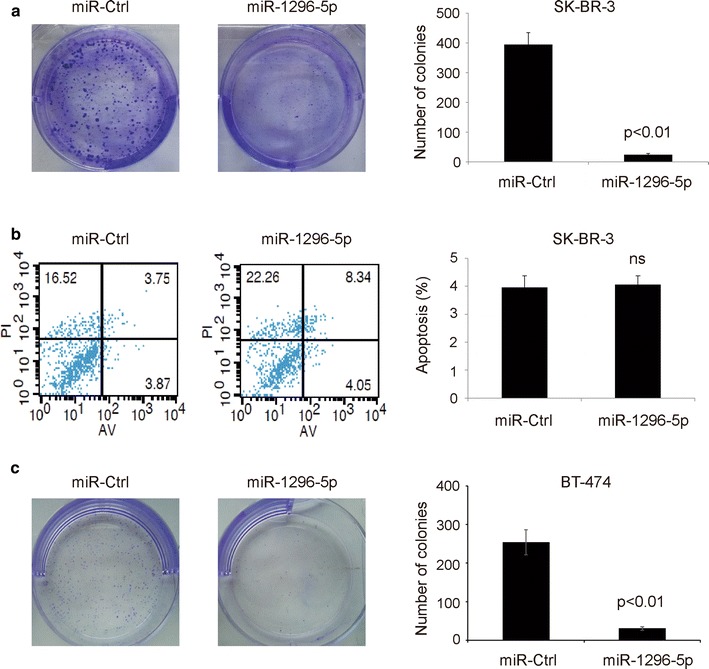
MiR-1296-5p suppresses the colony formation ability of ERBB2-positive breast cancer cells. a, c miR-1296-5p overexpression reduced the colony formation ability of SK-BR-3 or BT-474 breast cancer cells when compared to control miRNA-expressing cells. b miR-1296-5p overexpression did not alter the apoptosis of SK-BR-3 breast cancer cells when compared to control miRNA-expressing cells. ns no significance
Fig. 6
Fig. 6
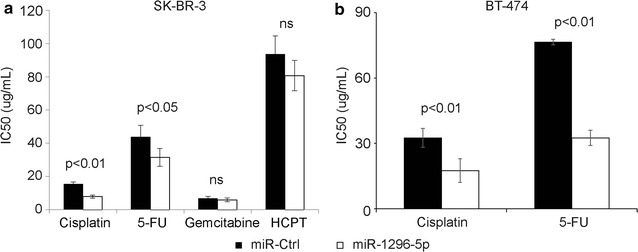
MiR-1296-5p sensitizes cells to chemotherapy drugs. a, b Overexpression of miR-1296 in SK-BR-3 or BT-474 breast cancer cells significantly sensitized cells to cisplatin and 5-fluorouracil (5-FU) treatment as compared to control miRNA. Cells were treated with cisplatin 24 h following miR-1296-5p transfection and the cell viability was assessed after 48 h of cisplatin treatment. 5-FU, 5-fluorouracil. HCPT, hydroxy camptothecin. ns no significance

References

    1. Fabi A, Mottolese M, Segatto O. Therapeutic targeting of ERBB2 in breast cancer: understanding resistance in the laboratory and combating it in the clinic. J Mol Med (Berl) 2014;92(7):681–695. doi: 10.1007/s00109-014-1169-7. - DOI - PubMed
    1. Slamon DJ, Godolphin W, Jones LA, Holt JA, Wong SG, Keith DE, Levin WJ, Stuart SG, Udove J, Ullrich A, et al. Studies of the HER-2/neu proto-oncogene in human breast and ovarian cancer. Science. 1989;244(4905):707–712. doi: 10.1126/science.2470152. - DOI - PubMed
    1. Chen H, Sun JG, Cao XW, Ma XG, Xu JP, Luo FK, Chen ZT. Preliminary validation of ERBB2 expression regulated by miR-548d-3p and miR-559. Biochem Biophys Res Commun. 2009;385(4):596–600. doi: 10.1016/j.bbrc.2009.05.113. - DOI - PubMed
    1. Hanahan D, Weinberg RA. Hallmarks of cancer: the next generation. Cell. 2011;144(5):646–674. doi: 10.1016/j.cell.2011.02.013. - DOI - PubMed
    1. Yu D, Hung MC. Overexpression of ErbB2 in cancer and ErbB2-targeting strategies. Oncogene. 2000;19(53):6115–6121. doi: 10.1038/sj.onc.1203972. - DOI - PubMed