


Achieving Goal-Concordant Care: A Conceptual Model and Approach to Measuring Serious Illness Communication and Its Impact
- PMID: 29091522
- PMCID: PMC5756461
- DOI: 10.1089/jpm.2017.0459
Achieving Goal-Concordant Care: A Conceptual Model and Approach to Measuring Serious Illness Communication and Its Impact
Abstract
Background: High-quality care for seriously ill patients aligns treatment with their goals and values. Failure to achieve "goal-concordant" care is a medical error that can harm patients and families. Because communication between clinicians and patients enables goal concordance and also affects the illness experience in its own right, healthcare systems should endeavor to measure communication and its outcomes as a quality assessment. Yet, little consensus exists on what should be measured and by which methods.
Objectives: To propose measurement priorities for serious illness communication and its anticipated outcomes, including goal-concordant care.
Methods: We completed a narrative review of the literature to identify links between serious illness communication, goal-concordant care, and other outcomes. We used this review to identify gaps and opportunities for quality measurement in serious illness communication.
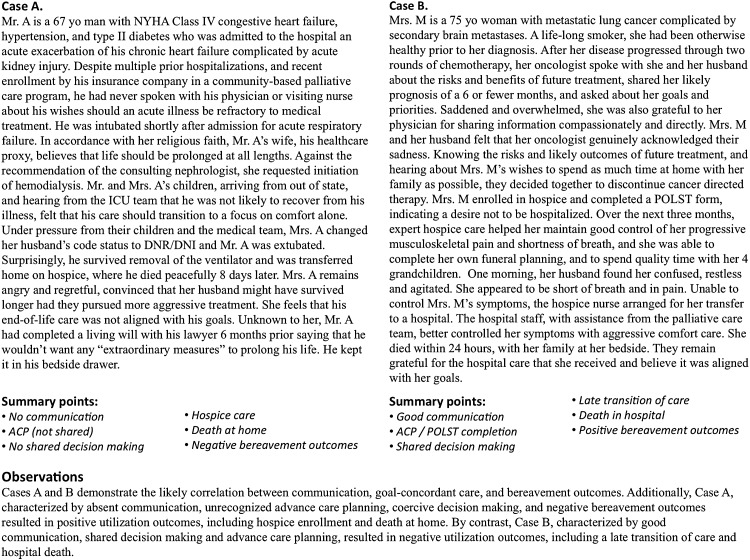
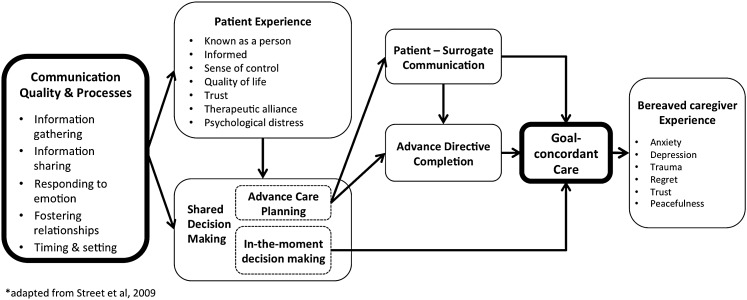
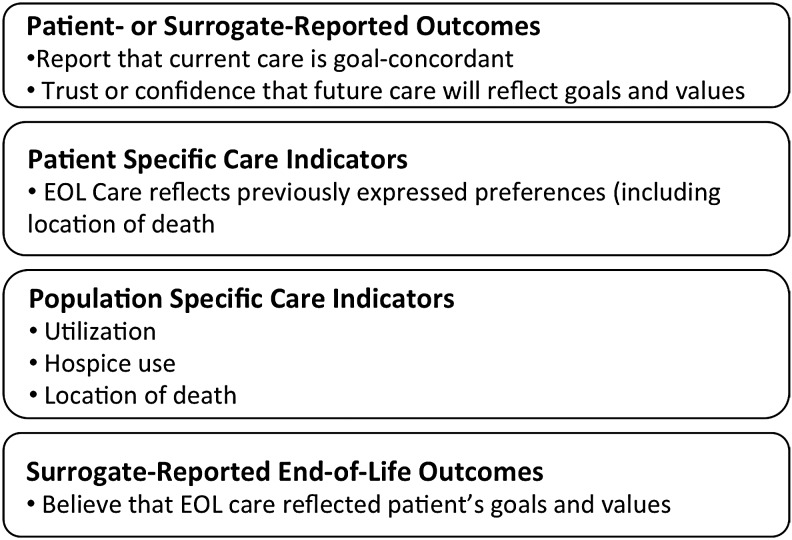
Results: Our conceptual model describes the relationship between communication, goal-concordant care, and other relevant outcomes. Implementation-ready measures to assess the quality of serious illness communication and care include (1) the timing and setting of serious illness communication, (2) patient experience of communication and care, and (3) caregiver bereavement surveys that include assessment of perceived goal concordance of care. Future measurement priorities include direct assessment of communication quality, prospective patient or family assessment of care concordance with goals, and assessment of the bereaved caregiver experience.
Conclusion: Improving serious illness care necessitates ensuring that high-quality communication has occurred and measuring its impact. Measuring patient experience and receipt of goal-concordant care should be our highest priority. We have the tools to measure both.
Keywords: goal-concordant care; quality measurement; serious illness communication.
Conflict of interest statement
No competing financial interests exist.
Figures
References
-
- Pollak KI, Arnold RM, Jeffreys AS, et al. : Oncologist communication about emotion during visits with patients with advanced cancer. J Clin Oncol 2007;25:5748–5752 - PubMed
-
- Kelley A: Consensus definition for Gordon & Betty Moore Foundation-funded symposium on quality measurement in community based serious illness programs. J Palliat Med 2017;20 Supp2:XXX–XXX
-
- Mullainathan S, Shafir E: Scarcity: Why Having Too Little Means so Much, 1st edn. New York: Times Books, Henry Holt and Company, 2013
-
- Institute of Medicine: To Err is Human; Building a Safer Health System. Washington, DC: National Academies Press, 1999 - PubMed
Publication types
MeSH terms
LinkOut - more resources
Full Text Sources
Other Literature Sources
Medical
