Review
doi: 10.1101/cshperspect.a022038.
Mechanical Properties of the Cytoskeleton and Cells
Affiliations
- PMID: 29092896
- PMCID: PMC5666633
- DOI: 10.1101/cshperspect.a022038
Item in Clipboard
Review
Mechanical Properties of the Cytoskeleton and Cells
Cold Spring Harb Perspect Biol.
.
Abstract
SUMMARYThe cytoskeleton is the major mechanical structure of the cell; it is a complex, dynamic biopolymer network comprising microtubules, actin, and intermediate filaments. Both the individual filaments and the entire network are not simple elastic solids but are instead highly nonlinear structures. Appreciating the mechanics of biopolymer networks is key to understanding the mechanics of cells. Here, we review the mechanical properties of cytoskeletal polymers and discuss the implications for the behavior of cells.
Copyright © 2017 Cold Spring Harbor Laboratory Press; all rights reserved.
Figures
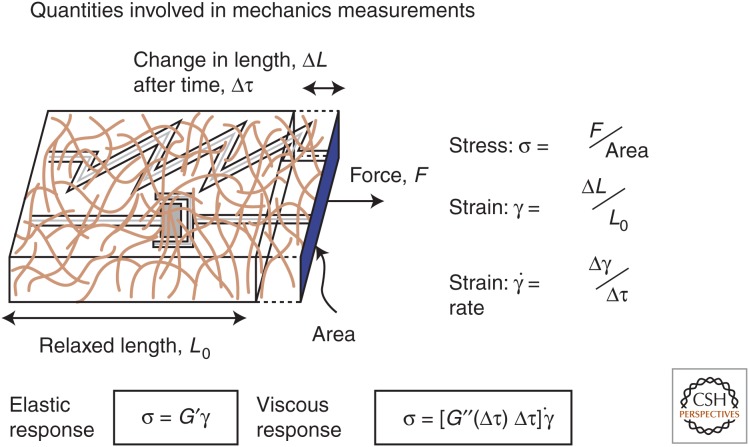
The terms applied to and the quantities measured in the study of rheology of biopolymer networks. G′, elastic response; G′′, the viscous response. Biopolymers are viscoelastic and both G′ and G′′ are significant. (Adapted from Kasza et al. 2007, with permission from Elsevier.)
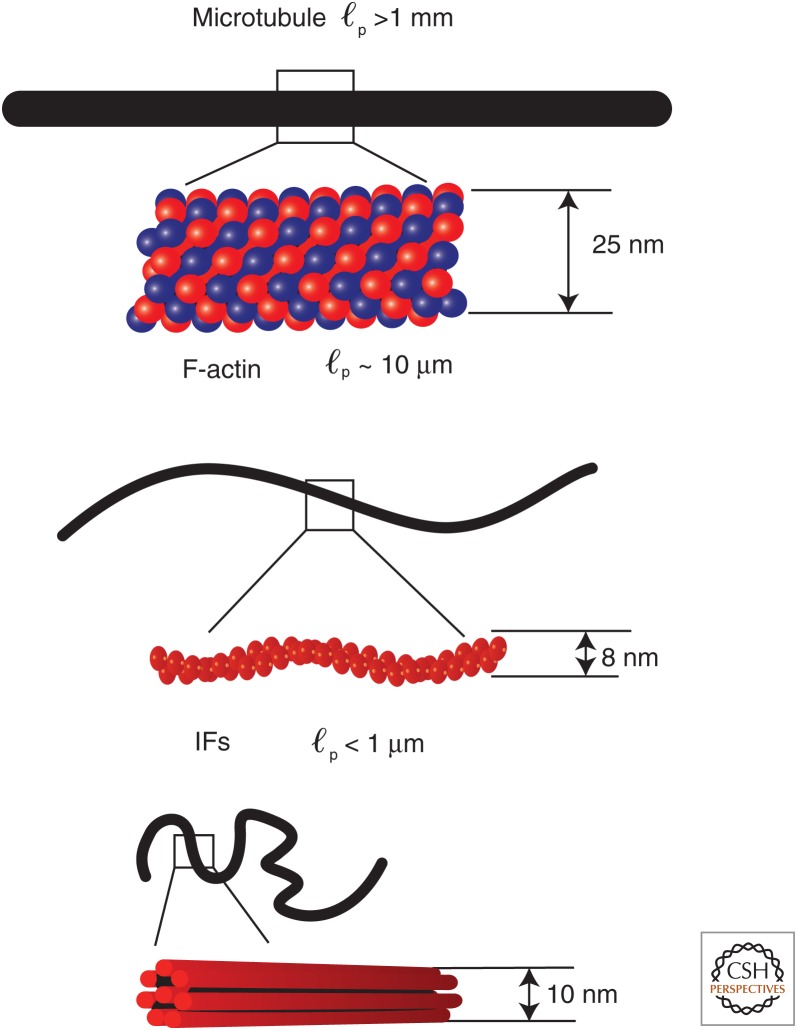
Stiffness and structure of cytoskeleton filaments. Microtubules (MTs), F-actin filaments, and intermediate filaments (IFs) of diameter 10 µm are drawn on the same scale. Stiffer filaments with larger persistence length (ℓp) appear to be straighter. (Reprinted from Wen and Janmey 2013, with permission from Elsevier.)
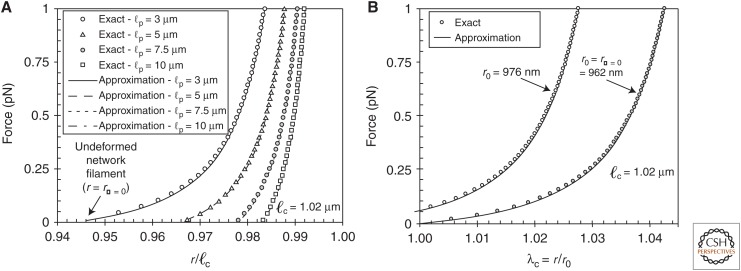
(A) The effect of persistence length (ℓp) on filament force–extension behavior, as computed using numerical solutions of the model developed by MacKintosh and colleagues (Storm et al. 2005) (symbols) compared with an analytic model approximation (lines) (Palmer and Boyce 2008) fixing contour length (ℓc) to ℓc = 1.02 µm. (B) The effect of pretension on filament force–stretch behavior as computed by both methods. The end-to-end distance of a filament at a given condition is given by r. (Reprinted from Palmer and Boyce 2008, with permission from Elsevier.)
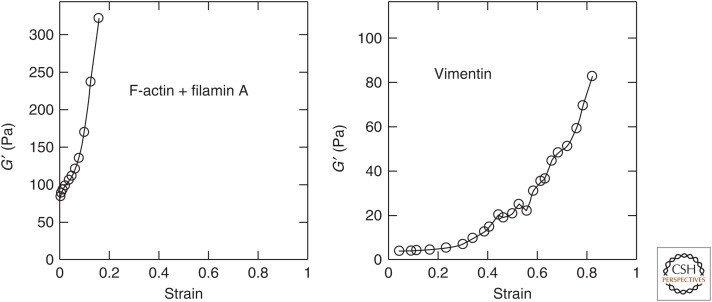
Strain stiffening of cytoskeletal networks in vitro. Shear storage modulus measurements of F-actin cross-linked by filamin A, and vimentin, measured at frequencies near 1 Hz and a range of strain magnitudes. Vimentin networks can be strained much more than actin networks and also strain-stiffen to a much larger degree. (Adapted from Storm et al. 2005; Wen and Janmey 2013, with permission from Elsevier.)
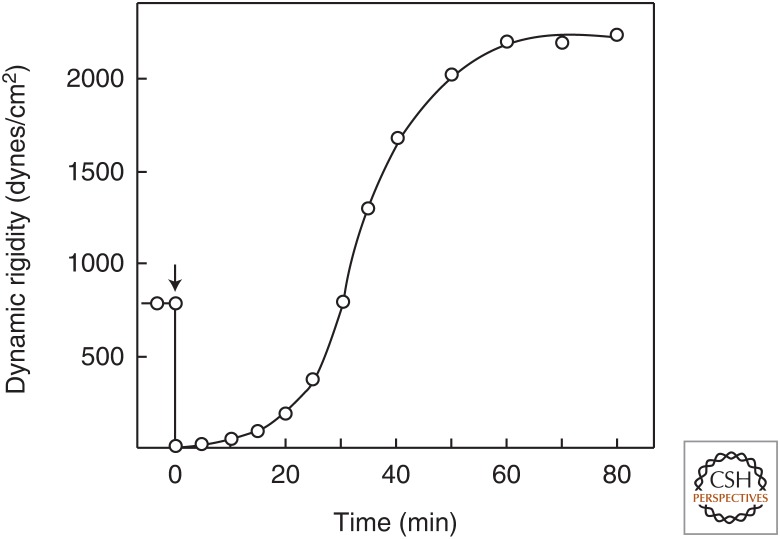
The effect of ATP on the dynamic rigidity of a heavy meromyosin–F-actin gel (heavy meromyosin, 4.0 mg/mL; F-actin, 2.0 mg/mL). The arrow indicates the time of addition of 5 mm ATP, causing an instantaneous drop in rigidity that recovers with time as the myosin hydrolyzes the ATP. (Adapted from Abe and Maruyama 1971, with permission from Elsevier.)
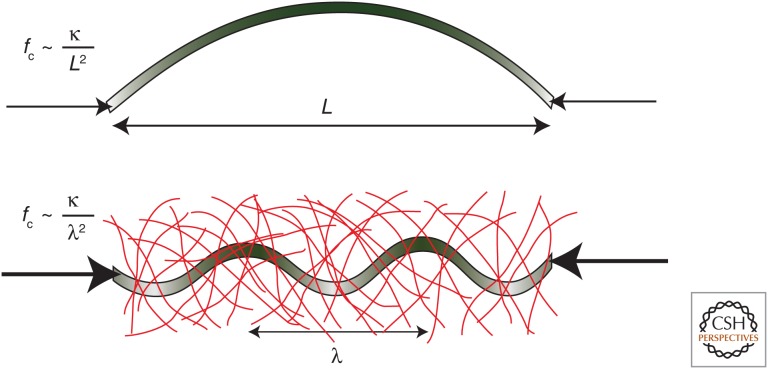
Buckling of stiff rods under compression, with and without a supporting elastic gel. A compressive force fc is applied to a rod of unbent length L and bending modulus κ. For a free rod (upper image), large-scale bending is free to occur (bending exaggerated for clarity). In the presence of a surrounding gel (lower image), large displacements are suppressed and short-wavelength buckling occurs instead and the compressive force depends on the characteristic length scale of the buckling, given by λ. (Reprinted from Brangwynne et al. 2006.)
References
-
- Abe S, Maruyama K. 1971. Dynamic rigidity of F-actin-heavy meromyosin solutions. Biochim Biophys Acta 243: 98–101. - PubMed
-
- Abe S, Maruyama K. 1973. Effect of α-actinin on F-actin—Dynamic viscoelastic study. J Biochem 73: 1205–1210. - PubMed
-
- Alberts B. 2015. Molecular biology of the cell. Garland Science, New York.
-
- Beck R, Deek J, Choi MC, Ikawa T, Watanabe O, Frey E, Pincus P, Safinya CR. 2010. Unconventional salt trend from soft to stiff in single neurofilament biopolymers. Langmuir 26: 18595–18599. - PubMed
Publication types
MeSH terms
Substances
Grants and funding
LinkOut - more resources
Full Text Sources
Other Literature Sources