Cannabis Use and Incidence of Testicular Cancer: A 42-Year Follow-up of Swedish Men between 1970 and 2011
- PMID: 29093004
- PMCID: PMC5812006
- DOI: 10.1158/1055-9965.EPI-17-0428
Cannabis Use and Incidence of Testicular Cancer: A 42-Year Follow-up of Swedish Men between 1970 and 2011
Abstract
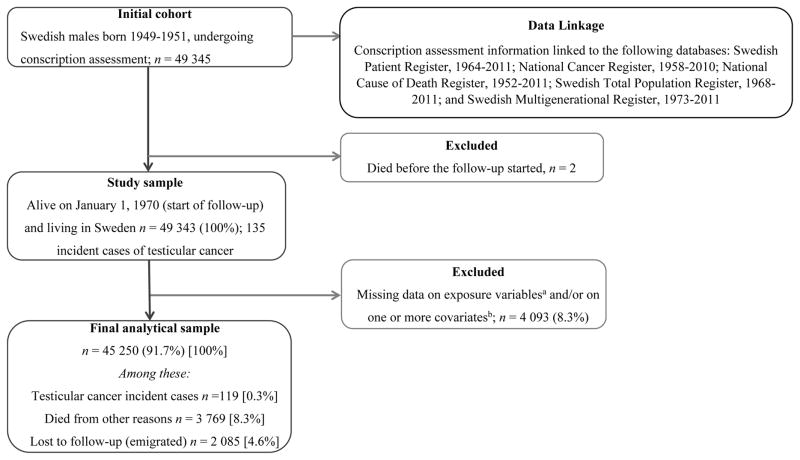
Background: Given current drug policy reforms to decriminalize or legalize cannabis in numerous countries worldwide, the current study assesses the relation between cannabis use and the development of testicular cancer.Methods: The study included a population-based sample (n = 49,343) of young men ages 18-21 years who underwent conscription assessment for Swedish military service in 1969-1970. The conscription process included a nonanonymous questionnaire eliciting information about drug use. Conscription information was linked to Swedish health and administrative registry data. Testicular cancers diagnosed between 1970 and 2011 were identified by International Classification of Diseases-7/8/9/10 testicular cancer codes in the Swedish National Patient Register, the Cancer Register, or the Cause of Death Register. Cox regression modeling was used to estimate the hazards associated with cannabis use and time to diagnosis of testicular cancer.Results: No evidence was found of a significant relation between lifetime "ever" cannabis use and the subsequent development of testicular cancer [n = 45,250; 119 testicular cancer cases; adjusted HR (aHR), 1.42; 95% confidence interval (CI), 0.83-2.45]. "Heavy" cannabis use (defined as usage of more than 50 times in lifetime, as measured at conscription) was associated with the incidence of testicular cancer (n = 45,250; 119 testicular cancer cases; aHR 2.57; 95% CI, 1.02-6.50).Conclusions: The current study provides additional evidence to the limited prior literature suggesting cannabis use may contribute to the development of testicular cancer.Impact: Emerging changes to cannabis drug policy should consider the potential role of cannabis use in the development of testicular cancer. Cancer Epidemiol Biomarkers Prev; 26(11); 1644-52. ©2017 AACR.
©2017 American Association for Cancer Research.
Conflict of interest statement
The authors declare no potential conflicts of interest.
Figures
References
-
- United Nations Office on Drugs and Crime. World Drug Report 2015 (United Nations publication, Sales No. E.15.XI.6) Geneva, Switzerland: United Nations Office on Drugs and Crime; 2015.
-
- Hall WD. The contribution of research to the development of a national cannabis policy in Australia. Addiction. 2008;103(5):712–20. - PubMed
-
- Hall W, Lynskey M. The challenges in developing a rational cannabis policy. Curr Opin Psychiatry. 2009;22(3):258–62. - PubMed
-
- Davenport S, Caulkins JP, Kleiman MAR. Controlling underage access to cannabis. Case W Reserve L Rev. 2015;65(3):541–66.
MeSH terms
Grants and funding
LinkOut - more resources
Full Text Sources
Other Literature Sources
Medical