Review
. 2018 Feb;29(2):389-399.
doi: 10.1681/ASN.2017060599. Epub 2017 Nov 1.

Tissue-Resident Lymphocytes in the Kidney

Affiliations
Review

Tissue-Resident Lymphocytes in the Kidney

Jan-Eric Turner et al. J Am Soc Nephrol. 2018 Feb.

Abstract

It has become evident that nonlymphoid tissues are populated by distinct subsets of innate and adaptive lymphocytes that are characterized by minimal exchange with recirculating counterparts. Especially at barrier sites, such as the skin, gut, and lung, these tissue-resident lymphocyte populations are ideally positioned to quickly respond to pathogens and other environmental stimuli. The kidney harbors several classes of innate and innate-like lymphocytes that have been described to contribute to this tissue-resident population in other organs, including innate lymphoid cells, natural killer cells, natural killer T cells, mucosal-associated invariant T cells, and γδ T cells. Additionally, a substantial proportion of the adaptive lymphocytes that are found in the kidney displays a surface phenotype suggestive of tissue residency, such as CD69+CD4+ T cells. In this review, we summarize recent advances in the understanding of tissue-resident lymphocyte populations, review the available evidence for the existence of these populations in the kidney, and discuss the potential physiologic and pathophysiologic roles thereof in kidney.

Keywords: Immunology and pathology; cytokines; lymphocytes.


Figures

Figure 1.
Figure 1.
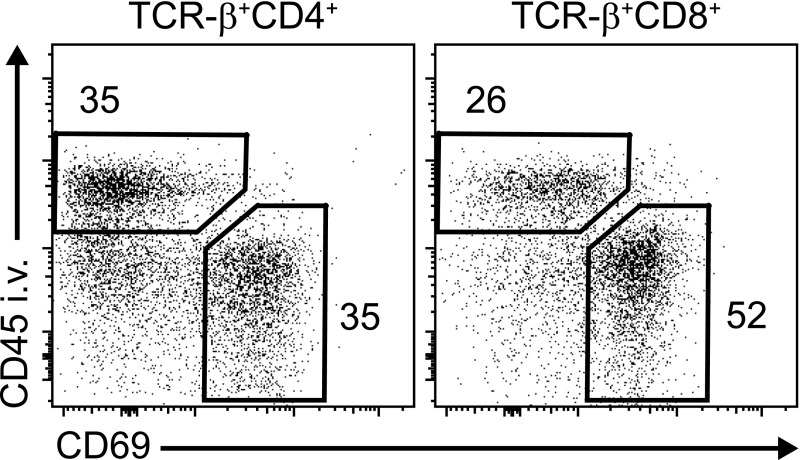
The marker CD69 identifies most tissue-resident conventional T cells in the kidney. For staining of intravascular leukocytes, naïve C57BL/6 mice were injected intravenously with a fluorochrome-coupled antibody against the panleukocyte marker CD45 5 minutes before euthanasia (CD45 i.v.). After enzymatic digestion and mechanic dissociation of the kidney tissue, leukocytes were isolated by Percoll density gradient centrifugation as previously described and stained with a combination of antibodies to identify CD4+ and CD8+ T cells as well as the expression of the tissue retention marker CD69. Flow cytometry plots are representative for three independent animals with similar results and show that, consistent with a Trm phenotype, a majority of CD45 intravenous negative T cells were CD69 positive. TCR, T cell receptor.
Figure 2.
Figure 2.
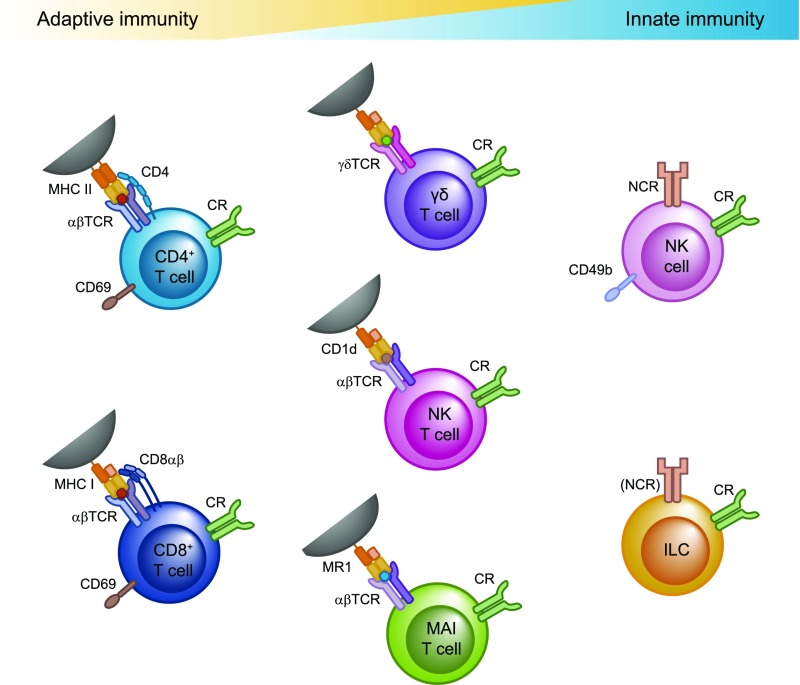
Innate, innate-like and adaptive lymphocytes contribute to the tissue-resident population in different organs. CD4+ and CD8+ T cells can be activated by ligation of their T cell receptor by peptide-loaded MHC proteins on the surface of antigen-presenting cells in conjunction with costimulatory molecules and cytokine signals. The γδ T cells, NKT cells, and MAIT cells have a T cell receptor with a restricted specificity. As innate-like T cells, they display a “preactivated” phenotype and can be activated via T cell receptor ligation or directly by cytokine signals. Conventional NK cells and “helper-like” ILCs are grouped together as ILCs and can be activated by direct recognition of damaged cells via natural killer cell receptors (NCRs) and/or cytokine signals (cytokine receptors [CRs]). TCR, T cell receptor.
Figure 3.
Figure 3.
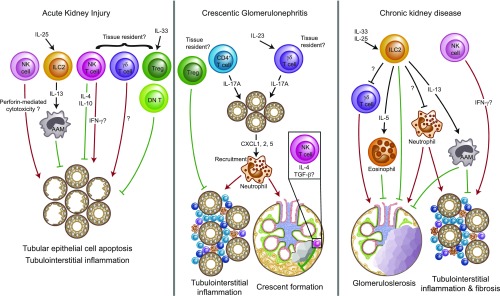
Tissue-resident lymphocytes are likely to play important roles in renal disease. Graphic summary of the so far identified functions of potentially tissue-resident innate, innate-like, and adaptive lymphocyte populations in AKI induced by ischemia and reperfusion,,,,,,, crescentic GN,,,,– and chronic progression of kidney disease., The tissue residency of a subset of NK cells and the presence of conventional Trm cells,, in the murine kidney have been clearly shown (Table 1). Given the results from other organs, the existence of kidney-resident subsets among renal γδ T cells, ILCs, NKT cells, and CD4+ T cells can be assumed. However, the formal experimental proof of this hypothesis is still lacking. Red arrows depict proinflammatory mechanisms that promote disease progression, whereas green symbols represent anti-inflammatory effects that dampen tissue damage. AAM, alternatively activated macrophages; DN T, double-negative T cell, Treg, regulatory T cell.

References

    1. Worbs T, Hammerschmidt SI, Förster R: Dendritic cell migration in health and disease. Nat Rev Immunol 17: 30–48, 2017 - PubMed
    1. von Andrian UH, Mackay CR: T-cell function and migration. Two sides of the same coin. N Engl J Med 343: 1020–1034, 2000 - PubMed
    1. Björkström NK, Ljunggren HG, Michaëlsson J: Emerging insights into natural killer cells in human peripheral tissues. Nat Rev Immunol 16: 310–320, 2016 - PubMed
    1. Fan X, Rudensky AY: Hallmarks of tissue-resident lymphocytes. Cell 164: 1198–1211, 2016 - PMC - PubMed
    1. Gasteiger G, Fan X, Dikiy S, Lee SY, Rudensky AY: Tissue residency of innate lymphoid cells in lymphoid and nonlymphoid organs. Science 350: 981–985, 2015 - PMC - PubMed

Publication types