. 2017 Nov 1;7(1):14826.
doi: 10.1038/s41598-017-13840-z.

Logistic growth of a surface contamination network and its role in disease spread

Affiliations

Logistic growth of a surface contamination network and its role in disease spread

Hao Lei et al. Sci Rep. .

Abstract

Surfaces and objects surround us, and touching them is integral to everyday life. Pathogen contaminated surfaces (fomites) are known to transmit diseases. However, little is known about the ways and speed at which surfaces become contaminated. We found that under certain conditions, the number of contaminated surfaces grows logistically, corresponding to possible rapid transmission of infection. In such a surface network, pathogen can be transmitted great distances quickly-as far as people move. We found that the surface contamination network in aircraft cabins exhibits a community structure, with small communities connected by the aisle seatback surfaces and toilets, which are high-touch surfaces. In less than two to three hours, most high-touch surfaces in the cabin are contaminated, and within five to six hours nearly all touchable surfaces are contaminated. During short haul flight, aisle passengers have higher fomite exposure. This closely matches the spatial infection pattern of one reported inflight norovirus outbreaks. Our model is generally applicable to other crowded settings. The commonly repeated advice to "wash hands frequently" may be replaced in future by more strategic advice such as "clean surfaces right now", or advice based on who should wash their hands, and when.


Conflict of interest statement

The authors declare that they have no competing interests.

Figures
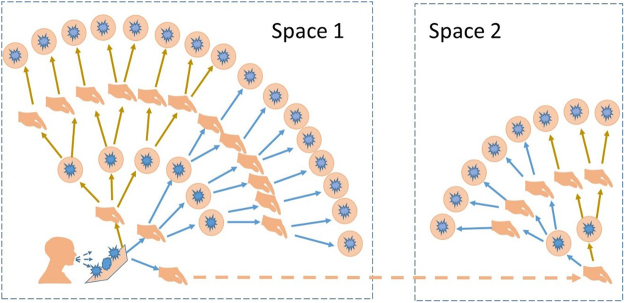
Figure 1
Figure 1
Illustration of how surfaces are connected to the root surface by hand touching. A contaminated hand may initiate a new network when an individual moves to a new environment.
Figure 2
Figure 2
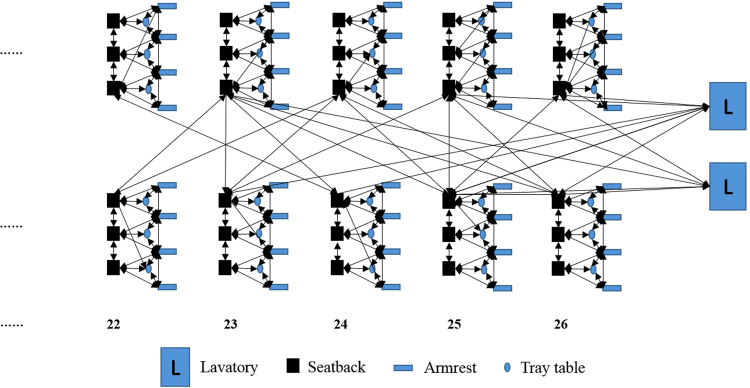
Part of the surface contamination network in one simulation of the GII 737 outbreak.
Figure 3
Figure 3
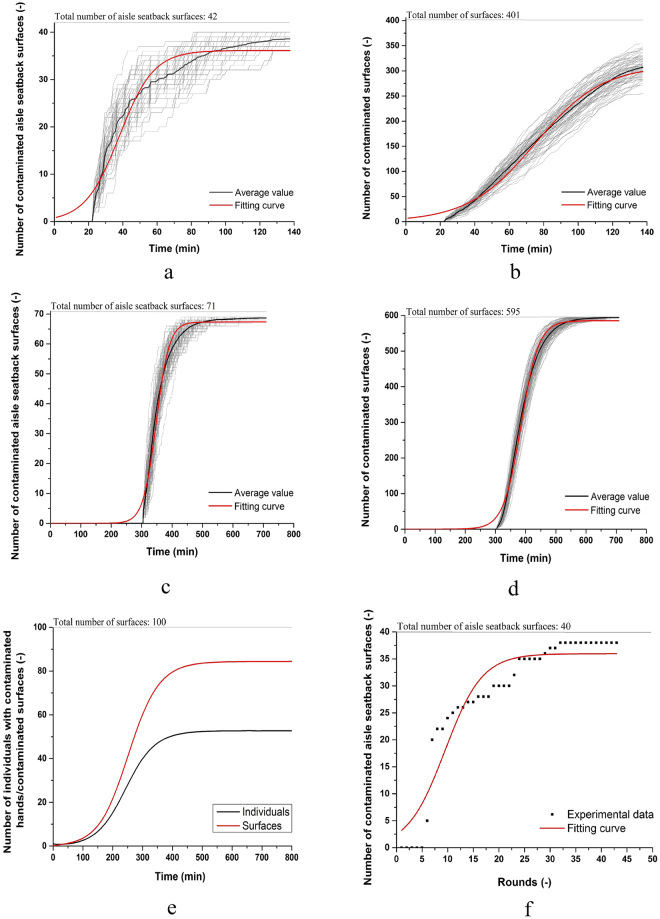
Growth of the number of contaminated surfaces (a). GII 737 outbreak, aisle seatback surfaces, (b) GII 737 outbreak, all surfaces; (c) GI 747 outbreak, aisle seatback surfaces, (d) GI 747 outbreak, all surfaces; (e) predicted result for both surfaces and individuals using a theoretical model shown in Supplementary Section 1.2; and (f) measured results (Supplementary Section 1.3). In (ad), each graph shows 100 simulations (grey) together with the average of these 100 simulations (black), and the fitting curve using the logistic function (red).
Figure 4
Figure 4
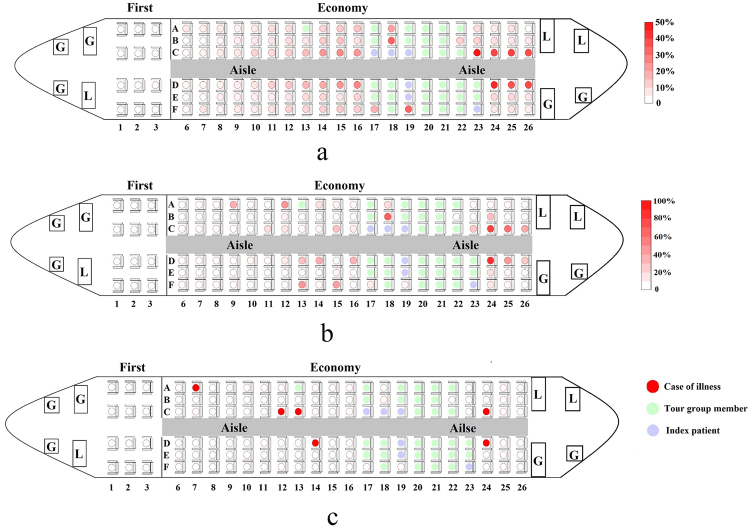
(a) Average simulated infection risk of 100 simulations; (b) simulated infection risk in one chosen simulation and (c) reported spatial distribution of cases in the norovirus GII 737 outbreak.
Figure 5
Figure 5
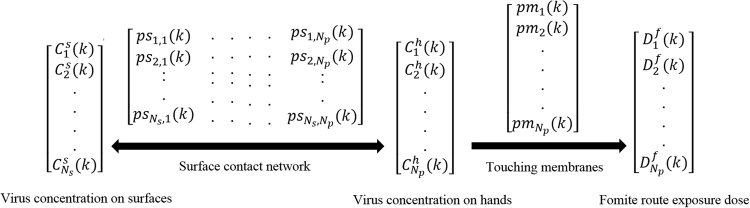
Diagram of the surface contact network and fomite route exposure model.
Figure 6
Figure 6
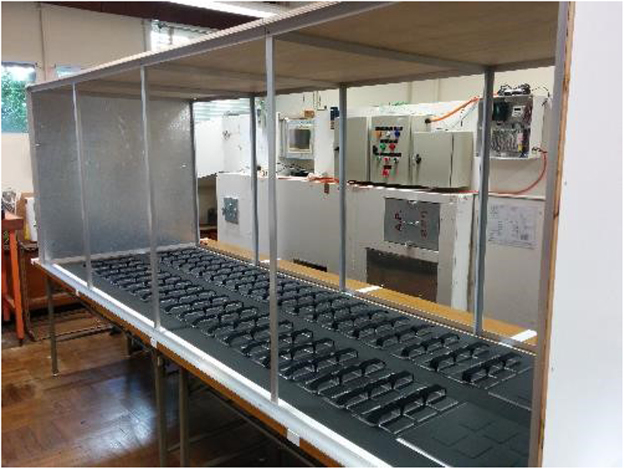
The laboratory table set up for the surface contamination network studies.

References

    1. Barker J, Vipond IB, Bloomfield SF. Effects of cleaning and disinfection in reducing the spread of Norovirus contamination via environmental surfaces. J. Hosp. Infect. 2004;58:42–49. doi: 10.1016/j.jhin.2004.04.021. - DOI - PubMed
    1. Rutala WA, Weber DJ. Current principles and practices; new research; and new technologies in disinfection, sterilization, and antisepsis (Supplement) Am. J. Infect. Control. 2013;41:1. doi: 10.1016/j.ajic.2012.12.003. - DOI - PubMed
    1. World Health Organization. WHO Guidelines on Hand Hygiene in Health Care. http://apps.who.int/iris/bitstream/10665/44102/1/9789241597906_eng.pdf?ua=1 (2009).
    1. Weber DJ, et al. Role of hospital surfaces in the transmission of emerging health care-associated pathogens: norovirus, Clostridium difficile, and Acinetobacter species. Am. J. Infect. Control. 2010;5:25–33. doi: 10.1016/j.ajic.2010.04.196. - DOI - PubMed
    1. Kundrapu S, et al. Daily disinfection of high-touch surfaces in isolation rooms to reduce contamination of healthcare workers’ hands. Infect. Control Hosp. Epidemiol. 2012;33:1039–1042. doi: 10.1086/667730. - DOI - PubMed

LinkOut - more resources