


Short- and long-term results of endoscopic ultrasound-guided transmural drainage for pancreatic pseudocysts and walled-off necrosis
- PMID: 29093619
- PMCID: PMC5656458
- DOI: 10.3748/wjg.v23.i39.7110
Short- and long-term results of endoscopic ultrasound-guided transmural drainage for pancreatic pseudocysts and walled-off necrosis
Abstract
Aim: To evaluate the short- and long-term results of endoscopic ultrasound-guided transmural drainage (EUS-GTD) for pancreatic fluid collection (PFC) and identify the predictive factors of treatment outcome for walled-off necrosis (WON) managed by EUS-GTD alone.
Methods: We investigated 103 consecutive patients with PFC who underwent EUS-GTD between September 1999 and August 2015. Patients were divided into four groups as follows: WON (n = 40), pancreatic pseudocyst (PPC; n = 11), chronic pseudocyst (n = 33), and others (n = 19). We evaluated the short- and long-term outcomes of the treatment. In cases of WON, multiple logistic regression analyses were performed to identify the predictor variables associated with the treatment success. In addition, PFC recurrence was examined in patients followed up for more than 6 mo and internal stent removal after successful EUS-GTD was confirmed.
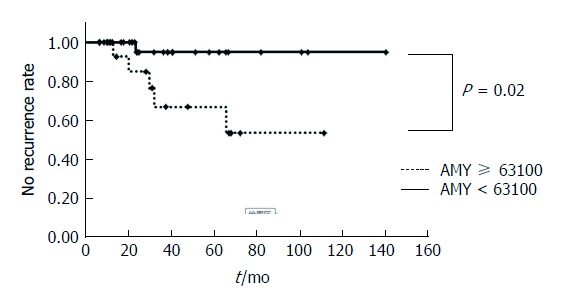
Results: In this study, the total technical success rate was 96.1%. The treatment success rate of WON, PPC, chronic pseudocyst, and others was 57.5%, 90.9%, 91.0%, and 89.5%, respectively. Contrast-enhanced computed tomography using the multivariate logistic regression analysis revealed that the treatment success rate of WON was significantly lower in patients with more than 50% pancreatic parenchymal necrosis (OR = 17.0; 95%CI: 1.9-150.7; P = 0.011) and in patients with more than 150 mm of PFC (OR = 27.9; 95%CI: 3.4-227.7; P = 0.002).The recurrence of PFC in the long term was 13.3% (median observation time, 38.8 mo). Mean amylase level in the cavity was significantly higher in the recurrence group than in the no recurrence group (P = 0.02).
Conclusion: The reduction of WON by EUS-GTD alone was associated with the proportion of necrotic tissue and extent of the cavity. The amylase level in the cavity may be a predictive factor for recurrence of PFC.
Keywords: Endoscopic ultrasound-guided transmural drainage; Pancreatic fluid collection; Revised Atlanta Classification; Walled-off necrosis.
Conflict of interest statement
Conflict-of-interest statement: The authors have no conflicts to disclose. All authors disclosed no financial relationships relevant to this publication.
Figures
References
-
- Banks PA, Bollen TL, Dervenis C, Gooszen HG, Johnson CD, Sarr MG, Tsiotos GG, Vege SS; Acute Pancreatitis Classification Working Group. Classification of acute pancreatitis--2012: revision of the Atlanta classification and definitions by international consensus. Gut. 2013;62:102–111. - PubMed
-
- van Brunschot S, Bakker OJ, Besselink MG, Bollen TL, Fockens P, Gooszen HG, van Santvoort HC; Dutch Pancreatitis Study Group. Treatment of necrotizing pancreatitis. Clin Gastroenterol Hepatol. 2012;10:1190–1201. - PubMed
-
- Varadarajulu S, Christein JD, Tamhane A, Drelichman ER, Wilcox CM. Prospective randomized trial comparing EUS and EGD for transmural drainage of pancreatic pseudocysts (with videos) Gastrointest Endosc. 2008;68:1102–1111. - PubMed
-
- Varadarajulu S, Bang JY, Phadnis MA, Christein JD, Wilcox CM. Endoscopic transmural drainage of peripancreatic fluid collections: outcomes and predictors of treatment success in 211 consecutive patients. J Gastrointest Surg. 2011;15:2080–2088. - PubMed
-
- Hookey LC, Debroux S, Delhaye M, Arvanitakis M, Le Moine O, Devière J. Endoscopic drainage of pancreatic-fluid collections in 116 patients: a comparison of etiologies, drainage techniques, and outcomes. Gastrointest Endosc. 2006;63:635–643. - PubMed
MeSH terms
LinkOut - more resources
Full Text Sources
Other Literature Sources
Miscellaneous
