. 2019 Jan;24(1):28-39.
doi: 10.1111/adb.12576. Epub 2017 Nov 2.

Mu opioid receptors in GABAergic neurons of the forebrain promote alcohol reward and drinking

Affiliations

Mu opioid receptors in GABAergic neurons of the forebrain promote alcohol reward and drinking

Sami Ben Hamida et al. Addict Biol. 2019 Jan.

Abstract

Mu opioid receptors (MORs) are widely distributed throughout brain reward circuits and their role in drug and social reward is well established. Substantial evidence has implicated MOR and the endogenous opioid system in alcohol reward, but circuit mechanisms of MOR-mediated alcohol reward and intake behavior remain elusive, and have not been investigated by genetic approaches. We recently created conditional knockout (KO) mice targeting the Oprm1 gene in GABAergic forebrain neurons. These mice (Dlx-MOR KO) show a major MOR deletion in the striatum, whereas receptors in midbrain (including the Ventral Tegmental Area or VTA) and hindbrain are intact. Here, we compared alcohol-drinking behavior and rewarding effects in total (MOR KO) and conditional KO mice. Concordant with our previous work, MOR KO mice drank less alcohol in continuous and intermittent two-bottle choice protocols. Remarkably, Dlx-MOR KO mice showed reduced drinking similar to MOR KO mice, demonstrating that MOR in the forebrain is responsible for the observed phenotype. Further, alcohol-induced conditioned place preference was detected in control but not MOR KO mice, indicating that MOR is essential for alcohol reward and again, Dlx-MOR KO recapitulated the MOR KO phenotype. Taste preference and blood alcohol levels were otherwise unchanged in mutant lines. Together, our data demonstrate that MOR expressed in forebrain GABAergic neurons is essential for alcohol reward-driven behaviors, including drinking and place conditioning. Challenging the prevailing VTA-centric hypothesis, this study reveals another mechanism of MOR-mediated alcohol reward and consumption, which does not necessarily require local VTA MORs but rather engages striatal MOR-dependent mechanisms.

Keywords: alcohol intake; forebrain GABAergic neurons; mu opioid receptor.


Conflict of interest statement

Disclosure/Conflict of Interest: The authors have no conflict of interest to disclose

Figures

Figure 1
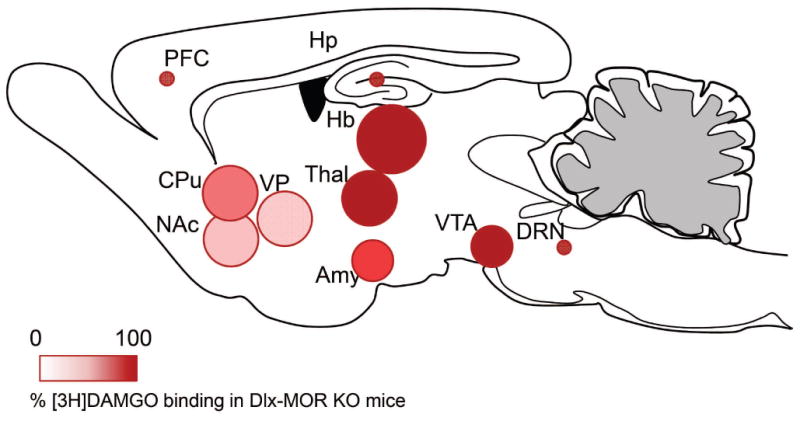
Figure 1. Anatomical distribution of the MOR deletion in Dlx-MOR KO mice
The scheme shows the quantification of MOR binding levels throughout the brain using [3H]DAMGO binding autoradiography in areas with sufficiently high signal (≥60 fmoles/mg tissue) adapted from (Charbogne et al., 2017). Circle size represents MOR density in control mice, red color intensity represents decrease of MOR agonist binding in Dlx-MOR KO mice (from dark red to white: 0% to 100% decrease). In Dlx-MOR KO mice, autoradiograms show strong receptor deletion in the NAc, VP and CPu, three structures that show abundant MOR expression in control mice. Binding is slightly decreased (Amy) or remains intact in other high-MOR (Hb, Thal, VTA) or low-MOR expressing structures (PFC, Hp, DRN). Abbreviations: Amy, Amygdala; CPu, Caudate Putamen; DRN, dorsal raphe nucleus; Hb, Habenula; Hp, Hippocampus; PFC, Prefrontal cortex; NAc, Nucleus Accumbens; Thal, Thalamus; VP, ventral pallidum; VTA, ventral tegmental area.
Figure 2
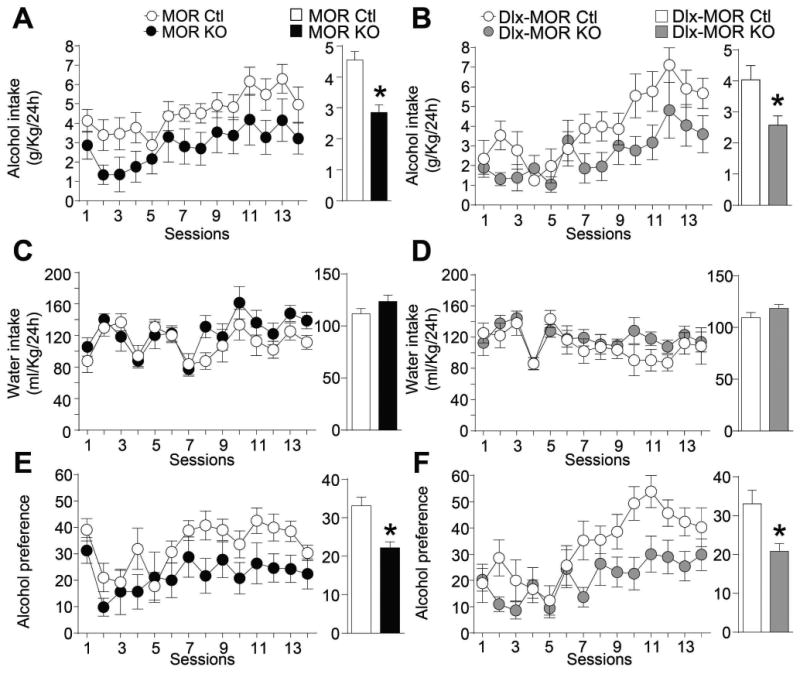
Figure 2. MOR KO and Dlx-MOR KO mice show reduced moderate alcohol consumption
MOR KO (A) and Dlx-MOR KO (B) mice consume less alcohol than their corresponding controls in an alcohol continuous-access 2-bottle-choice drinking paradigm. Animals were offered access to alcohol (10% v/v) (A-B) and water (C-D) in their home cages for 14 consecutive days (14 sessions). Values are presented as the daily mean g/kg of alcohol intake (±SEM) and ml/kg of water intake (±SEM), respectively. Alcohol preference (E-F) was calculated by dividing the total alcohol solution consumed by total fluid (alcohol plus water) consumption. Left panels represent the mean (±SEM) of alcohol and water consumption or alcohol preference per session; Right Panels represent mean (±SEM) of daily alcohol and water consumption or alcohol preference during the entire experiment. (A, C, E) n = 9-10, (B, D, F) n=9-12 for each group. *p < 0.05.
Figure 3
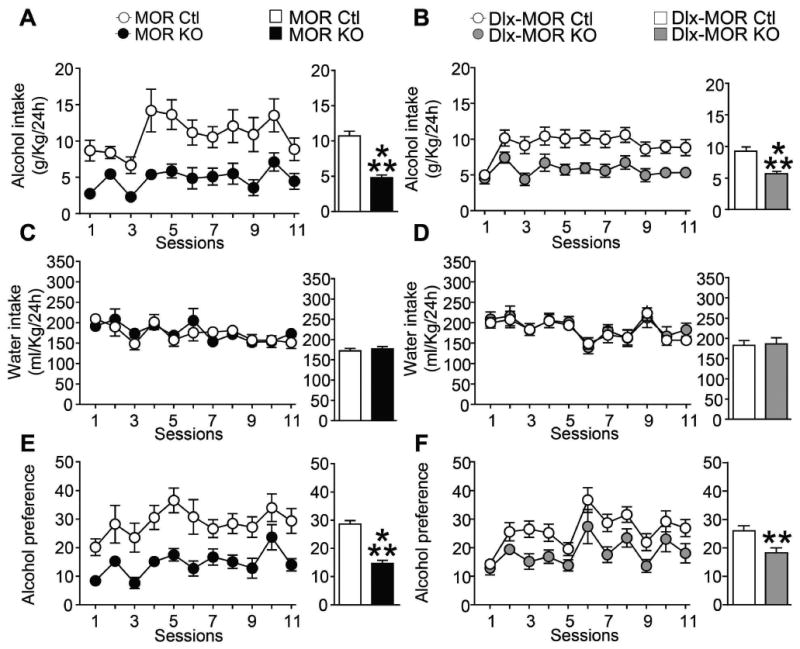
Figure 3. MOR KO and Dlx-MOR KO mice show reduced excessive alcohol consumption
MOR KO (A) and Dlx-MOR KO (B) mice consume less alcohol than their corresponding controls in a 20% alcohol intermittent-access 2-bottle-choice drinking paradigm. Animals were offered access to alcohol (20% v/v) (A-B) and water (C-D) in their home cages for 4 weeks (11 sessions). Values are presented as the daily mean g/kg of alcohol intake (±SEM) and ml/kg of water intake (±SEM), respectively. Alcohol preference (E-F) was calculated by dividing the total alcohol solution consumed by total fluid (alcohol plus water) consumption. Left panels represent the mean (±SEM) of alcohol and water consumption or alcohol preference per session; Right Panels represent mean (±SEM) of daily alcohol and water consumption or alcohol preference during the entire experiment. (A, C, E) n = 12-14, (B, D, F) n=19-28 for each group. **p < 0.01; ***p< 0.001.
Figure 4
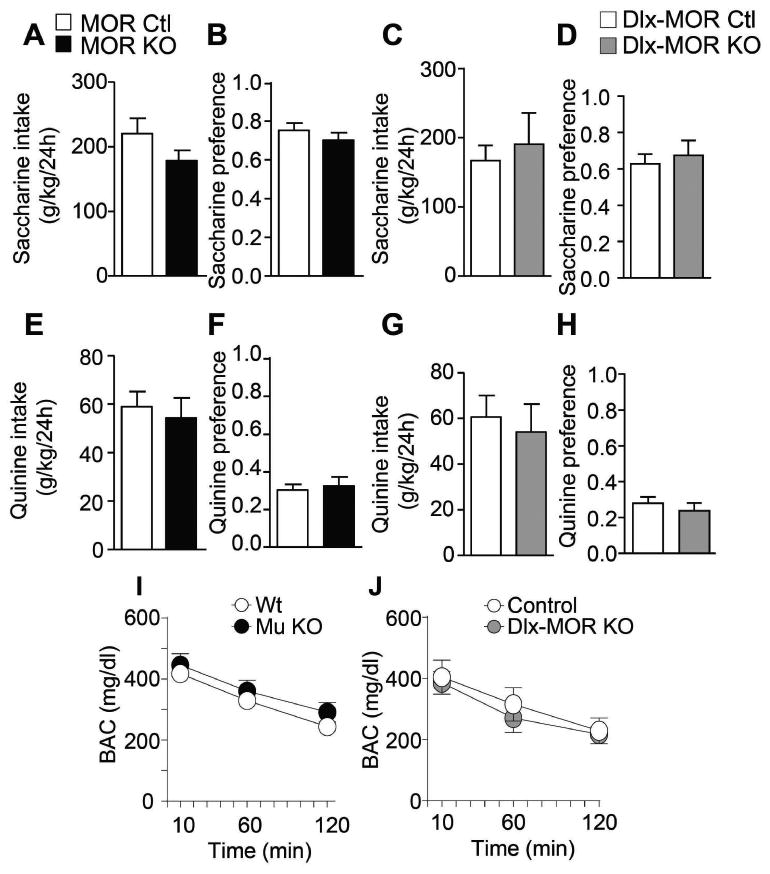
Figure 4. MOR KO and Dlx-MOR KO mice show intact taste palatability and alcohol metabolism
(A-H) No difference in consumption (A, C, E, G) or preference (B, D, F, H) for sweet (saccharin; A-D) or bitter (quinine, E-H) solutions between MOR KO and Dlx-MOR KO compared to their corresponding controls. Data are mean ± SEM of daily fluid intake in g/kg. (I-J) MORs KO and Dlx-MOR KO mice showed similar blood alcohol concentrations after injection of alcohol compared with WT controls. Data represent level of blood alcohol in mg/dL. (A-H) MORs KO, n = 12-14; Dlx-MOR KO, n =9-16 for each group. (I-J), n = 6-7 for each group.
Figure 5
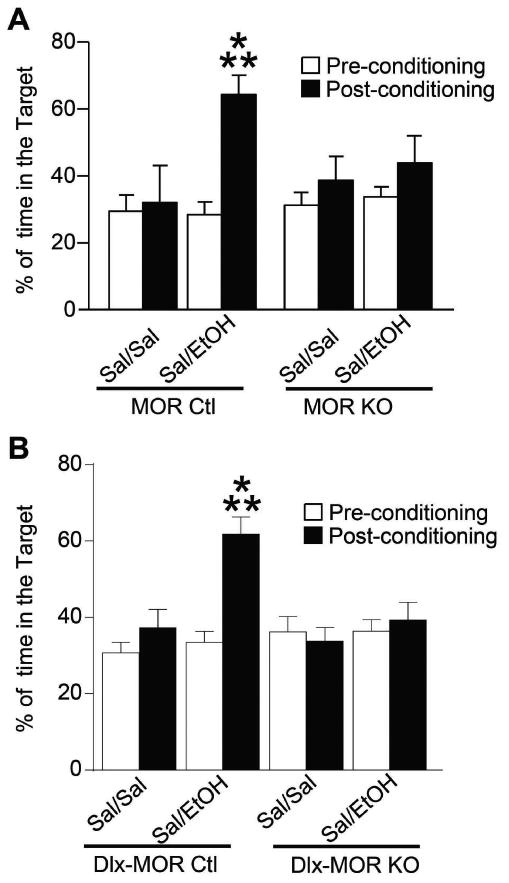
Figure 5. MOR KO and Dlx-MOR mice lack alcohol-induced conditioned place preference (CPP)
MOR KO (A) and Dlx-MOR KO (B) mice do not develop alcohol-induced CPP. The habituation day (pre-conditioning; day 1) was designed to evaluate drug-free baseline preference for the compartments. Animals were placed in the neutral compartment and had free access to the entire apparatus for 20 min. Next, during the conditioning phase (6 days), animals were daily administered (i.p.) alcohol (1.8 g/kg) or saline solution and were then confined in the drug- or non-drug-paired compartment for 5 min. 24 hours after the last conditioning day, mice went through the post-conditioning test which was similar to the habituation phase. Data represent percentage of total test time spent in the alcohol- or saline- paired compartment during the pre-conditioning and the post-conditioning tests. Data represent mean (± SEM). (A) n = 7-12, (B) n=19-23 for each group. ***p < 0.001.

References

    1. Bach P, Vollsta Dt-Klein S, Kirsch M, Hoffmann S, Jorde A, Frank J, Charlet K, Beck A, Heinz A, Walter H, Sommer WH, Spanagel R, Rietschel M, Kiefer F. Increased mesolimbic cue-reactivity in carriers of the mu-opioid-receptor gene OPRM1 A118G polymorphism predicts drinking outcome: a functional imaging study in alcohol dependent subjects. Eur Neuropsychopharmacol. 2015;25:1128–1135. - PubMed
    1. Bachmanov AA, Kiefer SW, Molina JC, Tordoff MG, Duffy VB, Bartoshuk LM, Mennella JA. Chemosensory factors influencing alcohol perception, preferences, and consumption. Alcohol Clin Exp Res. 2003;27:220–231. - PMC - PubMed
    1. Badiani A, Belin D, Epstein D, Calu D, Shaham Y. Opiate versus psychostimulant addiction: the differences do matter. Nat Rev Neurosci. 2011;12:685–700. - PMC - PubMed
    1. Balldin J, Berglund M, Borg S, Mansson M, Bendtsen P, Franck J, Gustafsson L, Halldin J, Nilsson LH, Stolt G, Willander A. A 6-month controlled naltrexone study: combined effect with cognitive behavioral therapy in outpatient treatment of alcohol dependence. Alcohol Clin Exp Res. 2003;27:1142–1149. - PubMed
    1. Barson JR, Carr AJ, Soun JE, Sobhani NC, Leibowitz SF, Hoebel BG. Opioids in the nucleus accumbens stimulate ethanol intake. Physiol Behav. 2009;98:453–459. - PMC - PubMed

Publication types