


Prospective research on infants with mild encephalopathy: the PRIME study
- PMID: 29095433
- PMCID: PMC8592379
- DOI: 10.1038/jp.2017.164
Prospective research on infants with mild encephalopathy: the PRIME study
Abstract
Objective: To determine short-term outcomes of infants with evidence of hypoxia-ischemia at birth and classified as mild neonatal encephalopathy (NE) at <6 h of age.
Study design: Prospective multicenter study. Mild NE was defined as ⩾1 abnormal category in modified Sarnat score. Primary outcome was any abnormality on early amplitude integrated electroencephalogram (aEEG) or seizures, abnormal brain magnetic resonance imaging (MRI) or neurological exam at discharge.
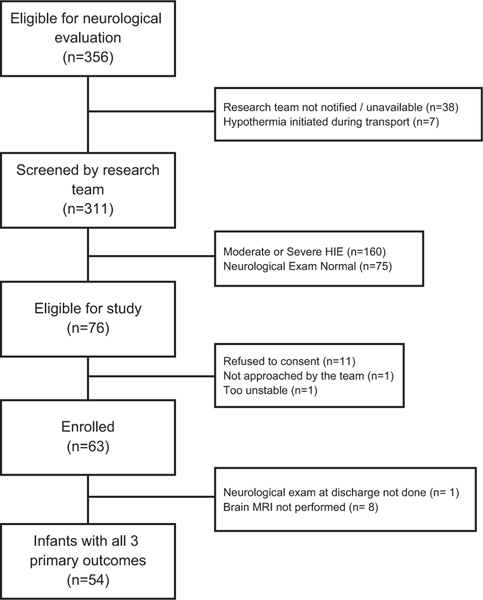
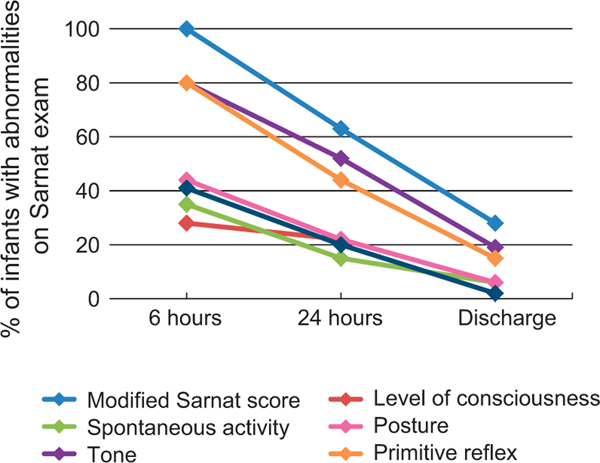
Results: A total of 54/63 (86%) of enrolled infants had data on components of the primary outcome, which was abnormal in 28/54 (52%): discontinuous aEEG (n=4), MRI (n=9) and discharge exam (n=22). Abnormal tone and/or incomplete Moro were the most common findings. MRI abnormalities were confined to cerebral cortex but two infants had basal ganglia and/or thalamus involvement. The 18 to 24 months follow-up is ongoing.
Conclusions: A larger than expected proportion of mild NE infants with abnormal outcomes was observed. Future research should evaluate safety and efficacy of neuroprotection for mild NE.
Trial registration: ClinicalTrials.gov NCT01747863.
Conflict of interest statement
CONFLICT OF INTEREST
The authors declare no conflict of interest.
Figures
References
-
- Black RE, Cousens S, Johnson HL, Lawn JE, Rudan I, Bassani DG et al. Global, regional, and national causes of child mortality in 2008: a systematic analysis. Lancet 2010; 375(9730): 1969–1987. - PubMed
-
- Sarnat HB, Sarnat MS. Neonatal encephalopathy following fetal distress: a clinical and electroencephalographic study. Arch Neurol 1976; 33(10): 696–705. - PubMed
-
- Levene MI, Grindulis H, Sands C, Moore JR. Comparison of two methods of predicting outcome in perinatal asphyxia. Lancet 1986; 327(8472): 67–69. - PubMed
-
- Finer NN, Robertson CM, Richards RT, Pinnell LE, Peters KL. Hypoxic-ischemic encephalopathy in term neonates: perinatal factors and outcome. J Pediatr 1981; 98(1): 112–117. - PubMed
-
- Robertson C, Finer N. Term infants with hypoxic-ischemic encephalopathy: outcome at 3.5 years. Dev Med Child Neurol 1985; 27(4): 473–484. - PubMed
Publication types
MeSH terms
Associated data
Grants and funding
LinkOut - more resources
Full Text Sources
Other Literature Sources
Medical
