. 2018 Jan;38(1):33-43.
doi: 10.1002/pd.5175. Epub 2017 Dec 3.

Diagnosis of lethal or prenatal-onset autosomal recessive disorders by parental exome sequencing

Affiliations

Diagnosis of lethal or prenatal-onset autosomal recessive disorders by parental exome sequencing

Karen L Stals et al. Prenat Diagn. 2018 Jan.

Abstract

Objective: Rare genetic disorders resulting in prenatal or neonatal death are genetically heterogeneous, but testing is often limited by the availability of fetal DNA, leaving couples without a potential prenatal test for future pregnancies. We describe our novel strategy of exome sequencing parental DNA samples to diagnose recessive monogenic disorders in an audit of the first 50 couples referred.

Method: Exome sequencing was carried out in a consecutive series of 50 couples who had 1 or more pregnancies affected with a lethal or prenatal-onset disorder. In all cases, there was insufficient DNA for exome sequencing of the affected fetus. Heterozygous rare variants (MAF < 0.001) in the same gene in both parents were selected for analysis. Likely, disease-causing variants were tested in fetal DNA to confirm co-segregation.

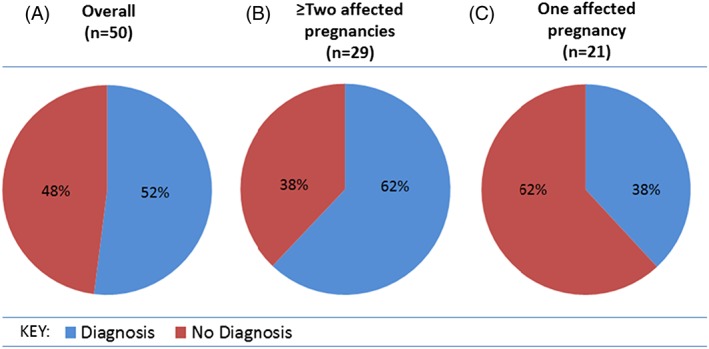
Results: Parental exome analysis identified heterozygous pathogenic (or likely pathogenic) variants in 24 different genes in 26/50 couples (52%). Where 2 or more fetuses were affected, a genetic diagnosis was obtained in 18/29 cases (62%). In most cases, the clinical features were typical of the disorder, but in others, they result from a hypomorphic variant or represent the most severe form of a variable phenotypic spectrum.

Conclusion: We conclude that exome sequencing of parental samples is a powerful strategy with high clinical utility for the genetic diagnosis of lethal or prenatal-onset recessive disorders. © 2017 The Authors Prenatal Diagnosis published by John Wiley & Sons Ltd.


Figures
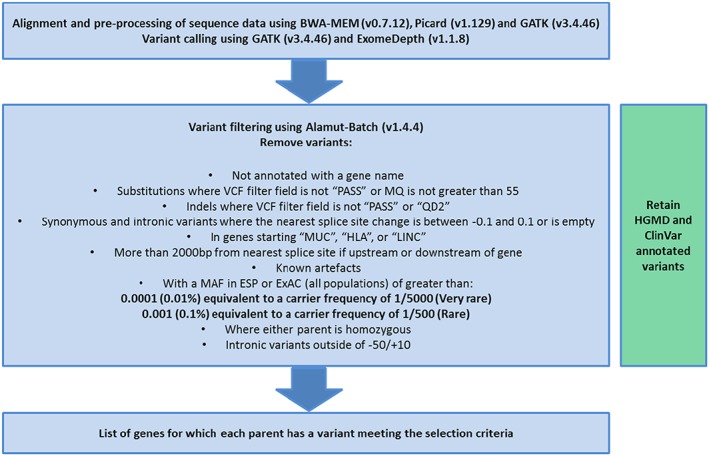
Figure 1
Figure 1
Bioinformatics pipeline. The filtering criteria are applied to generate a shortlist of genes in which both parents have a heterozygous variant meeting the criteria. Abbreviations: VCF (variant call format), MQ (mapping quality), QD2 (quality by depth), MUC (mucin antigen), HLA (human leukocyte antigen), LINC (LincRNA), MAF (minor allele frequency), ESP (Exome Sequencing Project http://evs.gs.washington.edu/EVS/), ExAC (Exome Aggregation Consortium http://exac.broadinstitute.org/), and dbSNP (NCBI short genetic variation database https://www.ncbi.nlm.nih.gov/projects/SNP/). [Colour figure can be viewed at wileyonlinelibrary.com]
Figure 2
Figure 2
(A) The overall diagnostic yield in the 50 couples included in this audit. (b) The diagnostic yield for couples with 2 or more affected pregnancies. (C) The diagnostic yield for couples with a single affected pregnancy
Figure 3
Figure 3
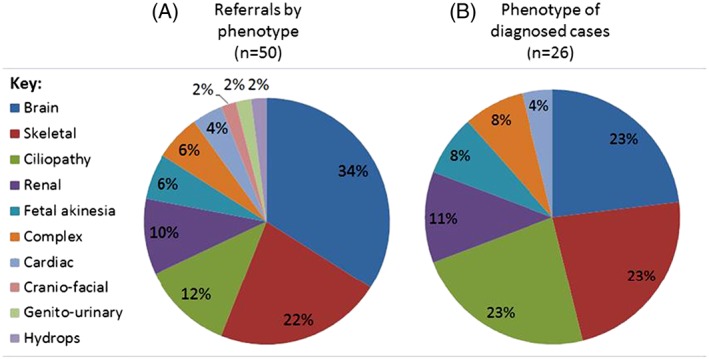
Pie charts to show the phenotypic spectrum for (A) all couples referred for testing by using this strategy and (B) the 26 couples with a genetic diagnosis
Figure 4
Figure 4
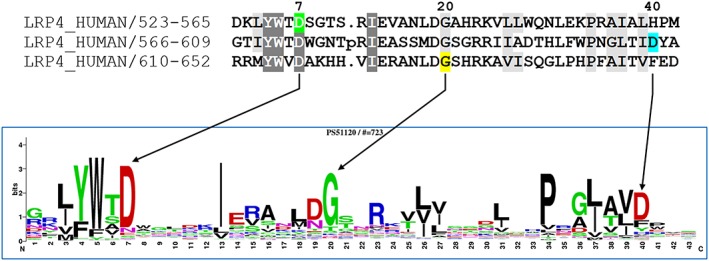
The upper panel shows an alignment of the YWTD repeats 2 to 4 of human LRP4 from PROSITE entry PS51120 (gaps removed), highlighting the variants identified in case 9, p.(Gly629Glu) (yellow) and p.(Asp606Asn) (blue) and the previously reported p.(Asp529Asn) (green). Representation of the sequence logo below indicates that the wild‐type residues are the most commonly seen, whereas the variant residues are either absent or present at a low frequency (≤1.5%)
Figure 5
Figure 5
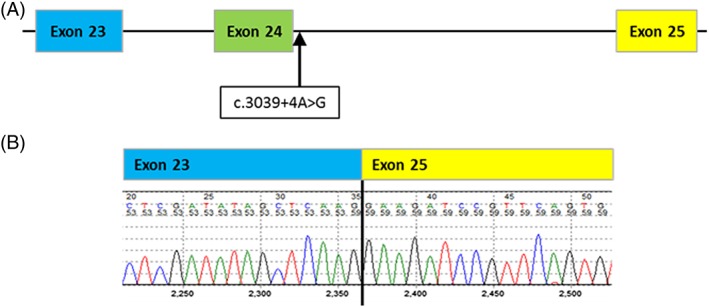
(A) Location of the IFT122 variant, NC_000003.11(NM_052985.3)c.3039+4A>G, in intron 24. (b) Sequence electropherogram of the IFT122 RT‐PCR product demonstrating the effect of this splicing variant in the maternal RNA. The primers used were designed over the suspected breakpoint (exon23‐exon25 boundary) so only the variant allele was amplified

References

    1. Yang Y, Muzny DM, Reid JG, et al Clinical whole‐exome sequencing for the diagnosis of mendelian disorders. N Engl J Med 2013. Oct 17;369(16):1502–1511. - PMC - PubMed
    1. Yang Y, Muzny DM, Xia F, et al Molecular findings among patients referred for clinical whole‐exome sequencing. JAMA 2014. Nov 12;312(18):1870–1879. - PMC - PubMed
    1. xLarge‐scale discovery of novel genetic causes of developmental disorders. Nature 2015. Mar 12;519(7542):223–228. - PMC - PubMed
    1. Reuter MS, Tawamie H, Buchert R, et al Diagnostic yield and novel candidate genes by exome sequencing in 152 consanguineous families with neurodevelopmental disorders. JAMA Psychiat 2017. Mar 01;74(3):293–299. - PubMed
    1. Ellard S, Kivuva E, Turnpenny P, et al An exome sequencing strategy to diagnose lethal autosomal recessive disorders. Eur J Hum Genet 2015. Mar;23(3):401–404. - PMC - PubMed