


Race modifies the relationship between cognition and Alzheimer's disease cerebrospinal fluid biomarkers
- PMID: 29096697
- PMCID: PMC5668981
- DOI: 10.1186/s13195-017-0315-1
Race modifies the relationship between cognition and Alzheimer's disease cerebrospinal fluid biomarkers
Abstract
Background: African Americans have been reported to have a higher prevalence of Alzheimer's disease (AD) than Caucasians, but etiology-specific AD biomarkers have not been systematically analyzed in older African Americans. Coexisting cerebrovascular disease may also contribute to this increased prevalence. We hypothesized that cerebrospinal fluid (CSF) biomarkers of amyloid, neurodegeneration, and endothelial dysfunction would differ between older African Americans and Caucasians with normal cognition and cognitive impairment associated with AD.
Methods: We prospectively recruited 135 older Americans to undergo detailed clinical, neuropsychological, genetic, magnetic resonance imaging (MRI), and CSF analysis from 2013 to 2015 at Emory University (Atlanta, GA, USA). We compared levels of CSF markers for β-amyloid (Aβ42, Aβ40), total and phosphorylated tau (t-tau and p-tau181, respectively), endothelial dysfunction (soluble vascular cell adhesion molecule 1, soluble intercellular adhesion molecule 1), α-synuclein, and neurodegeneration (neurofilament light chain [NfL]), as well as MRI markers, for hippocampal atrophy and cerebrovascular disease (white matter hyperintensity [WMH] volume).
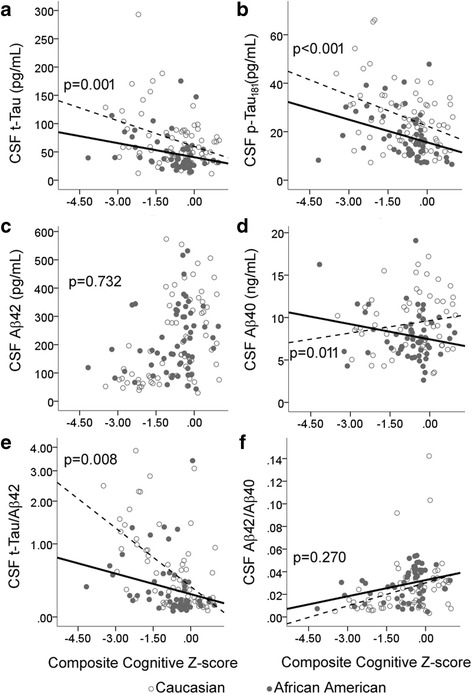
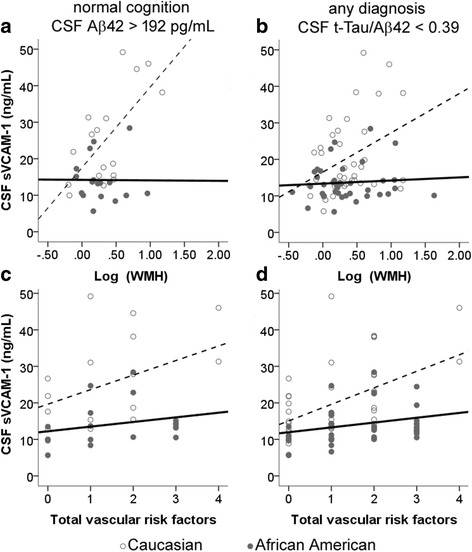
Results: Sixty-five older African Americans (average age, 69.1 years) and 70 older Caucasians (average age, 70.8 years) were included. After adjusting for demographic variables, AD risk alleles, and cognitive function, older African Americans had lower CSF levels of p-tau181 (difference of 7.4 pg/ml; 95% CI, 3.7-11.2 pg/ml; p < 0.001), t-tau (difference of 23.6 pg/ml; 95% CI, 9.5-37.7; p = 0.001), and Aβ40 (difference of 1.35 ng/ml; 95% CI, 0.29-2.42 ng/ml; p = 0.013) despite similar levels of Aβ42, NfL, WMH volume, and hippocampal volume. Cognitively impaired African Americans also had lower CSF t-tau/Aβ42 (difference of 0.255 per 1-SD change in composite cognition; 95% CI, 0.100-0.409; p = 0.001) and p-tau181/Aβ42 (difference of 0.076 per 1-SD change in composite cognition; 95% CI, 0.031-0.122; p = 0.001). These could not be explained by measured biomarkers of non-AD processes, but African Americans may be more susceptible than Caucasians to the cognitive effects of WMH.
Conclusions: Despite comparable levels of CSF Aβ42 and Aβ42/Aβ40, cognitive impairment in African Americans is associated with smaller changes in CSF tau markers but greater impact from similar WMH burden than Caucasians. Race-associated differences in CSF tau markers and ratios may lead to underdiagnosis of AD in African Americans.
Trial registration: ClinicalTrials.gov, NCT02089555 . Retrospectively registered on 14 March 2014.
Keywords: African American; Amyloid; Dementia; Endothelial dysfunction; Mild cognitive impairment; Tau.
Conflict of interest statement
Ethics approval and consent to participate
This study was approved by the Emory Institutional Review Board (number 66145). Informed consent was obtained from all subjects or their authorized representatives.
Consent for publication
Not applicable.
Competing interests
WTH has a patent (assignee, Emory University) on the use of CSF p/t-tau ratio in the evaluation of frontotemporal lobar degeneration, has received research support from Avid Pharmaceuticals, and has received travel support from Eli Lilly and Hoffman-La Roche. DQ has received research support from Medtronic and Siemens Healthcare.
Publisher’s Note
Springer Nature remains neutral with regard to jurisdictional claims in published maps and institutional affiliations.
Figures
References
-
- Reitz C, Jun G, Naj A, Rajbhandary R, Vardarajan BN, Wang LS, Valladares O, Lin CF, Larson EB, Graff-Radford NR, et al. Variants in the ATP-binding cassette transporter (ABCA7), apolipoprotein E ε4, and the risk of late-onset Alzheimer disease in African Americans. JAMA. 2013;309:1483–92. doi: 10.1001/jama.2013.2973. - DOI - PMC - PubMed
Publication types
MeSH terms
Substances
Associated data
Grants and funding
LinkOut - more resources
Full Text Sources
Other Literature Sources
Medical
