


PDX1, Neurogenin-3, and MAFA: critical transcription regulators for beta cell development and regeneration
- PMID: 29096722
- PMCID: PMC5667467
- DOI: 10.1186/s13287-017-0694-z
PDX1, Neurogenin-3, and MAFA: critical transcription regulators for beta cell development and regeneration
Abstract
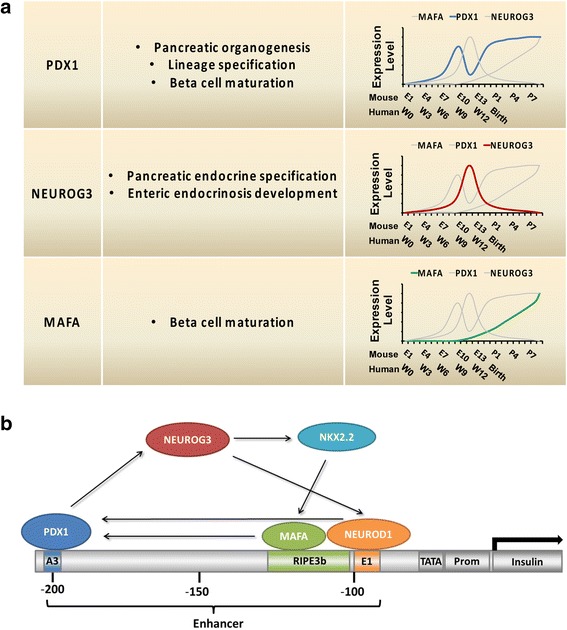
Transcription factors regulate gene expression through binding to specific enhancer sequences. Pancreas/duodenum homeobox protein 1 (PDX1), Neurogenin-3 (NEUROG3), and V-maf musculoaponeurotic fibrosarcoma oncogene homolog A (MAFA) are transcription factors critical for beta cell development and maturation. NEUROG3 is expressed in endocrine progenitor cells and controls islet differentiation and regeneration. PDX1 is essential for the development of pancreatic exocrine and endocrine cells including beta cells. PDX1 also binds to the regulatory elements and increases insulin gene transcription. Likewise, MAFA binds to the enhancer/promoter region of the insulin gene and drives insulin expression in response to glucose. In addition to those natural roles in beta cell development and maturation, ectopic expression of PDX1, NEUROG3, and/or MAFA has been successfully used to reprogram various cell types into insulin-producing cells in vitro and in vivo, such as pancreatic exocrine cells, hepatocytes, and pluripotent stem cells. Here, we review biological properties of PDX1, NEUROG3, and MAFA, and their applications and limitations for beta cell regenerative approaches. The primary source literature for this review was acquired using a PubMed search for articles published between 1990 and 2017. Search terms include diabetes, insulin, trans-differentiation, stem cells, and regenerative medicine.
Keywords: Diabetes; Embryonic stem cells; Induced pluripotent stem cells; Regenerative medicine; Trans-differentiation.
Conflict of interest statement
Ethics approval and consent to participate
Not applicable.
Consent for publication
Not applicable.
Competing interests
The authors declare that they have no competing interests.
Publisher’s note
Springer Nature remains neutral with regard to jurisdictional claims in published maps and institutional affiliations.
Figures
References
Publication types
MeSH terms
Substances
LinkOut - more resources
Full Text Sources
Other Literature Sources
Medical
Research Materials
