


Infectious disease transmission: survey of contacts between hospital-based healthcare workers and working adults from the general population
- PMID: 29097147
- PMCID: PMC7114670
- DOI: 10.1016/j.jhin.2017.10.020
Infectious disease transmission: survey of contacts between hospital-based healthcare workers and working adults from the general population
Abstract
Background: Healthcare workers (HCWs) may be the inadvertent interface between the healthcare setting and the community for infectious diseases transmission.
Aim: To investigate HCWs' contacts during a work day and compare these against working adults from the general population.
Methods: Prospective survey of contacts through 24 h self-reported diary in three public sector tertiary care hospitals and community-based working adults in Singapore. Participants were HCWs and working adults from the community.
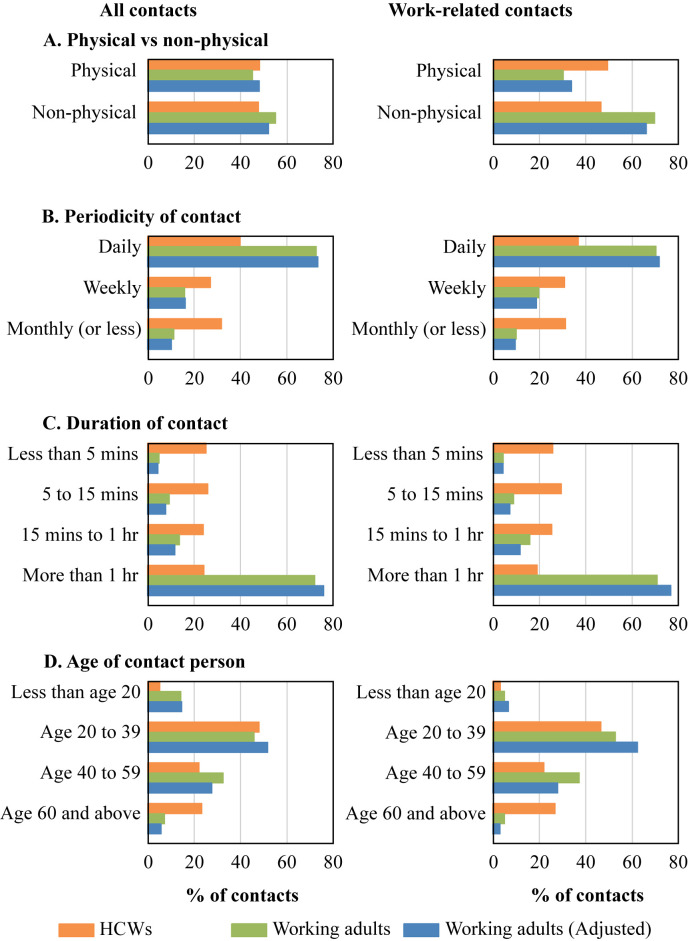
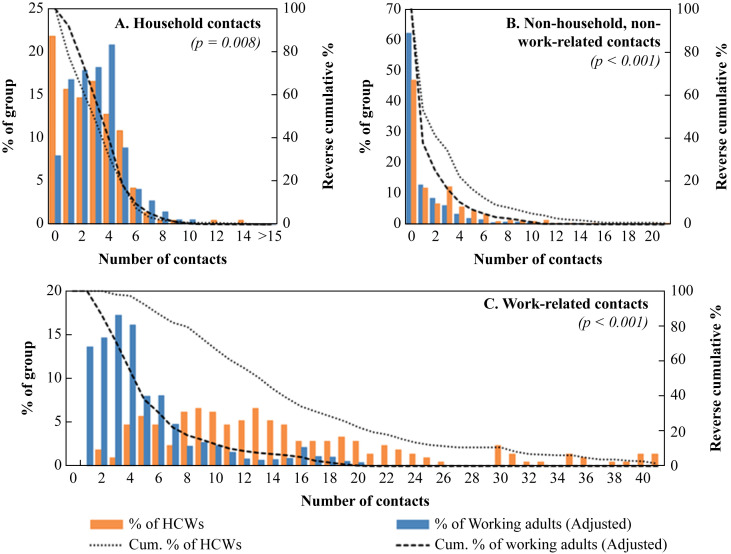
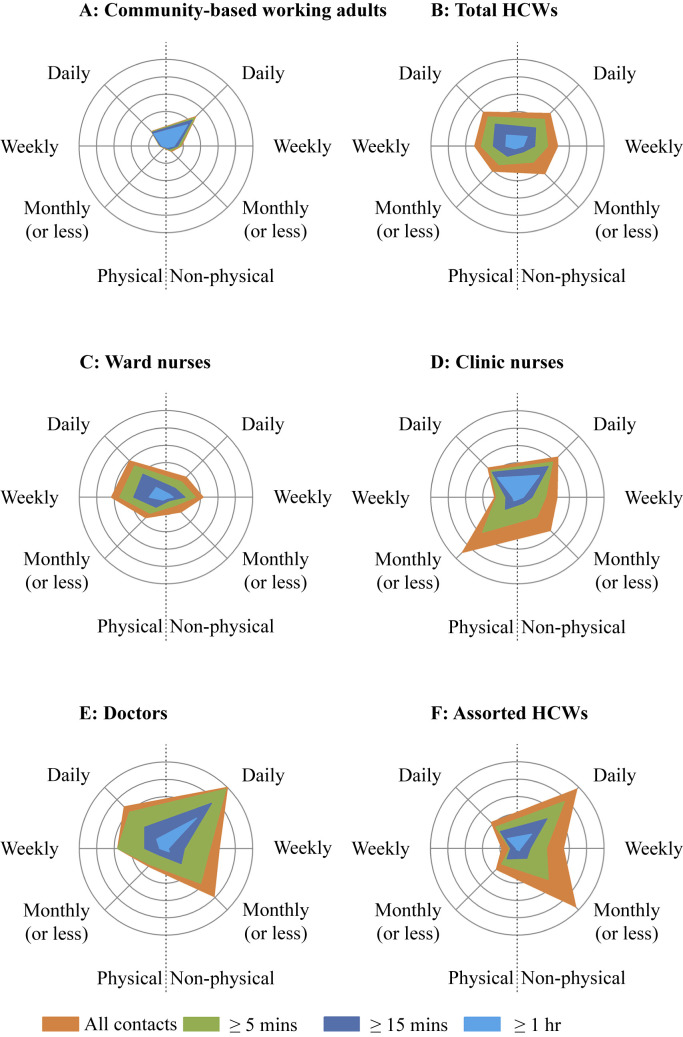
Findings: In all, 211 HCWs and 1028 working adults reported a total of 4066 and 9206 contacts. HCWs reported more work-related contacts than community-based working adults (median of 13 versus 4), and more contacts that were neither household nor work-related (1 versus 0) but fewer household contacts (2 versus 3). HCWs reported more work-related contacts involving physical contacts, and more new contacts particularly with short duration (≤15 min) compared to community-based working adults. Among different HCW types, doctors reported the highest whereas ward-based nurses reported the lowest total work-related contacts. Around half of ward-based and clinic-based nurses' contacts involved physical touch. Work-related contacts reported by clinic-based nurses, doctors, and assorted HCWs were shorter than in ward-based nurses, with a substantial number effectively occurring with new contacts. Institutional effects significant on univariate analyses were much reduced and non-significant after adjusting for confounding by HCW type.
Conclusion: HCWs' contacts differ substantially from those of community-based working adults. HCWs may thus be at higher risk of acquiring and spreading contact-transmissible and respiratory infections due to the nature of their work. Whereas total number of contacts was fairly similar between HCW types, the characteristics of their contacts differed substantively.
Keywords: Community-based adults; Doctors; Healthcare workers; Infectious diseases; Nurses; Transmission.
Copyright © 2017 The Authors. Published by Elsevier Ltd.. All rights reserved.
Figures
References
-
- Wallinga J., Edmunds W.J., Kretzschmar M. Perspective: human contact patterns and the spread of airborne infectious diseases. Trends Microbiol. 1999;7:372–377. - PubMed
-
- Huttunen R., Syrjänen J. Healthcare workers as vectors of infectious diseases. Eur J Clin Microbiol Infect Dis. 2014;33:1477–1488. - PubMed
-
- Jagger J. Caring for healthcare workers: a global perspective. Infect Control Hosp Epidemiol. 2007;28:1–4.
-
- Suwantarat N., Apisarnthanarak A. Risks to healthcare workers with emerging diseases: lessons from MERS-CoV, Ebola, SARS, and avian flu. Curr Opin Infect Dis. 2015;28:349–361. - PubMed
MeSH terms
LinkOut - more resources
Full Text Sources
Other Literature Sources
Medical
