Review
. 2018 Mar 1;314(3):L443-L460.
doi: 10.1152/ajplung.00374.2017. Epub 2017 Nov 2.

Emerging role of angiogenesis in adaptive and maladaptive right ventricular remodeling in pulmonary hypertension

Affiliations
Review

Emerging role of angiogenesis in adaptive and maladaptive right ventricular remodeling in pulmonary hypertension

Andrea L Frump et al. Am J Physiol Lung Cell Mol Physiol. .

Abstract

Right ventricular (RV) function is the primary prognostic factor for both morbidity and mortality in pulmonary hypertension (PH). RV hypertrophy is initially an adaptive physiological response to increased overload; however, with persistent and/or progressive afterload increase, this response frequently transitions to more pathological maladaptive remodeling. The mechanisms and disease processes underlying this transition are mostly unknown. Angiogenesis has recently emerged as a major modifier of RV adaptation in the setting of pressure overload. A novel paradigm has emerged that suggests that angiogenesis and angiogenic signaling are required for RV adaptation to afterload increases and that impaired and/or insufficient angiogenesis is a major driver of RV decompensation. Here, we summarize our current understanding of the concepts of maladaptive and adaptive RV remodeling, discuss the current literature on angiogenesis in the adapted and failing RV, and identify potential therapeutic approaches targeting angiogenesis in RV failure.


Figures
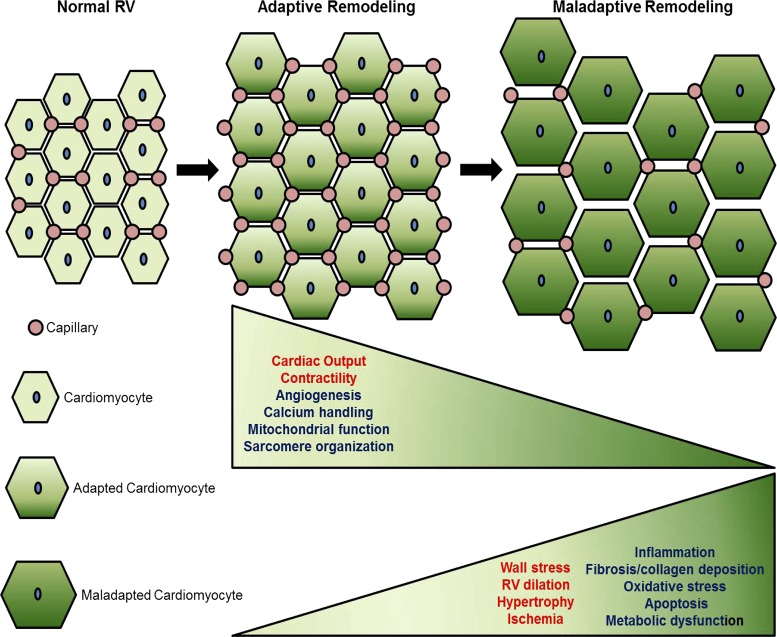
Fig. 1.
Fig. 1.
Right ventricle (RV) vasculature during transition from adaptive to maladaptive RV remodeling. Current evidence associates RV adaptive remodeling (characterized by maintained RV contractile function) with increased proangiogenic signaling and capillary density, whereas the transition to maladaptive remodeling (characterized by decreased RV contractile function) is marked by RV endothelial cell dysfunction and capillary rarefaction. In addition to capillary rarefaction, the transition from adaptive to maladaptive RV remodeling is characterized by decreased calcium handling, mitochondrial function, and sarcomere organization and increased hypertrophy, ischemia, inflammation, fibrosis, oxidative stress, apoptosis, and metabolic dysfunction. The exact contribution of each of these molecular processes is currently unknown and remains to be determined. Functionally, this process is characterized by worsening cardiac output and increasing RV dilation with increasing wall stress. Functional/structural changes shown in red font; biochemical/molecular changes shown in blue font.
Fig. 2.
Fig. 2.
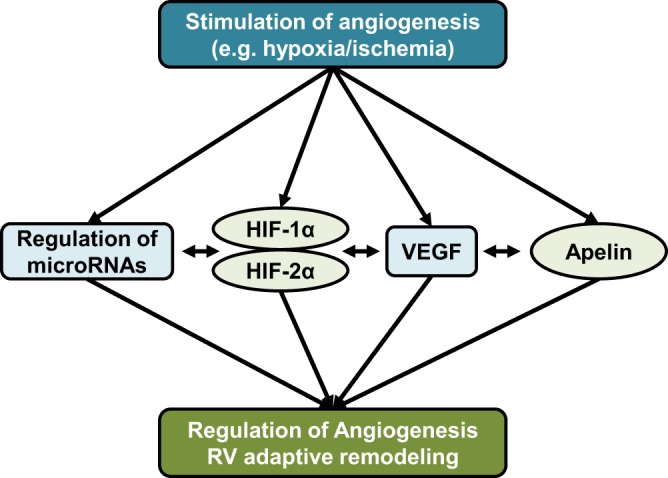
Simplified schematic of currently known pathways regulating angiogenesis in the right ventricle (RV). Proangiogenic factors such as hypoxia or ischemia increase activation and/or abundance of proangiogenic mediators such as hypoxia-inducible factors, VEGF, apelin, and micro-RNAs. Significant cross-talk exists between angiogenic pathways. For example, hypoxia-inducible factors (HIFs) are master regulators that regulate the expression of other regulators to induce angiogenesis during adaptive remodeling of the RV. However, vascular endothelial growth factor (VEGF), apelin, and micro-RNAs are likely also activated independently of HIFs. Decreased or insufficient upregulation of proangiogenic pathways, as well as defects in their downstream signaling pathways are purported to contribute to maladaptive RV remodeling and decompensation.
Fig. 3.
Fig. 3.
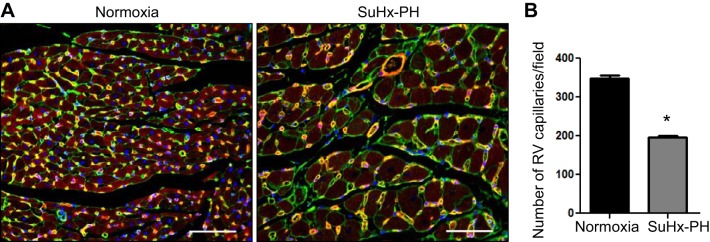
RV vascular rarefaction in Sugen5416 + Hypoxia- pulmonary hypertension (SuHx-PH) rats. A: immunofluorescence overlay of WGA (wheat germ agglutinin, green, cardiomyocytes), Lectin Griffonia simplicifolia (red, endothelial cells) and DAPI (blue, nuclei) stains in female normoxic control or SuHx-PH rats. B: capillaries were quantified from 4 fields per animal; n = 4 animals /group. Images were taken at ×20 magnification; scale bars, 50 µm. Data are expressed as means ± SE *P < 0.05 vs. normoxic control. Note that this analysis used traditional 2-D analysis similar to previous studies in the field.

References

    1. Abe K, Toba M, Alzoubi A, Ito M, Fagan KA, Cool CD, Voelkel NF, McMurtry IF, Oka M. Formation of plexiform lesions in experimental severe pulmonary arterial hypertension. Circulation 121: 2747–2754, 2010. doi:10.1161/CIRCULATIONAHA.109.927681. - DOI - PubMed
    1. Adamis AP, Miller JW, Bernal M-T, D’Amico DJ, Folkman J, Yeo T-K, Yeo K-T. Increased vascular endothelial growth factor levels in the vitreous of eyes with proliferative diabetic retinopathy. Am J Ophthalmol 118: 445–450, 1994. doi:10.1016/S0002-9394(14)75794-0. - DOI - PubMed
    1. Akhavein F, St-Michel EJ, Seifert E, Rohlicek CV. Decreased left ventricular function, myocarditis, and coronary arteriolar medial thickening following monocrotaline administration in adult rats. J Appl Physiol (1985) 103: 287–295, 2007. doi:10.1152/japplphysiol.01509.2005. - DOI - PubMed
    1. Alastalo TP, Li M, Pde Jesus Perez V, Pham D, Sawada H, Wang JK, Koskenvuo M, Wang L, Freeman BA, Chang HY, Rabinovitch M. Disruption of PPARγ/β-catenin-mediated regulation of apelin impairs BMP-induced mouse and human pulmonary arterial EC survival. J Clin Invest 121: 3735–3746, 2011. doi:10.1172/JCI43382. - DOI - PMC - PubMed
    1. Alzoubi A, Toba M, Abe K, O’Neill KD, Rocic P, Fagan KA, McMurtry IF, Oka M. Dehydroepiandrosterone restores right ventricular structure and function in rats with severe pulmonary arterial hypertension. Am J Physiol Heart Circ Physiol 304: H1708–H1718, 2013. doi:10.1152/ajpheart.00746.2012. - DOI - PubMed

Publication types

LinkOut - more resources