doi: 10.3324/haematol.2017.178723.
Epub 2017 Nov 2.
MDS1 and EVI1 complex locus (MECOM): a novel candidate gene for hereditary hematological malignancies
Affiliations
- PMID: 29097497
- PMCID: PMC5792286
- DOI: 10.3324/haematol.2017.178723
Item in Clipboard
MDS1 and EVI1 complex locus (MECOM): a novel candidate gene for hereditary hematological malignancies
Haematologica.
2018 Feb.
No abstract available
Figures
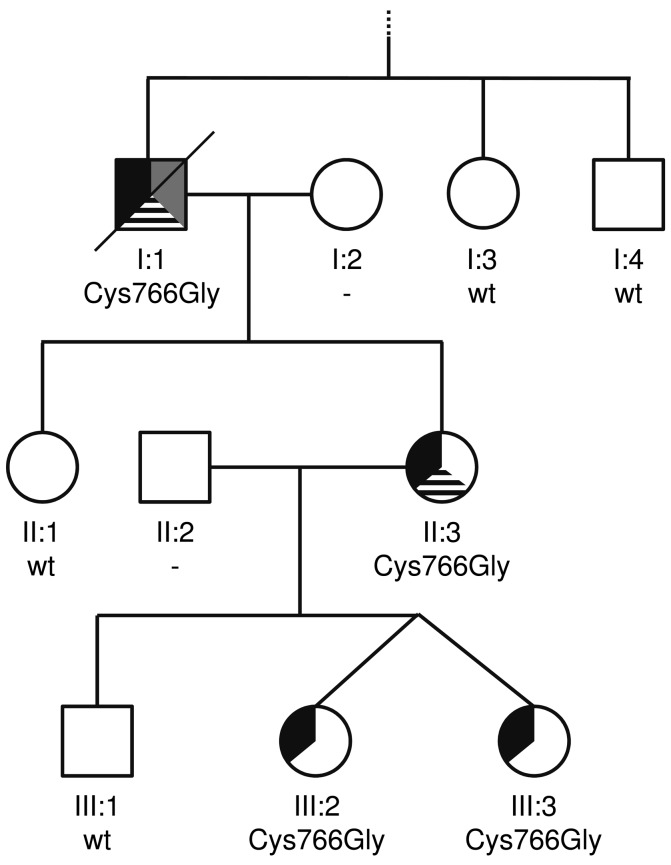
Family with MECOM:p.Cys766Gly missense mutation. Individual identifiers are given below the symbols. For additional information on the phenotype and an overview regarding the hematological malignancies in individual I:1 and II:3, please refer to Online Supplementary Table S1 and Online Supplementary Table S2. Symbol patterns refer to the following features: black upper left third, limb defects including radioulnar synostosis and hearing impairment, grey upper right third, congenital thrombocytopenia, and black-striped lower third, myeloid malignancy. Cys766Gly: heterozygous MECOM missense variant p.Cys766Gly; wt: wild-type; - signifies that no genetic analysis was performed.
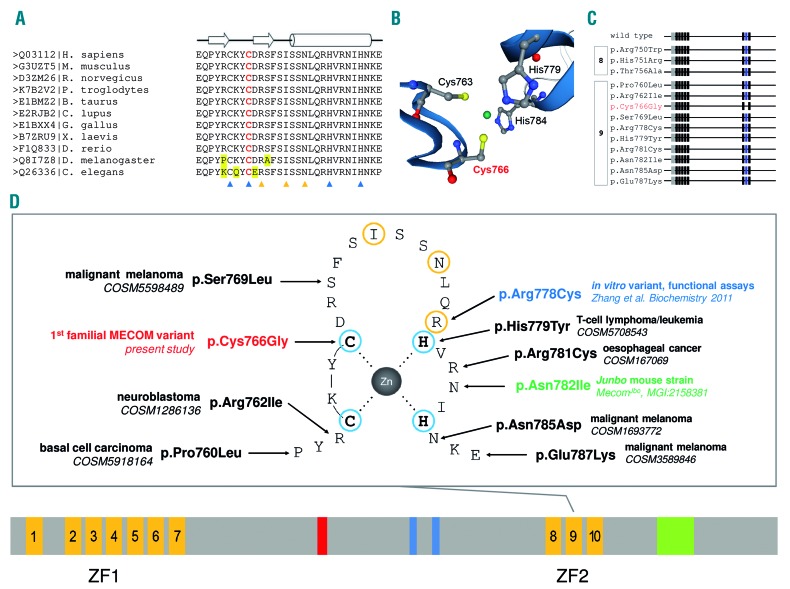
MECOM C2H2-type zinc finger motif 9. (A) Multiple sequence alignment of C2H2-zinc finger motif 9 of MECOM protein sequences using ClustalW2. Individual sequences are headed by the UniProtKB database identifier|species information. The alignment encompasses amino acid Q03112|758-787, of which amino acids 761-784 form ZF2, C2H2-zinc finger motif 9 of MECOM. The open arrows and cylinder depicted above the sequence alignment indicate β sheets and a helix, respectively. The blue and orange triangles below the alignment mark the amino acids that are essential for the folding stability of the zinc finger motif and potential DNA contact residues, respectively. Cys766 is highlighted in red. Alignment mismatches are highlighted in yellow. (B) SWISS-MODELL of Q03112, MDS and EVI1 complex locus protein EVI1 showing the four conserved amino acids of C2H2-type zinc finger motif 9 (i.e., Cys763, Cys766, His 779, and His784) which are crucial for the tetrahedral coordination of the zinc atom, shown in green. Cys766 is highlighted in red. (C) Screening of MECOM wild-type protein sequence (UniprotKB Q03112) for Pfam motif matches identifies zinc finger motifs zf-C2H2_6 (PF13912) and zf-C2H2 (PF00096), schematically displayed as grey and black boxes, respectively. The Pfam zinc finger motif zf-C2H2, matching C2H2-type zinc finger motif 9 of MECOM, is highlighted in blue. Below the wild-type sequence, results of reported mutations are shown and grouped with regard to C2H2-type zinc finger motif 8 and 9. The MECOM missense mutant p.Cys766Gly is highlighted in red. (D) At the bottom of the figure, a domain scheme of MECOM (Q03112) is given. C2H2-zinc finger motifs are shown in orange. Motif 1–7 and motif 8–10 form the N-terminal (ZF1) and C-terminal zinc finger domain 2 (ZF2), respectively. The nuclear localization signal, CTBP-binding motif 1/2, and an acidic domain are depicted in red, blue, and green, respectively. Above this outline, a schematic view of C2H2-zinc finger motif 9 is shown. The amino acids of the C2H2-zinc finger motif 9 refer to UniprotKB Q03112-1|760-787. Residues crucial for the tetrahedral coordination of the central zinc atom and potential DNA contact residues are highlighted in blue and orange, respectively. The germline variant p.Cys766Gly identified in the present study is highlighted in red. Somatic variants reported in COSMIC are shown in black. A mutant mouse strain and an in vitro variant are depicted in green and blue, respectively.
References
-
- Thompson AA, Nguyen LT. Amegakaryocytic thrombocytopenia and radio-ulnar synostosis are associated with HOXA11 mutation. Nat Genet. 2000;26(4):397–398. - PubMed
-
- Funabiki T, Kreider BL, Ihle JN. The carboxyl domain of zinc fingers of the Evi-1 myeloid transforming gene binds a consensus sequence of GAAGATGAG. Oncogene. 1994;9(6):1575–1581. - PubMed
-
- Brayer KJ, Segal DJ. Keep your fingers off my DNA: protein-protein interactions mediated by C2H2 zinc finger domains. Cell Biochem Biophys. 2008;50(3):111–131. - PubMed
-
- Pavletich NP, Pabo CO. Zinc finger-DNA recognition: crystal structure of a Zif268-DNA complex at 2.1 A. Science. 1991;252(5007):809–817. - PubMed
Publication types
MeSH terms
Substances
LinkOut - more resources
Full Text Sources
Other Literature Sources