A bioclinical prognostic model using MYC and BCL2 predicts outcome in relapsed/refractory diffuse large B-cell lymphoma
- PMID: 29097500
- PMCID: PMC5792273
- DOI: 10.3324/haematol.2017.179309
A bioclinical prognostic model using MYC and BCL2 predicts outcome in relapsed/refractory diffuse large B-cell lymphoma
Abstract
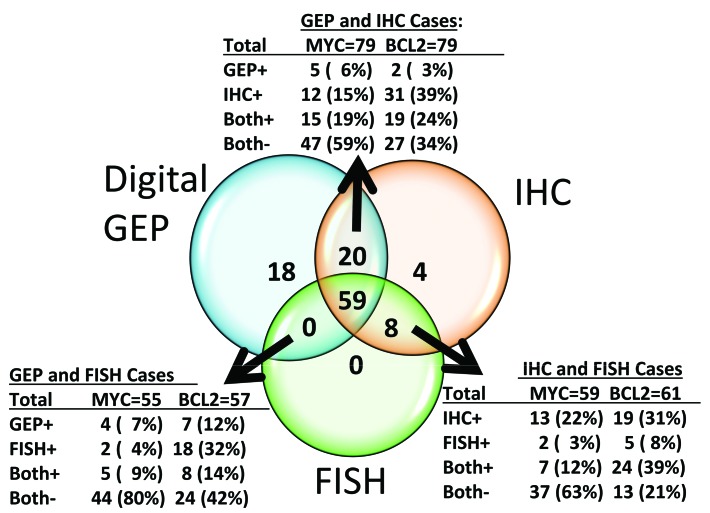
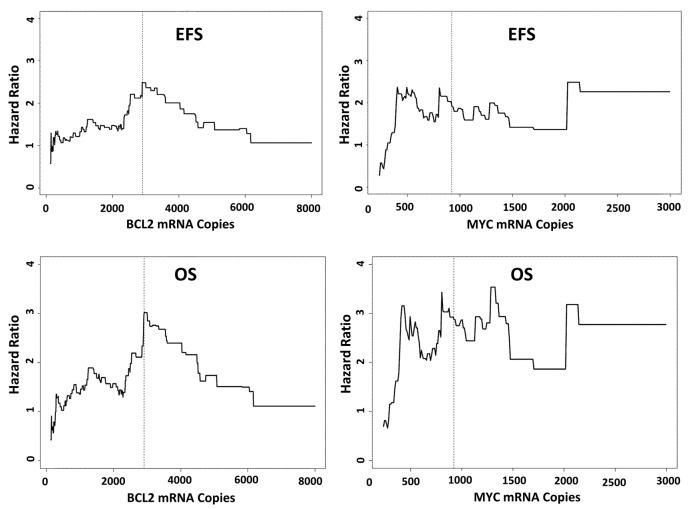
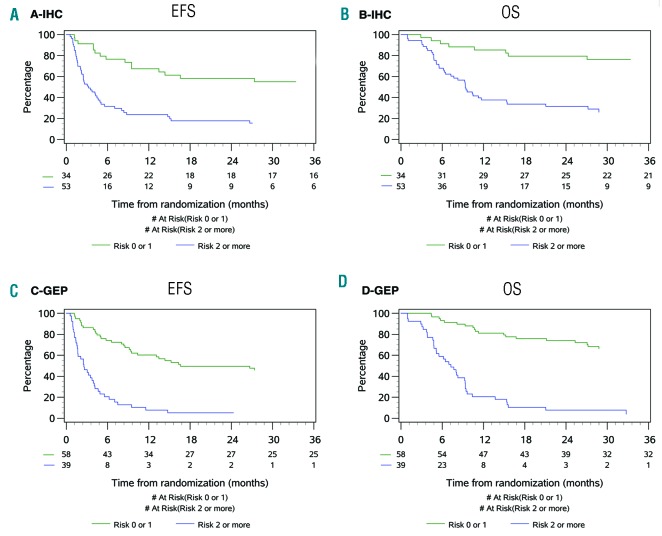
The objective of this study was to create a bioclinical model, based on clinical and molecular predictors of event-free and overall survival for relapsed/refractory diffuse large B-cell lymphoma patients treated on the Canadian Cancer Trials Group (CCTG) LY12 prospective study. In 91 cases, sufficient histologic material was available to create tissue microarrays and perform immunohistochemistry staining for CD10, BCL6, MUM1/IRF4, FOXP1, LMO2, BCL2, MYC, P53 and phosphoSTAT3 (pySTAT3) expression. Sixty-seven cases had material sufficient for fluorescent in situ hybridization (FISH) for MYC and BCL2 In addition, 97 formalin-fixed, paraffin-embedded tissue samples underwent digital gene expression profiling (GEP) to evaluate BCL2, MYC, P53, and STAT3 expression, and to determine cell-of-origin (COO) using the Lymph2Cx assay. No method of determining COO predicted event-free survival (EFS) or overall survival (OS). Factors independently associated with survival outcomes in multivariate analysis included primary refractory disease, elevated serum lactate dehydrogenase (LDH) at relapse, and MYC or BCL2 protein or gene expression. A bioclinical score using these four factors predicted outcome with 3-year EFS for cases with 0-1 vs 2-4 factors of 55% vs 16% (P<0.0001), respectively, assessing MYC and BCL2 by immunohistochemistry, 46% vs. 5% (P<0.0001) assessing MYC and BCL2 messenger ribonucleic acid (mRNA) by digital gene expression, and 42% vs 21% (P=0.079) assessing MYC and BCL2 by FISH. This proposed bioclinical model should be further studied and validated in other datasets, but may discriminate relapsed/refractory diffuse large B-cell lymphoma (DLBCL) patients who could benefit from conventional salvage therapy from others who require novel approaches. The LY12 study; clinicaltrials.gov Identifier: 00078949.
Trial registration: ClinicalTrials.gov NCT00078949.
Copyright© 2018 Ferrata Storti Foundation.
Figures
References
-
- Sujobert P, Salles G, Bachy E. Molecular classification of diffuse large B-cell lymphoma: what Is clinically relevant? Hematol Oncol Clin North Am. 2016; 30(6):1163–1177. - PubMed
-
- Crump M, Kuruvilla J, Couban S, et al. Randomized comparison of gemcitabine, dexamethasone, and cisplatin versus dexamethasone, cytarabine, and cisplatin chemotherapy before autologous stem-cell transplantation for relapsed and refractory aggressive lymphomas: NCIC-CTG LY.12. J Clin Oncol. 2014;32(31):3490–3496. - PubMed
-
- Martin A, Conde E, Arnan M, et al. R-ESHAP as salvage therapy for patients with relapsed or refractory diffuse large B-cell lymphoma: the influence of prior exposure to rituximab on outcome. A GEL/TAMO study. Haematologica. 2008;93(12):1829–1836 - PubMed
Publication types
MeSH terms
Substances
Associated data
LinkOut - more resources
Full Text Sources
Other Literature Sources
Medical
Research Materials
Miscellaneous