. 2017 Nov 2;7(1):14889.
doi: 10.1038/s41598-017-14006-7.

Healthy Adults Display Long-Term Trait-Like Neurobehavioral Resilience and Vulnerability to Sleep Loss

Affiliations

Healthy Adults Display Long-Term Trait-Like Neurobehavioral Resilience and Vulnerability to Sleep Loss

Laura E Dennis et al. Sci Rep. .

Abstract

Sleep loss produces well-characterized cognitive deficits, although there are large individual differences, with marked vulnerability or resilience among individuals. Such differences are stable with repeated exposures to acute total sleep deprivation (TSD) within a short-time interval (weeks). Whether such stability occurs with chronic sleep restriction (SR) and whether it endures across months to years in TSD, indicating a true trait, remains unknown. In 23 healthy adults, neurobehavioral vulnerability to TSD exposures, separated by 27-2,091 days (mean: 444 days; median: 210 days), showed trait-like stability in performance and subjective measures (82-95% across measures). Similarly, in 24 healthy adults, neurobehavioral vulnerability to SR exposures, separated by 78-3,058 days (mean: 935 days; median: 741 days), also showed stability (72-92% across measures). Cognitive performance outcomes and subjective ratings showed consistency across objective measures, and consistency across subjective measures, but not between objective and subjective domains. We demonstrate for the first time the stability of phenotypic neurobehavioral responses in the same individuals to SR and to TSD over long-time intervals. Across multiple measures, prior sleep loss responses are strong predictors of individual responses to subsequent sleep loss exposures chronically or intermittently, across months and years, thus validating the need for biomarkers and predictors.


Conflict of interest statement

The authors declare that they have no competing interests.

Figures
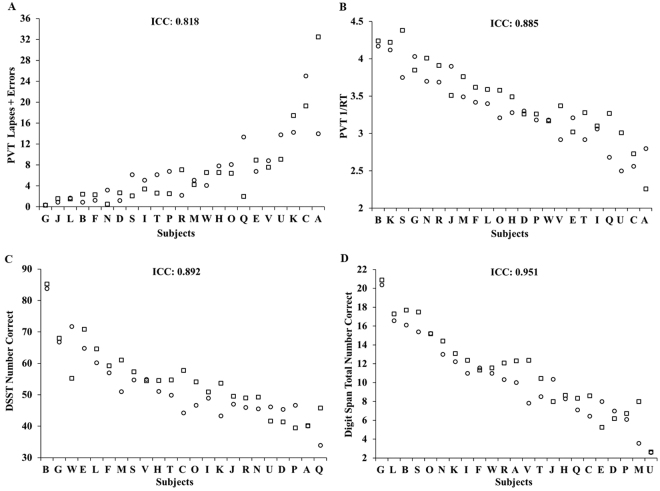
Figure 1
Figure 1
Individual differences and substantial phenotypic stability of cognitive measures to repeated TSD exposures across months to years. Neurobehavioral vulnerability to TSD exposures, separated by 27–2,091 days (mean: 444 days; median: 210 days), showed trait-like stability across performance measures, as evident by almost perfect intraclass correlation coefficients (ICCs): (A) 10-minute PVT lapses and errors, ICC = 0.818; (B) 10-minute PVT 1/RT, ICC = 0.885; (C) DSST number correct, ICC = 0.892; and (D) DS total number correct, ICC = 0.951. In all graphs, subjects (denoted individually with letters that correspond to Table 1) are ordered left to right from least to greatest TSD response as determined by the average of the Study 1 (circle) and Study 2 (square) performances. See text for ICC ranges.
Figure 2
Figure 2
Individual differences and substantial phenotypic stability of cognitive measures to repeated SR exposures across months to years. Neurobehavioral vulnerability to SR exposures, separated by 78–3,058 days (mean: 935 days; median: 741 days), showed trait-like stability across performance measures, as evident by substantial to almost perfect intraclass correlation coefficients (ICCs): (A) 10-minute PVT lapses and errors, ICC = 0.826; (B) 10-minute PVT 1/RT, ICC = 0.922; (C) DSST number correct, ICC = 0.721; and (D) DS total number correct, ICC = 0.906. In all graphs, subjects (denoted individually with letters that correspond to Table 2) are ordered left to right from least to greatest SR response as determined by the average of the Study 1(circle) and Study 2 (square) performances. See text for ICC ranges.
Figure 3
Figure 3
Individual differences and substantial phenotypic stability of subjective measures to repeated TSD exposures across months to years. Neurobehavioral vulnerability to TSD exposures, separated by 27–2,091 days (mean: 444 days; median: 210 days), showed trait-like stability across subjective measures, as evident by almost perfect intraclass correlation coefficients (ICCs): (A) KSS score, ICC = 0.851; (B) POMS fatigue, ICC = 0.839; and (C) POMS vigor, ICC = 0.894. In all graphs, subjects (denoted individually with letters that correspond to Table 1) are ordered left to right from least to greatest TSD response as determined by the average of the Study 1 (circle) and Study 2 (square) ratings. See text for ICC ranges.
Figure 4
Figure 4
Individual differences and substantial phenotypic stability of subjective measures to repeated SR exposures across months to years. Neurobehavioral vulnerability to SR exposures separated by 78–3,058 days (mean: 935 days; median: 741 days), showed trait-like stability across subjective measures as evident by substantial intraclass correlation coefficients (ICCs): (A) KSS score, ICC = 0.792; (B) POMS fatigue, ICC = 0.785; and (C) POMS vigor, ICC = 0.769. In all graphs, subjects (denoted individually with letters that correspond to Table 2) are ordered left to right from least to greatest SR response as determined by the average of the Study 1 (circle) and Study 2 (square) ratings. See text for ICC ranges.

References

    1. Dijkman M, et al. Effects of reduced stimulation on neurobehavioral alertness depend on circadian phase during human sleep deprivation. Sleep Res. 1997;26:265.
    1. Van Dongen HP, Maislin G, Mullington JM, Dinges DF. The cumulative cost of additional wakefulness: dose-response effects on neurobehavioral functions and sleep physiology from chronic sleep restriction and total sleep deprivation. Sleep. 2003;26:117–126. doi: 10.1093/sleep/26.2.117. - DOI - PubMed
    1. Van Dongen HP, Maislin G, Dinges DF. Dealing with interindividual differences in the temporal dynamics of fatigue and performance: importance and techniques. Aviat. Space Environ. Med. 2004;75:A147–A154. - PubMed
    1. Van Dongen HP, Belenky G. Individual differences in vulnerability to sleep loss in the work environment. Ind. Health. 2009;47:518–526. doi: 10.2486/indhealth.47.518. - DOI - PubMed
    1. Chua EC, et al. Sustained attention performance during sleep deprivation associates with instability in behavior and physiologic measures at baseline. Sleep. 2014;37:27–39. doi: 10.5665/sleep.3302. - DOI - PMC - PubMed

Publication types
