Review
. 2018 Feb;102(2):196-209.
doi: 10.1007/s00223-017-0351-7. Epub 2017 Nov 2.

New agents in the Treatment of Myeloma Bone Disease

Affiliations
Review

New agents in the Treatment of Myeloma Bone Disease

Elizabeth S Ring et al. Calcif Tissue Int. 2018 Feb.

Abstract

Patients with multiple myeloma develop a devastating bone disease driven by the uncoupling of bone remodelling, excess osteoclastic bone resorption and diminished osteoblastic bone formation. The bone phenotype is typified by focal osteolytic lesions leading to pathological fractures, hypercalcaemia and other catastrophic bone events such as spinal cord compression. This causes bone pain, impaired functional status, decreased quality of life and increased mortality. Early in the disease, malignant plasma cells occupy a niche environment that encompasses their interaction with other key cellular components of the bone marrow microenvironment. Through these interactions, osteoclast-activating factors and osteoblast inhibitory factors are produced, which together uncouple the dynamic process of bone remodelling, leading to net bone loss and focal osteolytic lesions. Current management includes antiresorptive therapies, i.e. bisphosphonates, palliative support and orthopaedic interventions. Bisphosphonates are the mainstay of treatment for myeloma bone disease (MBD), but are only partially effective and do have some significant disadvantages; for example, they do not lead to the repair of existing bone destruction. Thus, newer agents to prevent bone destruction and also promote bone formation and repair existing lesions are warranted. This review summarises novel ways that MBD is being therapeutically targeted.

Keywords: Anabolic agents; Antiresorptive agents; Bone remodelling; Myeloma; Myeloma bone disease.


Figures
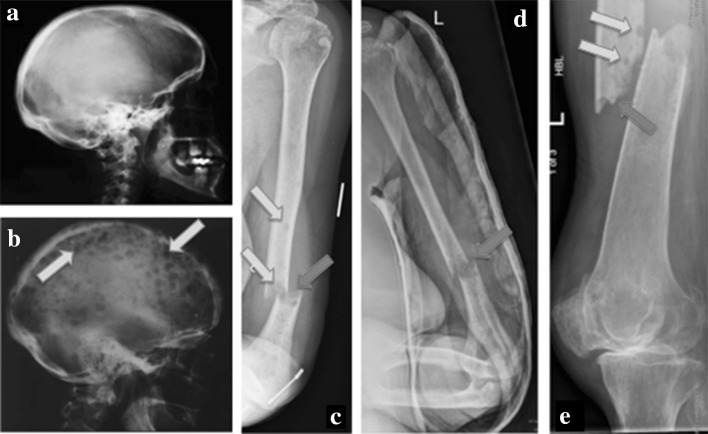
Fig. 1
Fig. 1
X-ray examples of serious but preventable myeloma-induced osteolytic lesions and pathological fractures potentially preventable if detected earlier. a Normal skull. b Myeloma ‘pepper pot skull’ riddles with lytic lesions. c, d Pathological fractures through lytic lesions in the distal shaft of the left humerus. e Pathological fracture through the proximal shaft of the left femur
Fig. 2
Fig. 2
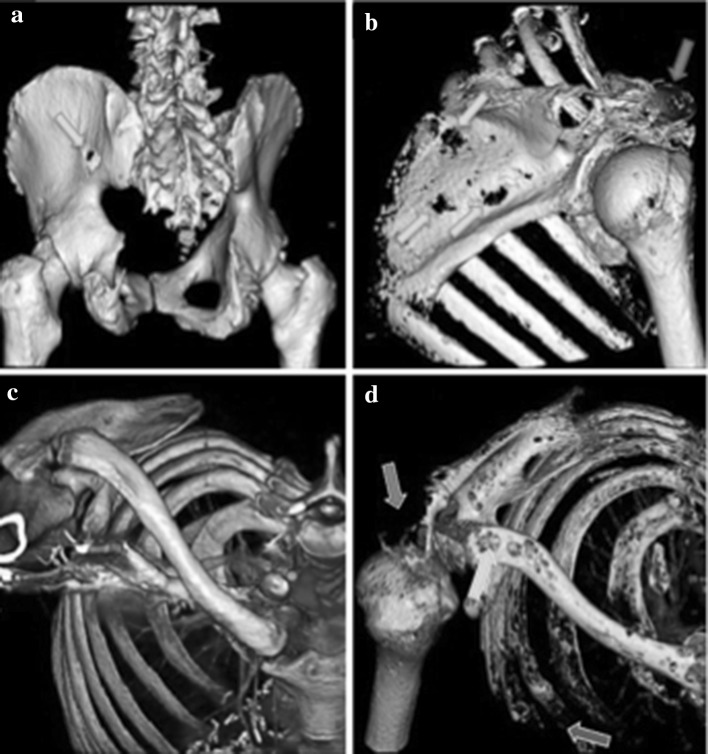
3D reconstructions of computerised tomography (CT) images using standard diagnostic settings demonstrating two patients with widespread myeloma-induced bone disease, leading to potential serious consequences. a Lytic lesion penetrating through the ischium (green arrow). b Multiple lytic lesions throughout the scapula (green arrows) with the acromion completely destroyed by myeloma bone disease (red arrow). c Example of normal bone from the shoulder, clavicle and ribs. d Contrast image of the patient riddled with lytic lesions due to myeloma bone disease. The acromion process is destroyed (red arrow), multiple lytic lesions are present throughout the clavicle (green arrow) and the anterior ribs have been destroyed (purple arrow) (Color figure online)
Fig. 3
Fig. 3
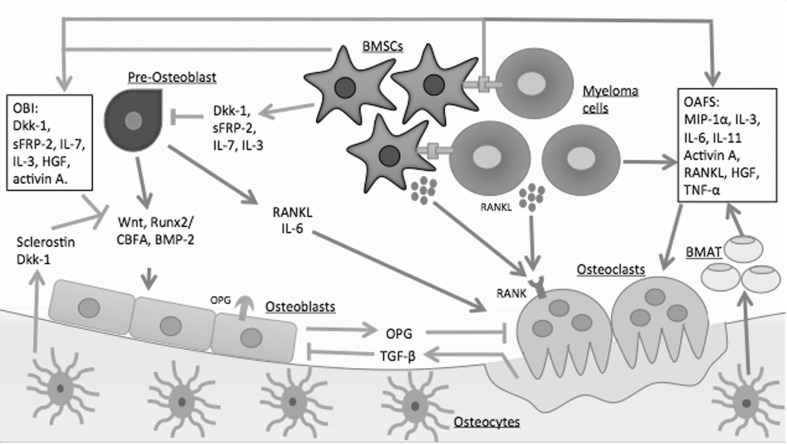
Pathophysiology of MBD. The uncoupling of osteoclasts and osteoblasts is stimulated by the release of osteoclast-activating factors (OAFs) and osteoblast inhibitory factors (OBIs). These factors are released by the adhesion of bone marrow stromal cells (BMSCs) to myeloma cells causing upregulation of osteoclast and bone resorption, whilst simultaneously inhibiting osteoblasts and bone formation. Osteocytes also play an important role by releasing sclerostin, which inhibits osteoblast differentiation and increases bone marrow adipose tissue (BMAT). Dkk-1 dickkopf-1, sFRP-2 secreted frizzled-related protein 2, IL-7 interleukin-7, IL-3 interleukin-3, HGF hepatocyte growth factor, Runx2 runt-related transcription factor 2, CBFA core-binding factor alpha, BMP-2 bone morphogenetic protein 2, RANK receptor activator of nuclear factor kappa B, RANKL receptor activator of nuclear factor kappa B ligand, IL-6 interleukin-6, MIP-1α macrophage inflammatory protein-1 alpha, OPG osteoprotegerin, TGF-β transforming growth factor beta, TNF-α tumour necrosis factor alpha
Fig. 4
Fig. 4
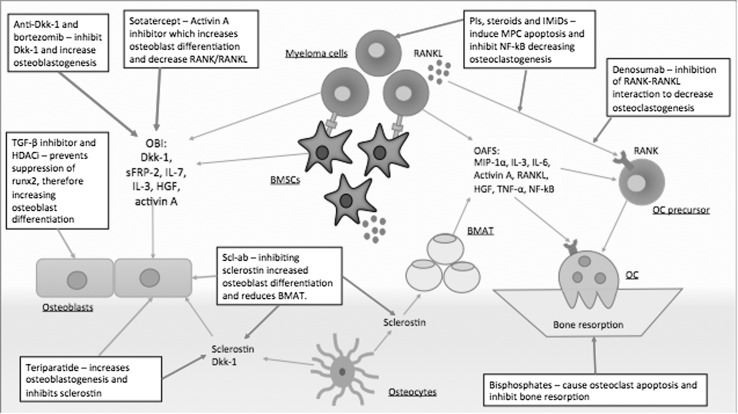
MBD treatments and their interactions in the BMME. MBD treatments use multiple different mechanisms in order to reduce bone resorption and increase bone formation to repair osteolytic lesions. A plethora of treatments are currently in trials; however, a combination of both anabolic and antiresorptive methods appears to have the most potential for healing MBD. RANKL receptor activator of nuclear factor kappa B ligand, RANK receptor activator of nuclear factor kappa B, PIs proteasome inhibitors, IMiDs immunomodulatory agents, OC osteoclast, Scl-ab anti-sclerostin antibody, Dkk-1 dickkopf-1, sFRP-2 secreted frizzled-related protein 2, IL-7 interleukin-7, IL-3 interleukin-3, HGF hepatocyte growth factor, Runx2 runt-related transcription factor 2, TGF-β transforming growth factor beta, NF-kB nuclear factor kappa B, BMSCs bone marrow stromal cells, BMAT bone marrow adipose tissue, OBIs osteoblast inhibitory factors, OAFs osteoblast-activating factors

References

    1. Hameed A, Brady JJ, Dowling P, Clynes M, Gorman P. Bone disease in multiple myeloma: pathophysiology and management. Cancer Growth Metastasis. 2014;7:33–42. doi: 10.4137/CGM.S16817. - DOI - PMC - PubMed
    1. Siegel RL, Miller KD, Jemal A. Cancer statistics, 2016. CA Cancer J Clin. 2016;66:7–30. doi: 10.3322/caac.21332. - DOI - PubMed
    1. Xi H, An R, Li L, Wang G, Tao Y, Gao L. Myeloma bone disease: progress in pathogenesis. Prog Biophys Mol Biol. 2016;122:149–155. doi: 10.1016/j.pbiomolbio.2016.08.003. - DOI - PubMed
    1. Bataille R, Harousseau J-L. Multiple myeloma. N Engl J Med. 1997;336:1657–1664. doi: 10.1056/NEJM199706053362307. - DOI - PubMed
    1. Walker RE, Lawson MA, Buckle CH, Snowden JA, Chantry AD. Myeloma bone disease: pathogenesis, current treatments and future targets. Br Med Bull. 2014;111:117–138. doi: 10.1093/bmb/ldu016. - DOI - PubMed

MeSH terms