. 2017 Nov 2;7(1):194.
doi: 10.1186/s13568-017-0494-y.

Taxonomic identification of the thermotolerant and fast-growing fungus Lichtheimia ramosa H71D and biochemical characterization of the thermophilic xylanase LrXynA

Affiliations

Taxonomic identification of the thermotolerant and fast-growing fungus Lichtheimia ramosa H71D and biochemical characterization of the thermophilic xylanase LrXynA

María Teresa Alvarez-Zúñiga et al. AMB Express. .

Abstract

The zygomycete fungus Lichtheimia ramosa H71D, isolated from sugarcane bagasse compost, was identified by applying phylogenetic analysis based on the DNA sequence of the Internal Transcribed Spacer (ITS), and subsequent secondary structure analysis of ITS2. L. ramosa H71D was able to grow over a wide range of temperatures (25-45 °C), manifesting optimal growth at 37 °C. A 64 kDa xylanase (named LrXynA) was purified from the culture supernatant of L. ramosa H71D grown on 2% carboxymethylcellulose (CMC), as the only carbon source. LrXynA displayed optimal activity at pH 6 and temperature of 65 °C. The enzyme retained more than 50% of its maximal activity over a broad range of pH values (4.5-7.5). Enzyme half-life (t½) times at 55, 65 and 75 °C were 80, 25, and 8 min, respectively. LrXynA showed higher affinity (k M of 2.87 mg/mL) and catalytic efficiency (k cat /k M of 0.651 mg s/mL) towards Beechwood xylan in comparison to other substrates such as Birchwood xylan, Oat-spelt xylan, CMC, Avicel and Solka floc. The predominant final products from LrXynA-mediated hydrolysis of Beechwood xylan were xylobiose and xylotriose, suggesting that the enzyme is an endo-β-1,4 xylanase. Scanning electron microscopy (SEM) imaging of sugar cane bagasse (SCB) treated with LrXynA, alone or in combination with commercial cellulases, showed a positive effect on the hydrolysis of SCB. To our knowledge, this is the first report focusing on the biochemical and functional characterization of an endo-β-1,4 xylanase from the thermotolerant and fast-growing fungus Lichtheimia ramosa.

Keywords: Internal transcribed spacer (ITS); Lichtheimia ramosa; Sugarcane hydrolysis; Xylanase; Zygomycete fungus.


Figures
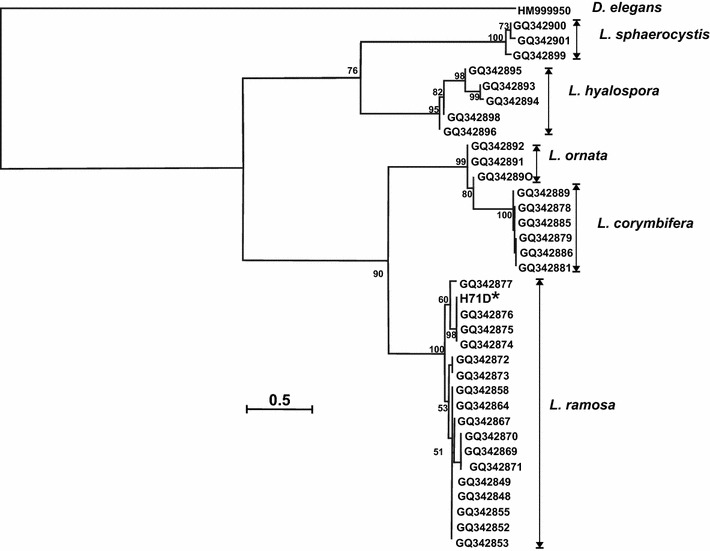
Fig. 1
Fig. 1
Phylogenetic tree inferred from ITS DNA sequences from Lichtheimia species. The tree was inferred under PhyML algorithm using an HKY85 model. The numbers on the branches correspond to the robustness (bootstrap values) obtained from 100 replicates
Fig. 2
Fig. 2
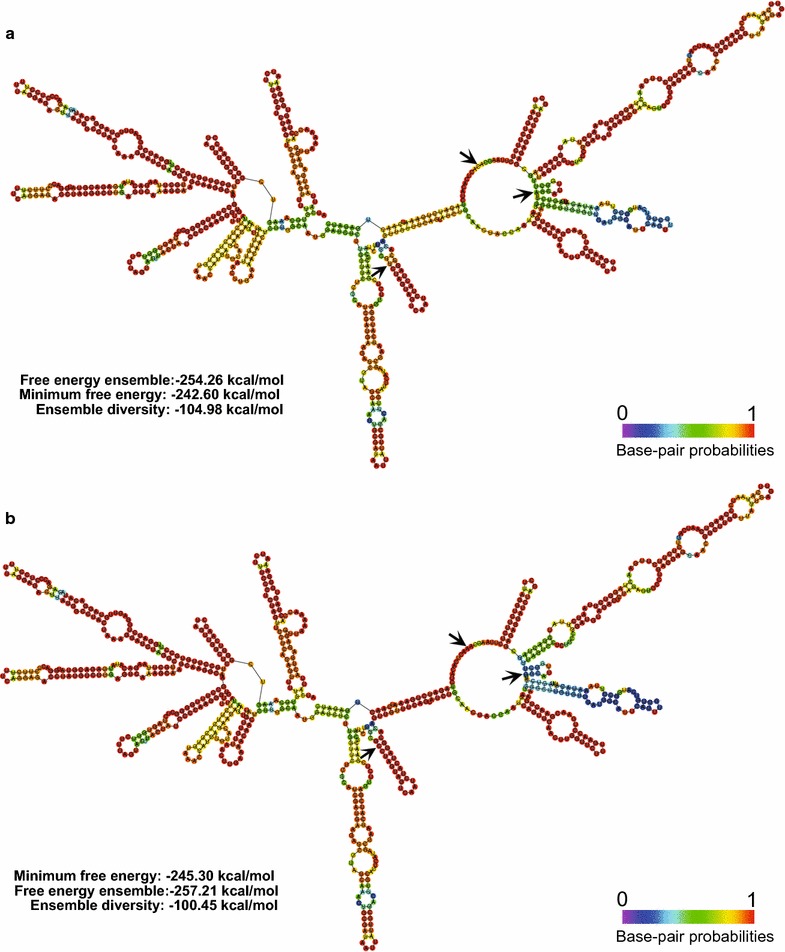
ITS2 secondary structures of strains a H71D and b GQ342874, determined with the RNA model Turner, 2004 (RNAfold Web Server); the most significant differences in the sequences that determined the secondary structure are indicated with black arrows
Fig. 3
Fig. 3
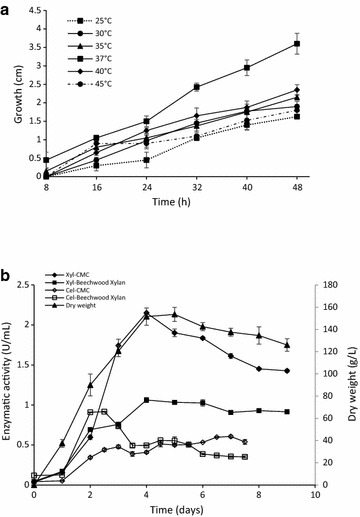
Xylanase and cellulose activities during growth of L. ramosa H71D. a Radial growth kinetic of L. ramosa H71D at different growth temperatures on PDA agar, the diameter was measured every 8 h for 48 h. b Growth and enzyme activities (xylanase and cellulose) of L. ramosa H71D at 37 °C. Dry weight in Mandels and Sternberg culture medium (Black up-pointing triangle). Xylanolytic activity produced on CMC (Black diamond suit) or Beechwood xylan (Black square), as a carbon source. Cellulolytic activity produced on CMC (Lozenge) or Beechwood xylan (Square), as a carbon source
Fig. 4
Fig. 4
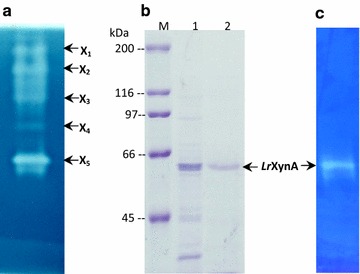
Protein and zymogram analysis of LrXynA from L. ramosa H71D on 10% SDS-PAGE. a Zymogram analysis of crude extract from L. ramosa H71D, using 1% RBB-X as the substrate. b 10% SDS-PAGE analysis of purified LrXynA. Lanes: M, molecular weight standard; 1, crude extract; 2, purified LrXynA. c Zymogram analysis of purified LrXynA, using 1% RBB-X as substrate
Fig. 5
Fig. 5
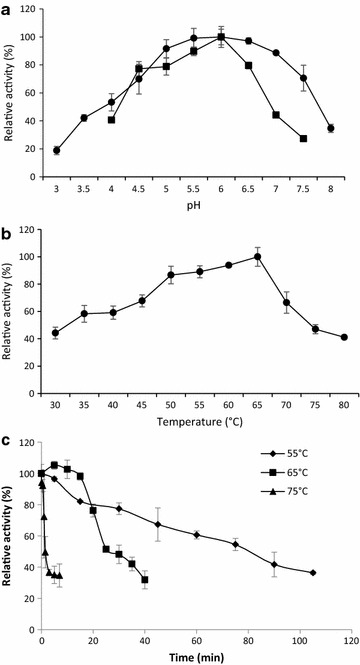
Effect of pH and temperature on LrXynA activity and stability. a Effect of pH on xylanolytic activity (Black circle) and stability (Black square) of LrXynA. LrXynA was incubated in 50 mM citrate–phosphate (3–7) or phosphates (6–8) buffer and incubated at 50 °C for 10 min; for pH stability, LrXynA was preincubated at 50 °C for 3 h in the same buffers. b Effect of temperature on the xylanolytic activity of LrXynA. The enzyme was incubated in 0.2% (w/v) Beechwood xylan in 50 mM citrate–phosphate buffer, pH 6.0 at different temperatures (30–80 °C). c Thermostability of LrXynA at 75 °C (Black up-pointing triangle), 65 °C (Black square) and 55 °C (Black diamond suit)
Fig. 6
Fig. 6
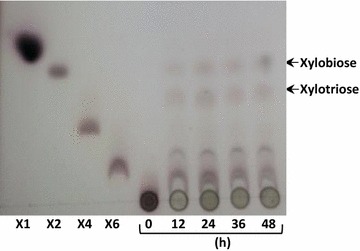
TLC analysis of Beechwood xylan by LrXynA trough kinetic time of 0, 12, 24, 36 and 48 h. Standards: X1 (xylose), X2 (xylobiose), X4 (xylotetrahose) and X6 (xylohexosa)
Fig. 7
Fig. 7
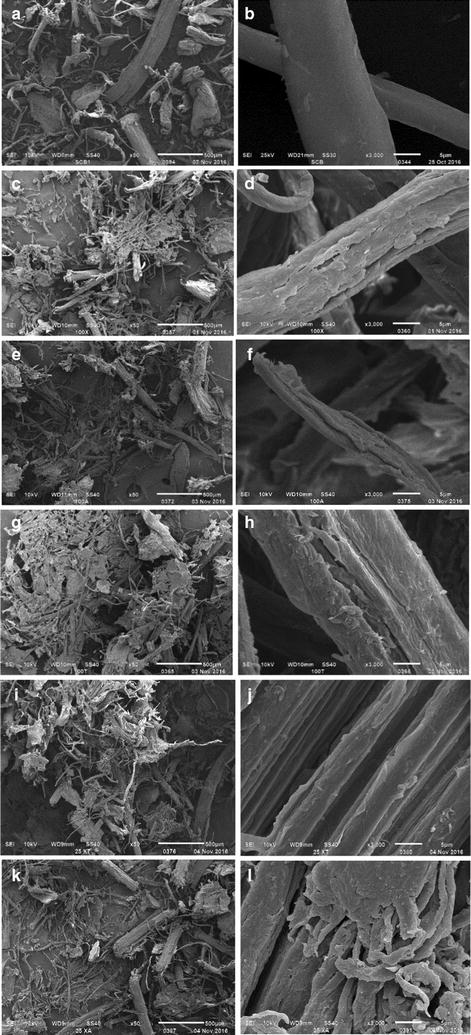
SEM analysis of untreated SCB samples (a, b) and with enzymatic treatment at 37 °C during 64 h of incubation. Using 100% of LrXynA from L. ramosa H71D (c, d); 100% of cellulase from A. niger (e, f); 100% of the cellulase from T. viridae (g, h); a mixture (25:75) of LrXynA/cellulase from A. niger (i, j), and a mixture (25:75) of LrXynA/cellulase from T. viridae (k, l). On the left side the micrographs are shown with an amplification of ×50, and on the right side are shown with an amplification of ×3000

References

    1. Alastruey-Izquierdo A, Hoffmann K, De Hoog GS, Rodriguez-Tudela JL, Voigt K, Bibashi E, Walther G. Species recognition and clinical relevance of the zygomycetous genus Lichtheimia (syn. Absidia pro parte, Mycocladus) J Clin Microbiol. 2010;48:2154–2170. doi: 10.1128/JCM.01744-09. - DOI - PMC - PubMed
    1. Amore A, Giacobbe S, Faraco V. Regulation of cellulase and hemicellulase gene expression in fungi. Curr Genomics. 2013;14:230–249. doi: 10.2174/1389202911314040002. - DOI - PMC - PubMed
    1. André ALCM, Hoffmann K, Lima DX, de Oliveira RJV, Vieira HEE, Malosso E, Maia LC, da Silva GA. A new species of Lichtheimia (Mucoromycotina, Mucorales) isolated from Brazilian soil. Mycol Prog. 2014;13:343–352. doi: 10.1007/s11557-013-0920-8. - DOI
    1. Apweiler R, Hermjakob H, Sharon N. On the frequency of protein glycosylation, as deduced from analysis of the SWISS-PROT database. Biochim Biophys Acta Gen Subj. 1999;1473:4–8. doi: 10.1016/S0304-4165(99)00165-8. - DOI - PubMed
    1. Beg QK, Bhushan B, Kapoor M, Hoondal GS. Enhanced production of a thermostable xylanase from Streptomyces sp. QG-11-3 and its application in biobleaching of eucalyptus kraft pulp. Enzyme Microb Technol. 2000;27:459–466. doi: 10.1016/S0141-0229(00)00231-3. - DOI - PubMed

LinkOut - more resources