


Work stressors, depressive symptoms and sleep quality among US Navy members: a parallel process latent growth modelling approach across deployment
- PMID: 29098744
- PMCID: PMC5934330
- DOI: 10.1111/jsr.12624
Work stressors, depressive symptoms and sleep quality among US Navy members: a parallel process latent growth modelling approach across deployment
Abstract
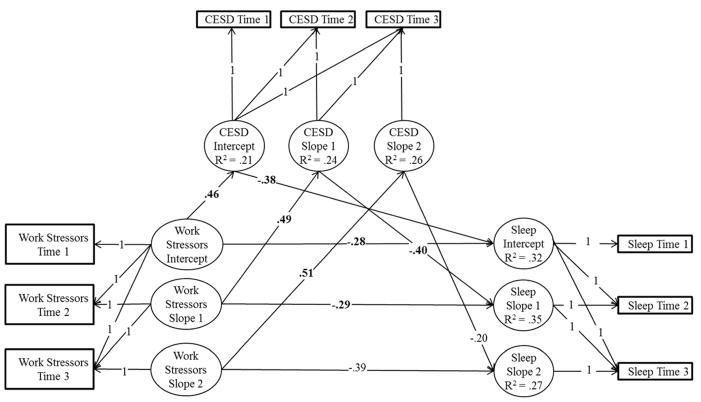
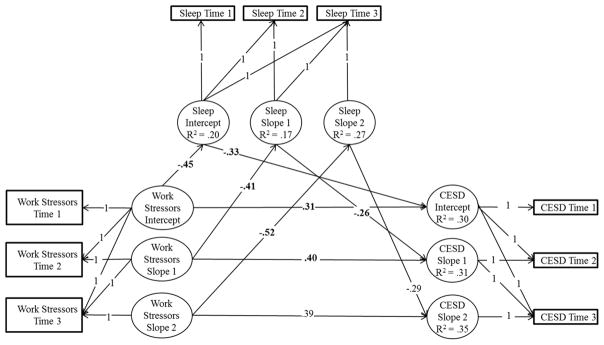
The present study examined whether work stressors contribute to sleep problems and depressive symptoms over the course of deployment (i.e. pre-deployment, post-deployment and 6-month reintegration) among US Navy members. Specifically, we examined whether depressive symptoms or sleep quality mediate the relationships between work stressors and these outcomes. Participants were 101 US Navy members who experienced an 8-month deployment after Operational Enduring Freedom/Operation Iraqi Freedom. Using piecewise latent growth models, we found that increased work stressors were linked to increased depressive symptoms and decreased sleep quality across all three deployment stages. Further, increases in work stressors from pre- to post-deployment contributed to poorer sleep quality post-deployment via increasing depressive symptoms. Moreover, sleep quality mediated the association between increases in work stressors and increases in depressive symptoms from pre- to post-deployment. These effects were maintained from post-deployment through the 6-month reintegration. Although preliminary, our results suggest that changes in work stressors may have small, but significant implications for both depressive symptoms and quality of sleep over time, and a bi-directional relationship persists between sleep quality and depression across deployment. Strategies that target both stress and sleep could address both precipitating and perpetuating factors that affect sleep and depressive symptoms.
Keywords: deployment; depression; military members; occupational health; sleep problems.
© 2017 European Sleep Research Society.
Conflict of interest statement
Figures
References
-
- Barber L, Grawitch MJ, Munz DC. Are better sleepers more engaged workers? A self-regulatory approach to sleep hygiene and work engagement. Stress Health. 2013;29:307–316. - PubMed
-
- Beattie L, Kyle SD, Espie CA, Biello SM. Social interactions, emotion and sleep: A systematic review and research agenda. Sleep Med Rev. 2015;24:83–100. - PubMed
-
- Bonde JPE. Psychosocial factors at work and risk of depression: A systematic review of the epidemiological evidence. Occup Environ Med. 2008;65:438–445. - PubMed
-
- Borbély AA, Daan S, Wirz-Justice A, Deboer T. The two-process model of sleep regulation: A reappraisal. J Sleep Res. 2016;25:131–43. - PubMed
-
- Borbély AA, Wirz-Justice A. Sleep, sleep deprivation and depression. A hypothesis derived from a model of sleep regulation. Hum Neurobiol. 1982;1:205–210. - PubMed
Publication types
MeSH terms
Grants and funding
LinkOut - more resources
Full Text Sources
Other Literature Sources
Medical
