Review
. 2018 Jan 1;9(1):9-19.
doi: 10.1080/19491034.2017.1371398. Epub 2017 Nov 13.

Mechano-adaptation of the stem cell nucleus

Affiliations
Review

Mechano-adaptation of the stem cell nucleus

Su-Jin Heo et al. Nucleus. .

Abstract

Exogenous mechanical forces are transmitted through the cell and to the nucleus, initiating mechanotransductive signaling cascades with profound effects on cellular function and stem cell fate. A growing body of evidence has shown that the force sensing and force-responsive elements of the nucleus adapt to these mechanotransductive events, tuning their response to future mechanical input. The mechanisms underlying this "mechano-adaptation" are only just beginning to be elucidated, and it remains poorly understood how these components act and adapt in tandem to drive stem cell differentiation. Here, we review the evidence on how the stem cell nucleus responds and adapts to physical forces, and provide a perspective on how this mechano-adaptation may function to drive and enforce stem cell differentiation.

Keywords: Epigenetics; Heterochromatin; LINC Complex; Lamin A/C; Mechanotransduction; Nuclear Mechanics; Stem Cells.


Figures
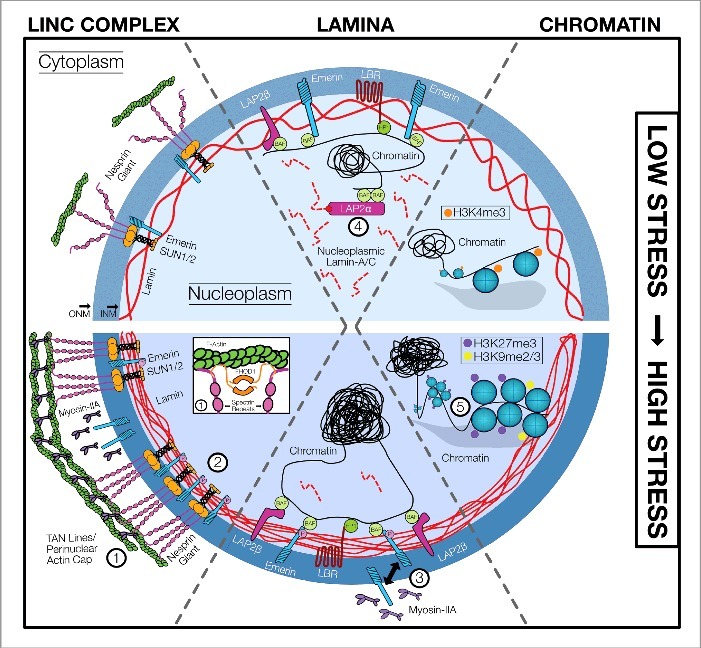
Figure 1.
Figure 1.
Schematic representation of mechano-adaptation in multiple compartments of the stem cell nucleus. Left: The LINC complex spans the nuclear membrane, mechanically linking the cytoskeleton to the nucleus and sub-nuclear structures. Nesprin giant isoforms cross the nuclear membrane, binding to F-actin and other cytoskeletal elements in the cytosol and to SUN proteins in the intra-nuclear space. SUN proteins in turn tether nesprins to the nuclear lamina. The LINC complex responds dynamically and adapts to changing stress within the cell. In low stress states, emerin closely associates with SUN at the INM, and nesprins form minimal contacts with the cytoskeleton. Under high stress conditions, nesprins cluster and are under tension (1), forming characteristic features known as ‘TAN lines' across the apical side of the nucleus. Further, emerin undergoes tyrosine phosphorylation (2), with a fraction of this protein translocating from the inner nuclear membrane (INM) to the outer nuclear membrane (ONM) in the high stress state, where it helps to locally increase the Myosin-IIA concentration (3). Middle: The nuclear lamina is composed of a meshwork of filamentous lamins that are central in the establishment of nuclear structure and mechanics. BAF binds to emerin at the INM, and also functions to tether nucleoplasmic LAP2α to chromatin. There is a balance of soluble nucleoplasmic lamin-A/C and stable lamin-A/C that is juxtaposed to the INM in a network (4). In all states, LAP2β localizes to the INM, and along with emerin, tethers chromatin to the lamina through interactions with BAF. LBR likewise interacts with HP1 to localize chromatin to the lamina. In high stress states, the pool of nucleoplasmic lamin-A/C is reduced as lamin-A/C translocates to the lamina, where it is assembled into a denser network that mechanically reinforces and stiffens the nucleus overall. Right: In addition to its role in storing genetic information, chromatin is also a critical determinant of nuclear mechanics. Under low stress conditions, the global chromatin state is generally open and active, with histones modified with active marks, including H3K4me3; additionally, the nucleus is relatively soft, due in part to the de-condensed state of the chromatin. Under high stress conditions, conversely, chromatin condenses and becomes transcriptionally repressed on a global scale (5). This results in nuclear stiffening and a general enrichment of repressive histone marks, including H3K27me3 and H3K9me2/3.
Figure 2.
Figure 2.
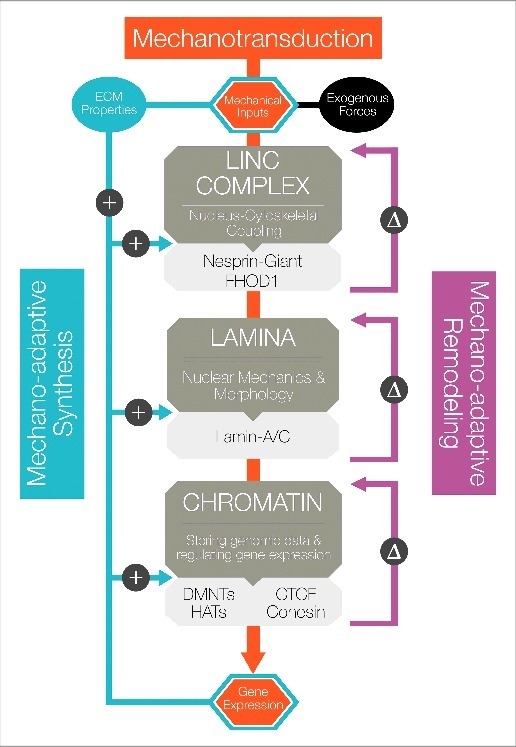
Mechano-Adaptation and Mechanical Memory Nuclear mechano-adaptation in stem cells can occur through both remodeling and synthetic mechanisms, with the former occurring over faster time scales than the latter. Mechanical inputs from the ECM or from exogenous loading are transmitted through the cell and to the nucleus, where each compartment can undergo mechano-adaptation, depending on the magnitude and repetition of the mechanical cues. The LINC complex responds and adapts through increased clustering of nesprins and TAN line formation (remodeling), as well as increased production of components of the LINC complex (synthesis). The lamina undergoes stiffening via reinforcement of the lamin meshwork from the nucleoplasmic pool of soluble lamin-A/C, as well as increased production of lamin-A/C. Finally, the chromatin adapts through marked changes in spatial organization, as indicated by increased condensation levels, as well as increased transcription of proteins associated with chromatin structural reinforcement and stabilization. More broadly, synthetic and reorganizational changes combine to alter the properties of each nuclear compartment, such that the next mechanical input encountered by the cell is transduced to and through the nucleus in a slightly different manner. This mechanically mediated reconfiguration of the LINC complex, lamina, and epigenome alters overall cell mechanosensing and may confer a ‘mechanical memory’ in the system.

References

    1. Maniotis AJ, Chen CS, Ingber DE. Demonstration of mechanical connections between integrins, cytoskeletal filaments, and nucleoplasm that stabilize nuclear structure. Proc Natl Acad Sci. 1997;94:849-54. doi:10.1073/pnas.94.3.849 - DOI - PMC - PubMed
    1. Tajik A, Zhang Y, Wei F, Sun J, Jia Q, Zhou W, Singh R, Khanna N, Belmont AS, Wang N. Transcription upregulation via force-induced direct stretching of chromatin. Nat Mater. 2016;15:1287-96. doi:10.1038/nmat4729. PMID:27548707 - DOI - PMC - PubMed
    1. Driscoll TP, Cosgrove BD, Heo S-J, Shurden ZE & Mauck RL. Cytoskeletal to Nuclear Strain Transfer Regulates YAP Signaling in Mesenchymal Stem Cells. Biophys J. 2015;108:2783-93. doi:10.1016/j.bpj.2015.05.010. PMID:26083918 - DOI - PMC - PubMed
    1. Guilluy C, Guilluy C, Osborne LD, Van Landeghem L SL, Superfine R, Garcia-Mata R, Burridge K. Isolated nuclei adapt to force and reveal a mechanotransduction pathway in the nucleus. Nat. Cell Biol. 2014;16:376-81. doi:10.1038/ncb2927. PMID:24609268 - DOI - PMC - PubMed
    1. Wang N, Tytell JD, Ingber DE. Mechanotransduction at a distance: mechanically coupling the extracellular matrix with the nucleus. Nat Rev Mol Cell Biol. 2009;10:75-82. doi:10.1038/nrm2594. PMID:19197334 - DOI - PubMed

Publication types

LinkOut - more resources