Review
. 2018 Jan;25(1):13-20.
doi: 10.1038/cdd.2017.145. Epub 2017 Nov 3.

Viewing BCL2 and cell death control from an evolutionary perspective

Affiliations
Review

Viewing BCL2 and cell death control from an evolutionary perspective

Andreas Strasser et al. Cell Death Differ. 2018 Jan.

Abstract

The last 30 years of studying BCL2 have brought cell death research into the molecular era, and revealed its relevance to human pathophysiology. Most, if not all metazoans use an evolutionarily conserved process for cellular self destruction that is controlled and implemented by proteins related to BCL2. We propose the anti-apoptotic BCL2-like and pro-apoptotic BH3-only members of the family arose through duplication and modification of genes for the pro-apoptotic multi-BH domain family members, such as BAX and BAK1. In that way, a cell suicide process that initially evolved as a mechanism for defense against intracellular parasites was then also used in multicellular organisms for morphogenesis and to maintain the correct number of cells in adults by balancing cell production by mitosis.


Conflict of interest statement

The authors declare no conflict of interest.

Figures
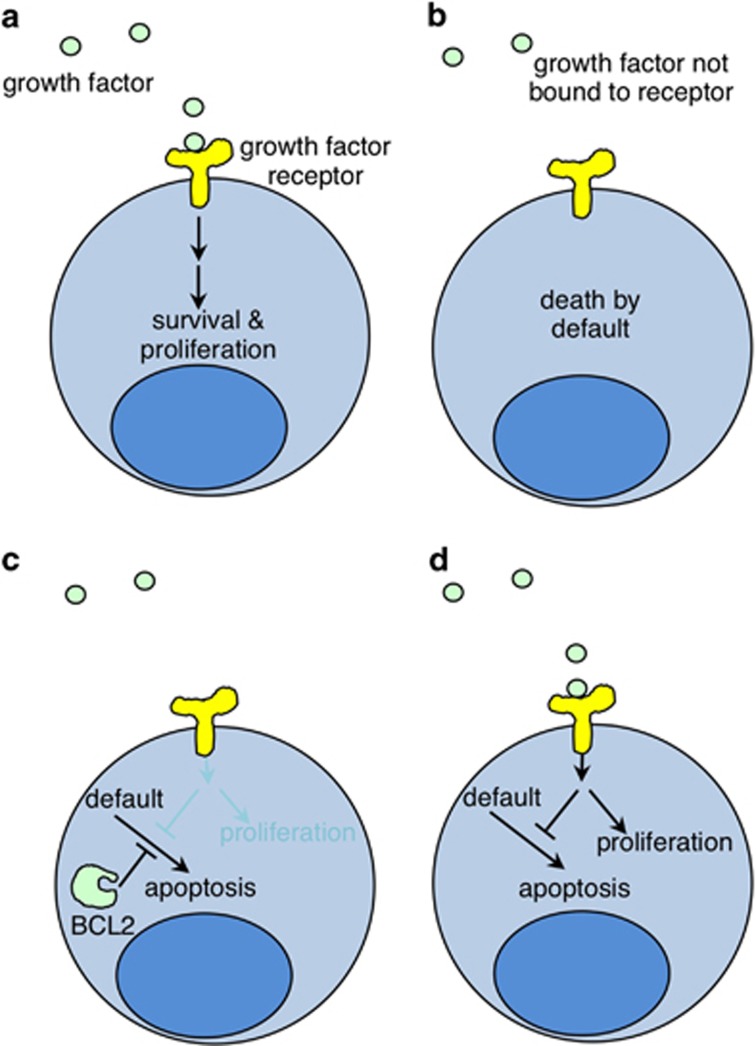
Figure 1
Figure 1
Separate growth factor receptor-activated pathways regulating cell division and cell survival. Ligation of growth factor receptors was known to signal survival and proliferation (a and b). Enforced expression of BCL2 (c) showed that growth factor receptors control independent mechanisms for cell proliferation and cell survival/cell death (d). These experiments showed that BCL2 inhibited cell death, but had no impact on cell division
Figure 2
Figure 2
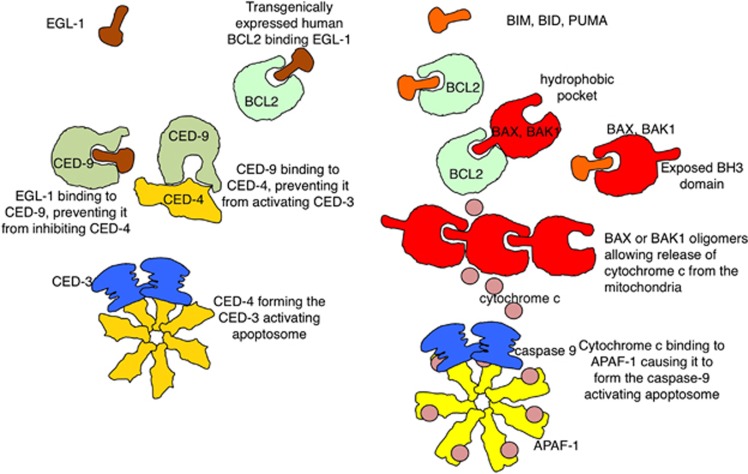
Comparison of pathways for programmed cell death in C. elegans and apoptosis in mammalian cells. Key differences are that in C. elegans anti-apoptotic CED-9 causes cell survival by preventing activation of CED-4, the activator of the caspase, CED-3, whereas in mammalian cells pro-survival BCL2 inhibits apoptosis by preventing activation of BAX/BAK1 and by neutralizing BH3-only proteins. When expressed in C. elegans, human BCL2 prevents cell death by binding to the BH3-only protein EGL-1, but cannot bind to CED-4 and prevent it activating the caspase CED-3. To block cell death in C. elegans, human BCL2 requires the presence of residual CED-9
Figure 3
Figure 3
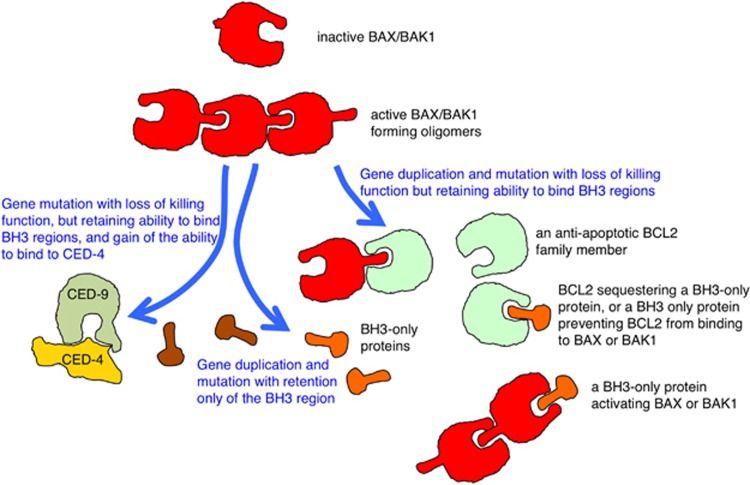
Speculative evolution of the BCL2 protein subfamilies. The first members were like pro-apoptotic BAX and BAK1, and had three functions: exposing a BH3 domain; binding a BH3 domain of another protein; and forming oligomers that could act as channels allowing proteins to cross membranes. Anti-apoptotic family members (such as BCL2 itself) arose by gene duplication from a BAX/BAK1-like ancestor, and mutations that caused the protein to lose its ability to expose its BH3 domain in a way that higher-order multimers could form, whilst retaining its ability to bind to the BH3 domains of other proteins, such as BAX and BAK1. In this way, anti-apoptotic BCL2 family members act as dominant negative versions of BAX and BAK1. BH3-only family members arose as proteins that could bind to anti-apoptotic BCL2 family members to unleash BAX or BAK1, or could bind to BAX or BAK1 to activate them directly, in both ways triggering formation of multimers. Cartoons are diagrammatic only
Figure 4
Figure 4
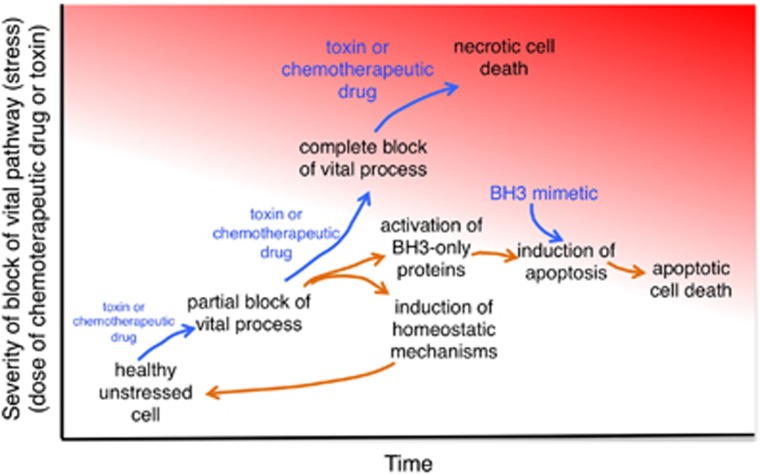
Cell suicide as a response to cell stress and chemotherapy – opportunities for use of BH3-only mimetics. Toxins and chemotherapeutic drugs can partially or completely interrupt vital processes causing cell stress (red color). Healthy cells have well-tuned homeostatic mechanisms, and can repair such damage, but if there is sufficient damage, they can trigger the apoptotic mechanism to kill themselves. Tumor cells with higher levels of anti-apoptotic BCL2 family members would resist apoptosis, and be at a selective advantage. A chemotherapeutic drug will be useful if it causes tumor cells to die either by direct toxicity or by inducing apoptosis, as long as it does not cause too many normal cells to die. BH3 mimetic drugs might act alone to cause death of tumor cells with high levels of anti-apoptotic BCL2 family proteins, and might synergize with chemotherapeutic drugs by decreasing their threshold for activation of apoptosis. The therapeutic index would be a function of the strength of the homeostatic mechanisms and the relative dependence on high levels of anti-apoptotic BCL2 family proteins

References

    1. Fukuhara S, Rowley JD. Chromosome 14 translocations in non-Burkitt lymphomas. Int J Cancer 1978; 22: 14–21. - PubMed
    1. Tsujimoto Y, Finger LR, Yunis J, Nowell PC, Croce CM. Cloning of the chromosome breakpoint of neoplastic B cells with the t(14;18) chromosome translocation. Science 1984; 226: 1097–1099. - PubMed
    1. Tsujimoto Y, Jaffe E, Cossman J, Gorham J, Nowell PC, Croce CM. Clustering of breakpoints on chromosome 11 in human B-cell neoplasms with the t(11;14) chromosome translocation. Nature 1985; 315: 340–343. - PubMed
    1. Cleary ML, Smith SD, Sklar J. Cloning and structural analysis of cDNAs for bcl-2 and a hybrid bcl-2/immunoglobulin transcript resulting from the t(14;18) translocation. Cell 1986; 47: 19–28. - PubMed
    1. Vaux DL, Cory S, Adams JM. Bcl-2 gene promotes haemopoietic cell survival and cooperates with c-myc to immortalize pre-B cells. Nature 1988; 335: 440–442. - PubMed

Substances