


Biochemical aspirin resistance is associated with increased stroke severity and infarct volumes in ischemic stroke patients
- PMID: 29100372
- PMCID: PMC5652766
- DOI: 10.18632/oncotarget.20356
Biochemical aspirin resistance is associated with increased stroke severity and infarct volumes in ischemic stroke patients
Abstract
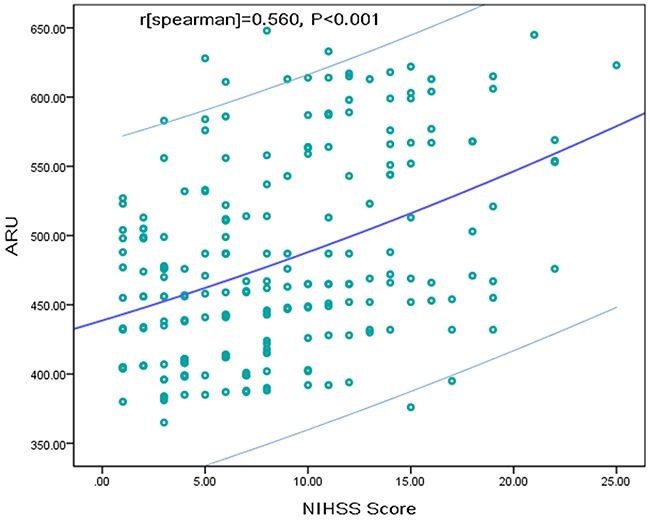
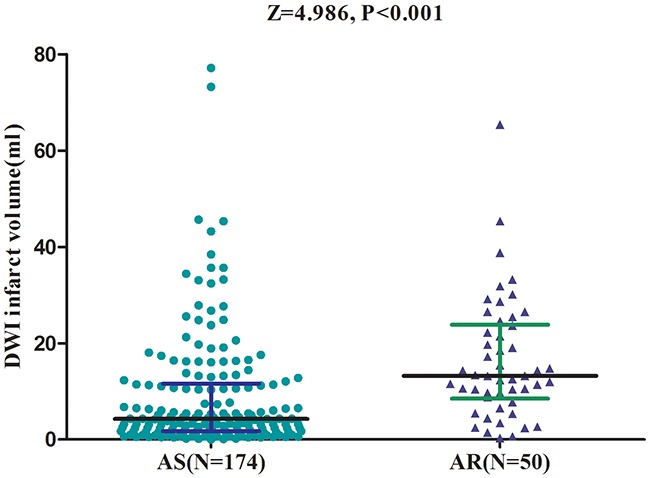
To explore the correlation of aspirin resistance (AR) with clinical stroke severity and infarct volume using diffusion-weighted imaging (DWI) in 224 Chinese ischemic stroke patients who were taking aspirin before stroke onset. In those patients, the median age was 64 years (IQR, 56-75 years), and males accounting for 54.9%(123)of the total subjects. Fifty of 224 enrolled patients (22.3%; 95% confidence interval (CI), 16.9% to 27.7%) showed AR. In the median regression model, significant increase was estimated in NIHSS score of 0.04 point for every 1-point increase in aspirin reaction units (ARU) (95% CI, 0.02 to 0.06; P<0.001). Diffusion-weighted MRI (DWI)-measured infarct volume were significantly higher in patients with AR as compared with those with AS [13.21 (interquartile ranges [IQR], 8.51-23.88) vs.4.26 (IQR, 1.74-11.62); P<0.001). Furthermore, a statistically significant increase was also measured in NIHSS score of 0.05 point for every 1-point increase in ARU in the median regression model (95% CI, 0.03 to 0.08; P<0.001). The median DWI infarct volume was significantly larger in the highest ARU quartile when compared to that in the low 3 quartiles (P<0.001). In conclusion, stroke patients with AR indicated higher risk of severe strokes and large infarcts compared to patients in the aspirin-sensitive group.
Keywords: aspirin resistance; diffusion-weighted imaging; infarct volume; stroke severity.
Conflict of interest statement
CONFLICTS OF INTEREST On behalf of all authors, the corresponding author states that there is no conflicts of interest.
Figures
References
-
- Meschia JF, Bushnell C, Boden-Albala B, Braun LT, Bravata DM, Chaturvedi S, Creager MA, Eckel RH, Elkind MS, Fornage M, Goldstein LB, Greenberg SM, Horvath SE, et al. Guidelines for the primary prevention of stroke: a statement for healthcare professionals from the American Heart Association/ American Stroke Association. Stroke. 2014;45:3754–832. - PMC - PubMed
-
- Gum PA, Kottke-Marchant K, Welsh PA, White J, Topol EJ. A prospective, blinded determination of the natural history of aspirin resistance among stable patients with cardiovascular disease. J Am Coll Cardiol. 2003;41:961–5. - PubMed
-
- Mueller MR, Salat A, Stangl P, Murabito M, Pulaki S, Boehm D, Koppensteiner R, Ergun E, Mittlboeck M, Schreiner W, Losert U, Wolner E. Variable platelet response to low-dose ASA and the risk of limb deterioration in patients submitted to peripheral arterial angioplasty. Thromb Haemost. 1997;78:1003–7. - PubMed
-
- Eikelboom JW, Hirsh J, Weitz JI, Johnston M, Yi Q, Yusuf S. Aspirin-resistant thromboxane biosynthesis and the risk of myocardial infarction, stroke, or cardiovascular death in patients at high risk for cardiovascular events. Circulation. 2002;105:1650–5. - PubMed
LinkOut - more resources
Full Text Sources
Other Literature Sources
Research Materials
