


CUL4B promotes bladder cancer metastasis and induces epithelial-to-mesenchymal transition by activating the Wnt/β-catenin signaling pathway
- PMID: 29100384
- PMCID: PMC5652777
- DOI: 10.18632/oncotarget.20455
CUL4B promotes bladder cancer metastasis and induces epithelial-to-mesenchymal transition by activating the Wnt/β-catenin signaling pathway
Retraction in
-
Retraction: CUL4B promotes bladder cancer metastasis and induces epithelial-to-mesenchymal transition by activating the Wnt/β-catenin signaling pathway.Oncotarget. 2024 Aug 5;15:542. doi: 10.18632/oncotarget.28407. Oncotarget. 2024. PMID: 39102210 Free PMC article. No abstract available.
Abstract
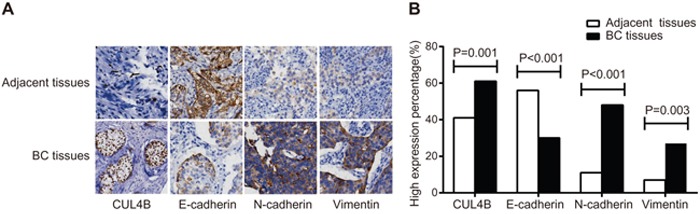
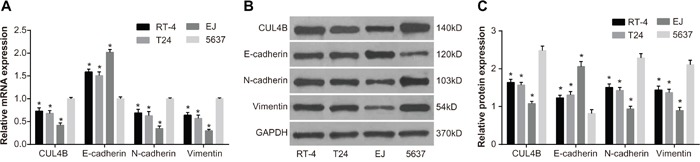
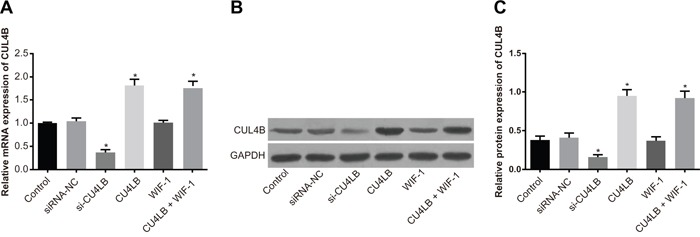
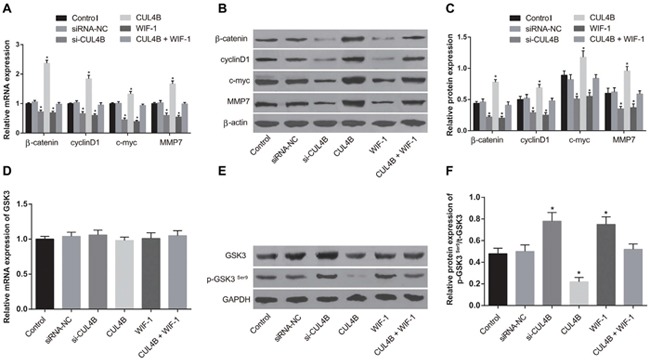
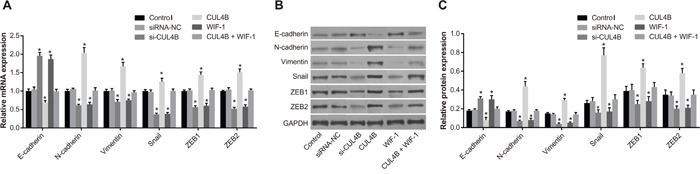
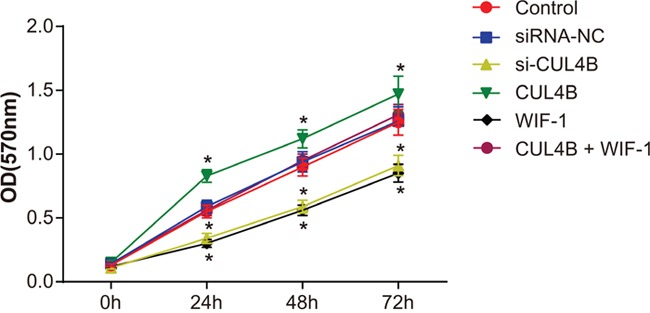
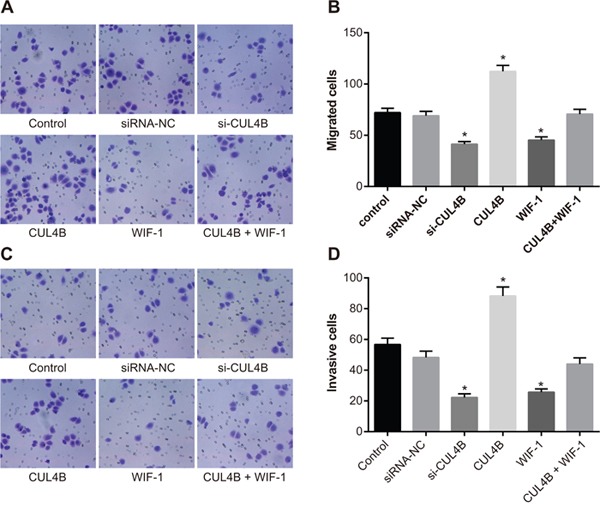
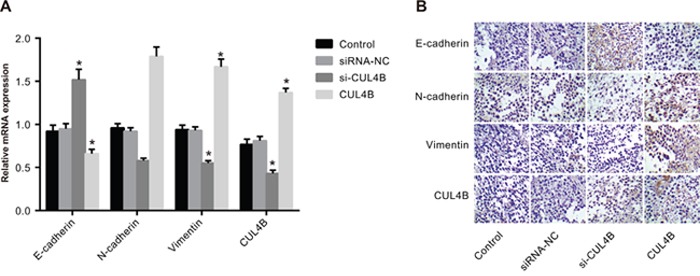
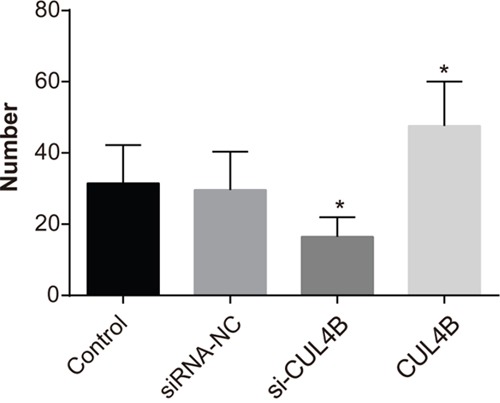
Increased expression of cullin 4B (CUL4B) is linked to progression in several cancers. This study aims to explore the effects of CUL4B on bladder cancer (BC) metastasis and epithelial-to-mesenchymal transition (EMT) and potential correlation to the Wnt/β-catenin signaling pathway. We collected BC tissues and adjacent normal tissues from 124 BC patients. Quantitative real-time polymerase chain reaction (qRT-PCR) and western blotting were employed in order to detect the expression of Wnt/β-catenin signaling pathway-related proteins and EMT markers. MTT and Transwell assays were used in order to measure cell proliferation, migration, and invasion. BC 5637 cells were transfected with control, siRNA scramble control (siRNA-NC), si-CUL4B, and CUL4B or Wnt inhibitory factor 1 (WIF-1) overexpression constructs. Levels of CUL4B mRNA and protein were increased in BC tissues in comparison with the adjacent normal tissues. CUL4B expression was negatively correlated with the expression of E-cadherin and positively correlated to the expression of N-cadherin and Vimentin. Compared to the control group, levels of β-catenin, cyclinD1, c-myc, MMP7, and EMT markers were reduced, whereas phosphorylated GSK3βSer9 and E-cadherin levels were increased in the si-CUL4B and WIF-1 groups. In addition, cell proliferation, migration, and invasion abilities were also increased. Increasing CUL4B expression had the opposite effect. These findings suggest that CUL4B induces EMT and promotes metastasis of BC by activating the Wnt/β-catenin signaling pathway.
Keywords: CUL4B; Wnt/β-catenin signaling pathway; bladder cancer; epithelial-to-mesenchymal transition; proliferation.
Conflict of interest statement
CONFLICTS OF INTEREST The authors declare no conflicts of interest.
Figures
References
-
- Bansal N, Gupta AK, Gupta A, Sankhwar SN, Mahdi AA. Serum-based protein biomarkers of bladder cancer: a pre- and post-operative evaluation. J Pharm Biomed Anal. 2016;124:22–25. - PubMed
-
- Wang J, Zhang X, Wang L, Dong Z, Du L, Yang Y, Guo Y, Wang C. Downregulation of urinary cell-free microRNA-214 as a diagnostic and prognostic biomarker in bladder cancer. J Surg Oncol. 2015;111:992–999. - PubMed
-
- Witjes JA, Comperat E, Cowan NC, De Santis M, Gakis G, Lebret T, Ribal MJ, Van der Heijden AG, A; Sherif, European Association of Urology EAU guidelines on muscle-invasive and metastatic bladder cancer: summary of the 2013 guidelines. Eur Urol. 2014;65:778–792. - PubMed
-
- Babjuk M, Oosterlinck W, Sylvester R, Kaasinen E, Bohle A, Palou-Redorta J, Roupret M, European Association of Urology EAU guidelines on non-muscle-invasive urothelial carcinoma of the bladder, the 2011 update. Eur Urol. 2011;59:997–1008. - PubMed
Publication types
LinkOut - more resources
Full Text Sources
Other Literature Sources
Research Materials
